



- Home
- /
- High Courts
- /
- Tripura High Court
- /
- CCTV Footage Helped Court Intervene...
CCTV Footage Helped Court Intervene In Police Station Assault Case: Tripura High Court
Bhavya Singh
8 Oct 2026 9:40 AM IST
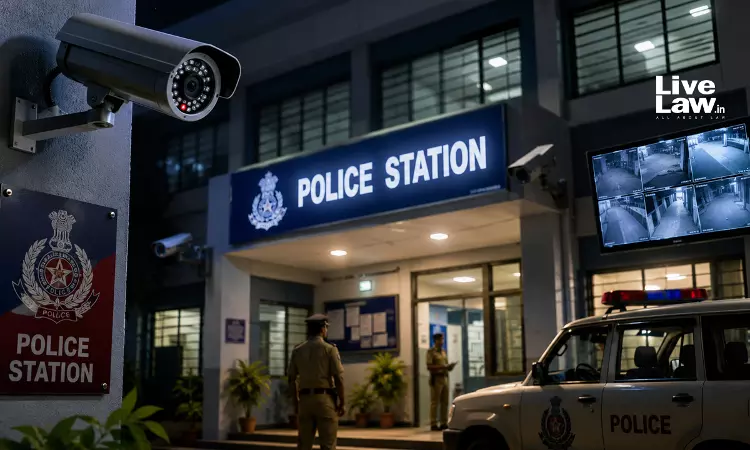
The Tripura High Court has observed that it was able to intervene effectively in a case of assault and torture inside East Agartala Police Station because CCTV footage of the incident was available.A Division Bench of Chief Justice M.S. Ramachandra Rao and Justice Biswajit Palit observed, “We may point out that this Court was able to intervene effectively in the matter only because there...
This is a premium content
Available exclusively to
Our subscribers
Subscribe Premium 
INR 1099+GST
Your support helps us to bring you more content at
an affordable subscription scheme !!!
All payment options available
The Tripura High Court has observed that it was able to intervene effectively in a case of assault and torture inside East Agartala Police Station because CCTV footage of the incident was available.
A Division Bench of Chief Justice M.S. Ramachandra Rao and Justice Biswajit Palit observed, “We may point out that this Court was able to intervene effectively in the matter only because there was CCTV footage available on what transpired inside the East Agartala Police Station on the intervening nights of 04.04.2026 and 05.04.2026.”
The observation came in a writ petition concerning an incident in which the petitioner's son, Saikat Saha, was allegedly forcibly taken by Rabindranath Ghosh, an employee of the Agartala Municipal Corporation, and Joy Debnath, a Special Police Officer, to East Agartala Police Station on April 4, 2026. It was alleged that Saha was assaulted, humiliated and tortured in the presence of police personnel during the intervening nights of April 4 and 5. The incidents were recorded on CCTV cameras, which the Court had directed to be seized on May 6, 2026.
A Special Investigation Team headed by an Inspector General of Police was thereafter constituted on May 14. The SIT, in its report dated June 16, prima facie confirmed the allegations against Ghosh and Debnath. The State also informed the Court that police officials of East Agartala Police Station had been issued show-cause notices, placed under suspension and subjected to departmental proceedings. The services of Ghosh and Debnath appeared to have subsequently been terminated, and a charge sheet was filed against them before the jurisdictional criminal court.
The Court was subsequently informed that articles of charge had also been framed against the Officer-in-Charge of East Agartala Police Station and other policemen who were on duty when the alleged assault took place, after placing them under suspension, and that the departmental proceedings were continuing.
While considering the matter, the High Court referred to another writ petition, Smt. Lipika Lodh v. State of Tripura & Others, where a similar assault was alleged to have taken place inside a police station. In that case, however, CCTV footage was unavailable as the cameras had remained non-functional for three days before and three days after the alleged incident. The Bench said that, to ensure that such a situation did not recur, it considered it appropriate to address the issue of CCTV functioning in police stations.
The Court then referred to the Supreme Court's decision in Paramvir Singh Saini v. Baljit Singh & Others, which directed installation of CCTV cameras in every police station and required coverage of, among other places, entry and exit points, lock-ups, corridors, reception areas, verandas, the Inspector's and Sub-Inspector's rooms, station halls and areas outside washrooms and toilets.
The Supreme Court had further directed that CCTV systems be equipped with night vision and audio as well as video recording facilities, and that recording systems should preserve footage for 18 months, or for the maximum period technically possible but in any event not below one year where equipment capable of 18-month storage was unavailable.
The High Court noted that the Supreme Court had specifically placed the duty and responsibility for the working, maintenance and recording of CCTV cameras on the Station House Officer concerned. The SHO was also required to immediately report malfunctioning or non-functioning cameras to the District Level Oversight Committee and, where CCTV cameras were not functioning, provide details of arrests and interrogations carried out during that period.
It further noted that the Supreme Court had required the SHO to assess the working condition of CCTV cameras, take corrective steps for restoration of non-functional cameras and remain responsible for CCTV data maintenance, backup and fault rectification.
Accordingly, the High Court directed that the directions issued by the Supreme Court in Paramvir Singh Saini be implemented “in letter and spirit”. It directed the respondents not only to install CCTV cameras in police stations as mandated by the Supreme Court, but also to make the Officer-in-Charge of the concerned police station responsible for their working, maintenance and recording.
The Court further directed that, where CCTV cameras were not functioning, the Officer-in-Charge must inform the District Level Oversight Committee about arrests and interrogations carried out in the police station during that period and forward the relevant record to the Committee without fail.
Where malfunctioning or non-functioning CCTV cameras were reported, the District Level Oversight Committee was directed to immediately request the State Level Oversight Committee for repair and purchase of equipment. The Court also directed that the Officer-in-Charge be made responsible for CCTV data maintenance, backup and fault rectification.
Reiterating its previous orders and issuing the above directions, the Court disposed of the writ petition.

Bhavya Singh
Reporter

