



- Home
- /
- Know the Law
- /
- What Are Interrogatories? Explained...
What Are Interrogatories? Explained Amid INDIA Bloc's Plea To Question Election Commission On SIR
Yash Mittal
19 Nov 2026 10:19 AM IST
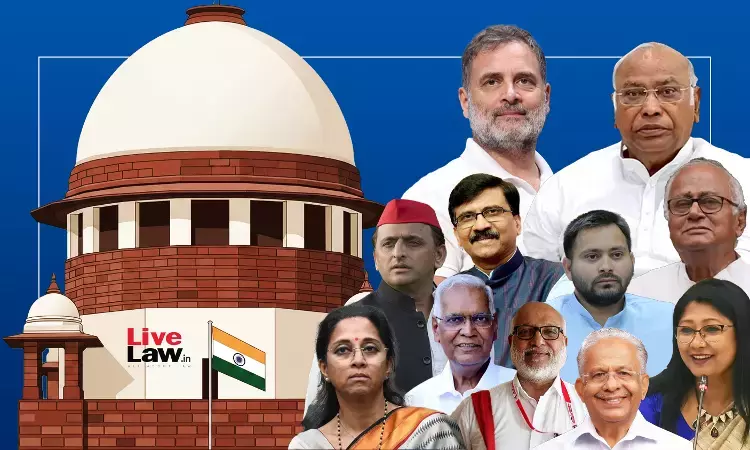
An application moved by the Leader of the Opposition in the Lok Sabha, Rahul Gandhi, and other INDIA bloc leaders before the Supreme Court seeking to serve 48 interrogatories on the Election Commission of India (ECI) over its Special Intensive Revision (SIR) brought into focus an important procedural mechanism under civil law.Governed by Order XI of the Code of Civil Procedure, 1908...
This is a premium content
Available exclusively to
Our subscribers
Subscribe Premium 
INR 1099+GST
Your support helps us to bring you more content at
an affordable subscription scheme !!!
All payment options available
An application moved by the Leader of the Opposition in the Lok Sabha, Rahul Gandhi, and other INDIA bloc leaders before the Supreme Court seeking to serve 48 interrogatories on the Election Commission of India (ECI) over its Special Intensive Revision (SIR) brought into focus an important procedural mechanism under civil law.
Governed by Order XI of the Code of Civil Procedure, 1908 (CPC), interrogatories are a set of written questions served by one litigating party upon the opposite party, with the court's permission, to obtain answers to specific factual matters relevant to the dispute. The purpose of serving interrogatories is to obtain admissions, clarify disputed facts, and avoid unnecessary evidence in order to narrow down the scope of the litigation, to avoid wastage of precious time and expenditure in litigation.
The interrogatories sought to be served upon the ECI seek specific factual answers concerning the ECI's decision-making process. The questions reportedly seek particulars regarding approvals by the Chief Election Commissioner and other Election Commissioners, dates and modes of approval, file records, whether objections or dissent were recorded, and matters concerning electoral-roll changes and related processes.
The Supreme Court has not yet granted leave to serve interrogatories on the ECI, and has adjourned the matter till December 9, after the ECI objected to the petitioners' application, stating that a final call on the petitioner's application to serve interrogatories would be taken after hearing both sides.
What are interrogatories?
Order XI Rule 1 CPC provides that a plaintiff or defendant may, with the leave of the court, deliver interrogatories in writing for examination of the opposite party.
The provision requires interrogatories to indicate which questions each person is required to answer. It also restricts a party from delivering more than one set of interrogatories to the same party without an order of the court.
Importantly, the questions which do not relate to matters in controversy are deemed irrelevant, even if they might otherwise be admissible during oral cross-examination.
“Provided also that interrogatories which do not relate to any matters in question in the suit shall be deemed irrelevant, notwithstanding that they might be admissible on the oral cross-examination of a witness.” the second proviso of Rule 1 says.
Under Rule 2, a party seeking leave to deliver interrogatories must submit the proposed questions before the court.
The Court considers whether the questions are necessary for fair disposal of the suit or for saving costs. It may also consider whether the opposite party has offered to furnish particulars, make admissions or produce documents concerning the matters in question.
The Court is not bound to permit every proposed interrogatory. It may allow certain questions, reject others or modify them. The test is whether the proposed interrogatories would assist the court in fairly determining the controversy or avoid unnecessary expense.
For instance, in a suit concerning cancellation of a contract by a company, a party may seek to know whether the cancellation was approved by the Board of Directors, the date of approval and whether the decision was recorded in the minutes. Such questions may help establish facts that would otherwise require proof through witnesses or documents.
However, questions seeking unrelated information about the opposite party's business affairs or conduct would ordinarily be rejected, as it would not be relevant for fairly determining the controversy.
Under Rule 5, interrogatories can also be delivered to any member or officer of a corporation or a body of persons, empowered by law to sue or be sued, whether in its own name or in the name of any officer or other person. This means that interrogatories sought to be served upon ECI can also be served upon its office bearers.
How are interrogatories answered?
Under Order XI Rules 8 and 9 CPC, interrogatories are ordinarily answered by affidavit within the prescribed period or within such time as the court may allow.
The responding party may raise objections under Rule 6 on grounds including irrelevance, privilege, scandalous nature, lack of materiality or other legally sustainable objections.
The court determines whether the objections are valid and whether the answers furnished are sufficient.
Under Rule 7, upon an application made by an opposite party within seven days of serving of interrogatories, the Court may set aside any interrogatories on the ground that they have been exhibited unreasonably or vexatiously or struck out on the ground that they are prolix, oppressive, unnecessary or scandalous.
Where a party omits to answer a question or gives an insufficient answer, Rule 11 permits the interrogating party to seek a direction requiring the opposite party to answer or answer further. The Court may direct further answers by affidavit or oral examination.
Consequences when interrogatories remained unanswered
Rule 21 provides serious procedural consequences for failure to comply with an order relating to interrogatories, discovery or inspection.
Where the defaulting party is the plaintiff, the suit may be dismissed for want of prosecution. Where the defaulting party is the defendant, the defence may be struck out, and the defendant may be placed in the position as if the defendant had not defended.
Such consequences are not mechanically imposed for every failure. The Court must follow the prescribed procedure, provide an opportunity of hearing and consider the circumstances of the default.
“Where any party fails to comply with any order to answer interrogatories, or for discovery or inspection of documents, he shall, if a plaintiff, be liable to have his suit dismissed for want of prosecution, and, if a defendant, to have his defence, if any struck out, and to be placed in the same position as if he had not defended, and the party interrogating or seeking discovery or inspection may apply to the Court for an order to that effect and [an order may be made on such application accordingly, after notice to the parties and after giving them a reasonable opportunity of being heard.]”, Rule 21 says.
Order XI Rule 22 further permits a party to use at trial any one or more answers, or any part of an answer, given by the opposite party to interrogatories as evidence, subject to the court's directions concerning connected answers necessary for proper understanding.
Interrogatories must touch upon the core of the allegations, and not the fringe of the matter
In Raj Narain v. Smt. Indira Nehru Gandhi 1972 INSC 81, the Supreme Court, while examining the interrogatories sought to be served upon by the petitioner upon Mrs. Gandhi in an election petition challenging her election from Rae Bareli Lok Sabha constituency, held that only such interrogatories having a reasonable connection with 'any matter in question' would be considered valid, and not the ones merely touching the fringe of the matter. The Court also said that when the original election petition lacked sufficient foundational facts, the interrogatories tied to those issues were deemed unnecessary and irrelevant. This means the interrogatories must have a reasonably close connection with "matters in question".
In Union of India v. Ibrahim Uddin 2012 INSC 288, the Supreme Court said that a right to submit interrogatories relating to the same matter in issue should be liberally exercised, stressing that “the object of introducing such provision is to secure all material documents and to put an end to protracted enquiry with respect to document/material in possession of the other party.”
While intended to shorten litigation, save costs and obtain admissions, interrogatories cannot be used to conduct fishing inquiries into matters not germane to the suit. The Court can allow service of interrogatories, at any stage of the suit, for which it has been conferred wider discretion, but at the same time, the discretion must be exercised in a judicious way. The information sought to be furnished must have some nexus or relevancy with the dispute in question. (See Tara Batra vs Punam A.Kumar & Ors., 2021:DHC:2809)
Can interrogatories be used in writ proceedings?
Order XI CPC ordinarily governs interrogatories in suits. The INDIA bloc–ECI proceedings, however, are writ proceedings and not an ordinary civil suit.
The CPC does not automatically apply to every constitutional proceeding in the same manner as an ordinary civil suit. Constitutional courts possess procedural powers to regulate their proceedings and ensure that justice is effectively administered.
The Supreme Court Rules, 2013 contain provisions governing discovery and inspection in suits instituted before the Supreme Court, including Order XXX, which applies Order XI CPC to discovery and inspection in such suits, subject to specified exceptions.
In Raj Narain, the Supreme Court recognised the applicability of the procedure of discovery and interrogatories to election petitions through Section 87 of the Representation of the People Act, 1951, which governs the trial of election petitions before High Courts. The Court emphasised that interrogatories should be encouraged as they may elicit admissions, narrow the scope of disputes and expedite litigation, making them a valuable procedural right that should not be lightly denied to a party. Against this backdrop, it would be interesting to see how the Supreme Court approaches the petitioners' application seeking permission to serve interrogatories on the Election Commission of India in a writ petition.

Yash Mittal
Yash Mittal is a Correspondent with LiveLaw, covering the Supreme Court of India

