




Law Firm Articles

Strengthening Ties: Singapore Leads The Way For Future Indian Insolvency Cases
This is the story of the first Indian insolvency proceeding to be granted recognition by the Singapore Court under the UNCITRAL Model Law on Cross-Border Insolvency (“Model Law”). This recognition, besides facilitating the challenging cross-border asset recovery, has also opened the doors for deeper insolvency cooperation between India and Singapore.What prompted the Resolution Professional to knock on the doors of the Singapore Court and what does this decision mean for Indian businesses that...

The U.S. Tariff Regime Under Trump: April 2025: Snapshot And Strategic Overview
With frequent Executive Orders issued by President Trump, keeping a track of the current U.S. tariff regime has become increasingly challenging. The situation is fast changing given the recent proclamations and new tariff measures.The US Tariff Policy seeks to redress the trade deficit which exists for most countries around the world. The idea is to homeshore jobs and revitalize domestic manufacturing. President Trump has adopted a negotiation strategy designed to exert maximum pressure on...

'Discourage Litigation, Persuade Your Neighbours To Compromise Whenever You Can'
'Discourage Litigation. Persuade Your Neighbours To Compromise Whenever You Can' -These words quite often echo in various advocate robing rooms, court corridors and stuffy conference rooms. The words are those of Abraham Lincoln and they remain as cogent and compelling today as they were years ago. For centuries, lawyers in the UK have leaned towards such philosophy when considering the strengths and weakness of potential litigation. Settlements, resolution and finding a half-way...
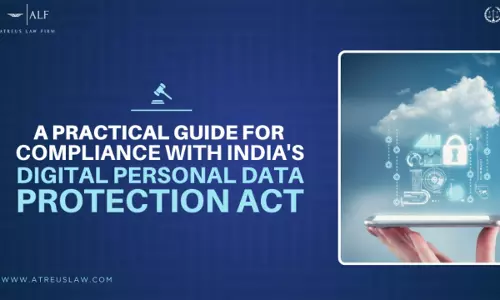
A Practical Guide For Compliance With India's Digital Personal Data Protection Act & Rules
Over the last decade, the conversation around data privacy in India has gone from hushed boardroom corners to dinner table debates. With more of our lives moving online—from shopping and banking to healthcare and education—the digital footprints we leave behind have grown deeper and more revealing. Against this backdrop, India's new Digital Personal Data Protection Act, 2023 (“DPDP Act”) (& Rules) marks a critical shift in how our personal information is to be handled, protected, and...
Consent Asymmetry And Synthetic Neutrality In Arbitration: When AI Tilts The Scales Of Justice
The Illusion of Neutrality in Digital Systems Picture an AI ruling on your dispute—fast, flawless, and utterly opaque. Is this justice, or a high-tech illusion? Artificial intelligence (AI) tools are increasingly used in arAetbitration to streamline case analysis, rank submissions, or generate summaries. These systems promise objectivity, speed, and cost-efficiency. But beneath their polished interfaces lie systemic risks. Can we trust machines to be neutral? And what happens when...

Legality Of Restriction Posed By Circular No. 181/13/2022-GST Dated 10.11.2022; Adding To Woes Of Edible Oil & Coal Industry
The issuance of Circular No. 181/13/2022-GST dated 10.11.2022 by Central Board of Indirect Taxes and Customs (CBIC) has sparked considerable litigation, particularly among suppliers of specified goods falling under Chapter 15 (edible oils) and Chapter 27 (coal, lignite) of Custom Tarriff Act, 1975. The retroactive denial of refund claim has led to widespread disputes, with affected taxpayers challenging the legality of Circular No. 181/13/2022-GST dated 10.11.2022. It is ...
The Mining Royalty Judgment And The GST Amnesty Scheme: A False Connection?
On 25th July 2024, a 9-judge bench of the Supreme Court delivered the judgment in Mineral Area Development Authority (MADA) v. Steel Authority of India Limited (SAIL) (MADA Judgment), effectively overruling the judgment in India Cement Ltd. v. State of Tamil Nadu. The Apex Court held that Royalty on Mining is not in the nature of Tax. The MADA judgment has raised certain anxieties amongst the commercial sector/mining entities that are GST compliant, about its potential impact on pending...

Legal Protections For Scheduled Castes And Scheduled Tribes: Understanding The Framework
A law designed to address the systemic discrimination, social exclusion, and violence faced by marginalized communities of Schedule Casts (“SC”) and Scheduled Tribes (“ST”) was enacted as the Scheduled Castes and the Scheduled Tribes (Prevention of Atrocities) Act, 1989 (commonly referred to as the 'SC/ST Act' or 'Prevention of Atrocities Act'). This was enacted to prevent crimes and atrocities against members of SC/ ST classes in India. It was also enacted to overcome certain loopholes of...
The Misuse Of Section 17B Of The Industrial Disputes Act, 1947
The Industrial Disputes Act, 1947 [“ID Act”] and its many amendments, have always striven to secure social justice to workmen and to ensure that they are not left helpless against industries and corporations. One such provision is Section 17B of the ID Act, which was introduced by way of The Industrial Disputes (Amendment) Act, 1982 which came into effect from 21.08.1984. Section 17B was enacted to give protection to workman who, having succeeded in obtaining an award from the Labour...

Beneath Tip Of The Iceberg: Defenses For Insider Trading
Defenses against the charge of Insider Trading, much like an iceberg, reveal only a fraction of its true form above the surface. What is seen and codified is but a sliver of what actually exists. On paper, SEBI (Prohibition of Insider Trading) Regulations 2015 (“2015 Regulations”) appear to offer a neatly defined framework, with Regulation 4(1) categorically stating that trading when in possession of UPSI would attract the charge of Insider Trading and the Explanation thereof latches a...
Insertion Of Sub-Sections 18(1B) And (1C) And Its Impact On Provisional Assessment Timeline In Cases Of Verification Of Origin In Terms Of FTA
The Finance Bill, 2025 (Bill No 14 of 2025) seeks to amend Section 18 of the Customs Act, 1962 (“the Act”) by way of insertion of sub-section 18(1B) and sub-section 18(1C). Section 18 of the Act deals with provisional assessment of duty. The importer or the exporter can exercise the option for provisional assessment of duty by making a request before the proper officer. Further, where the proper officer deems it necessary, may direct that the duty leviable on such goods be assessed...

Can Warner & DC 'Superman' Over International Law? Decoding The Copyright Dispute
Written and illustrated in 1933, accredited to Joseph Shuster and Jerome Siegel and stated to be assigned to Detective Comics, Superman has been making the headlines for its “periodic litigation” since decades. A recent claim made by Mark Peary, the estate of Shuster alleges a violation of international laws by DC Comics, and thus Warner Bros (Accused). Filed on January 31, in the District Court of New York, it has been stated that pursuant to the foreign reversion rights in 2017, and 2021, the...