



Electoral Rights Of Person With Disability
Pragati Agarwal & Harsh Kumar Jha
14 Sept 2026 10:00 AM IST
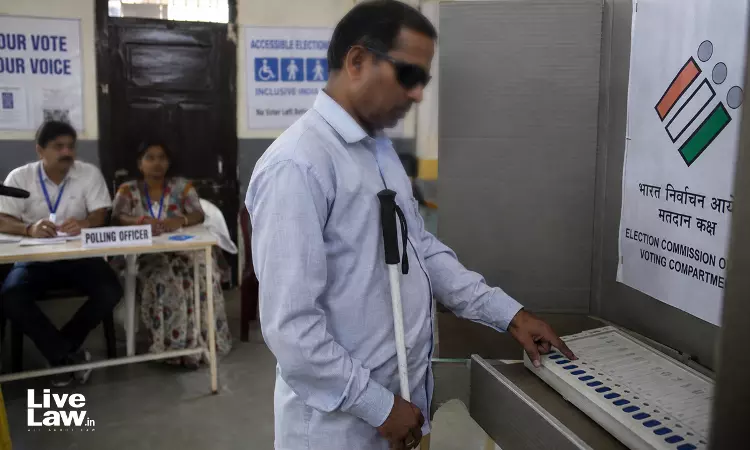
The Right to Vote, also known as suffrage, is the cornerstone of the democratic process bestowed upon citizens to participate in the electoral process by casting their votes to elect representatives enshrined in the Constitution i.e Article 326: Provides right to every citizen to vote based on universal adult franchise and electoral laws i.e. RPA,1950, Section 16: Bars non – citizen being enrolled for citizen and Section 62: Bars disqualified person to vote of the country.
There are 96.88Cr registered eligible voters out of which around 88.35Lakh are specially challenged electors (Person with Disabilities-PwDs) while estimated eligible PwDs range to 1.89cr.

The Ostracism of PwDs is evident in the clear disparity between the number of eligible PwDs voters and those actually registered on the electoral rolls. The reason for this includes: Inaccessibility of Polling Stations, absence of assistive Voting Technologies , insufficient Training and awareness of Electoral Staff, Poor Voter Registration and Information Access: Prevailing Social and Psychological Barriers ,Gaps in Legal and Policy Framework Gaps, Lack of Inclusive Design in Electoral Process. In recent years, concept of online voting (i.e. e-voting) has gained significant traction. The future of online elections looks promising, with advancements in technology and increasing public acceptance driving their adoption.


E-voting, while touted as a modern and convenient alternative to traditional paper voting methods, poses significant security risks that are highly concerning. There exists risk from hackers, technology malfunctions, software bugs, and human error as well as issues with accessibility for all voters, particularly those without access to technology or with disabilities.
To show commitment towards protecting the rights of person with disabilities India has aligned their law with international human rights standards by introducing Rights of Person With Disability (RPwD) Act,2016 following the principles of international human rights treaty, the United Nations Convention on the Rights of Persons with Disabilities (CRPD). However, the practical realization of these rights remains inconsistent, due to persistent of multiple challenges.
This article examines the theme that assess “Electoral Rights of Persons with Disabilities.” It is engaged in evaluating barriers that continue to exclude PwDs from electoral participation, and further analysing the factors catalyzing it. And also it broaden the concept of the digital divide in the current society the divide in the form of digital world expands the divide among the PWDs.
Beyond the Balot Box: Examining the Legal Barriers to Electoral Participation for Persons with Disabilities
Adult suffrage as provided under Article 326 holds worth only when people (here PwD) can vote independently, privately and without humiliation thereof respecting the core components of Article 21 ( Right to life includes right to privacy) so that both of them operates in close harmony
in addition to this Article 21 also strengthens Article 326 by ensuring elections are informed, not merely formal.
The policies made specially for people with disabilities lack structure and implementation that are not merely administrative but also legal in nature that is often being ignored by citizens.
In the case Tamil Nadu V/S K. Shyam Sunder ( 2011) 8 SCC 737 holding para 21 and 22 relevant SC observed about the relevancy of reading article 21 with article 14 and removal of disparity would enhance virtues and improve the quality of human life, elevate the thoughts which advance our constitutional philosophy of equal society respectively.
The Representation People Act,1951 while governing elections through sections 11A and 62 does not make a specific statute regarding PWDs rather they are just governed through guidelines that depict inadequacy in legality. The critical gaps present under the act includes:
● No provisions making polling booths accessible as also mentioned in second report provided by Disability Justice Project where an independent young woman based in Lucknow, North India named Priya Srivastava was unable to reach the button she wanted to press on the electronic voting machine (EVM). The machine was placed higher than the recommended height for accessibility to wheelchair users. Srivastava opted not to seek assistance from anyone in the interest of her voting privacy and independence. She pressed the button she could reach, which was for another candidate from another political party. “I made my choice based on accessibility,” Srivastava says.
● No provisions making accessible infrastructure as a part of voting as majority of India's Polling booth are located in schools, colleges, (a list of polling booths for district Karimganj is provided for reference) https://ceoassam.nic.in/summary/2024/ps_wise_data/AC_126.pdf . These schools should be providing crucial infrastructure however remains non-existent. Based on the second report by the Disability Justice Project, a member of the Disability Right Alliance named Samita Sadasivan said she found the ramps so steep that she couldn't go up without someone pushing her wheelchair. “This shows the lack of clarity on accessibility and accessibility standards among the authorities,” she says. Case of lack of penalties and write a little about it.
Similarly RPWD Act, 2016 while providing for rights it holds critical legal gaps in provision like:
● If one looks into Section 40 of RPWD Act that deals with Accessibility it provides too vague definition by using the term 'other facilities and services' and therefore not expressly including Polling stations, Electoral offices, voting routes and voting machines.
● Though provided in Chapter 16 of the act about the penalties they lack in implementation and courts usually issue directions in furtherance of act rather the penalizing the appropriate authority and this gap of implementation can be studied in case of Deaf Employees Welfare Association v Union of India.
After referring to the various provisions of the Constitution, which guarantees equality and prohibits discrimination. Despite this the people of the land, face the consequences of being deprived of their right in the law of land where the provisions have explicitly mentioned about the core principles of justice and fairness in every sense yet it is seen and observed that it is yet to come out of the box of the Constitution.
Although e-voting is meant to make elections faster, more transparent, and more accessible, it may not benefit everyone equally. For persons with disabilities and those with limited digital access or literacy, technology can either increase independence or create new barriers.
The real issue is whether electronic voting promotes Digital Democracy or Digital Divide?
The idea of using an Electronic Voting Machine (EVM) was proposed in 1977 . A working model was evolved in 1979 and was showcased to various political parties in August 1980. The EVMs were first trialed in May 1982 in the by-election to Paravur assembly constituency in Kerala in a limited number of polling stations (50 out of the 85 polling stations.)
A case was filed against the use of EVM named “A.C. Jose v Svan Pillai & Ors, 1984 of The Supreme Court Of India ruled that RPA,1951 and the Conduct of Election Rules,1961 specified the usage of paper ballots and forbid the use of any new methods including electronic voting. The court stated the manner in which the orders were issued for the use of EVMs were unconstitutional and the usage of any alternate means required to be specified under the law.
But looking at the rate at which EVM/ or E- voting has resolved things for India amendment in Section 61 of the RPA Act, 1951, took place in 1988 which was upheld in ALL INDIA ANNA DRAVIDA VS CHIEF ELECTIONAL COMMISSIONER which observed that Article 326 and
327 cannot be interpreted to enable the jurisdiction or the powers of Election Commission under Article 324 and therefore validating the application of EVM's.
There is no denial in saying that Electronic Voting Machines (EVMs) offer critical benefits for disabled citizens, including audio ballots, Braille labels, and large buttons. These features enable independent voting. However, disadvantages persist. Many machines lack support for sip-and-puff devices or private remote access. Complex interfaces can also confuse users with cognitive disabilities. True accessibility remains an ongoing challenge.
India's digital divide for disabled voters is not about internet speeds, it is about stolen dignity. Consider privacy and independence: According to the Election Commission of India, over 88 lakh persons with disabilities registered to vote in 2024 EVM accessibility can fail when Braille sheets are misaligned or machines placed too high, forcing blind and wheelchair-dependent voters to surrender their secret ballot to a stranger .
Now look at legal frameworks: Section 11 of the Rights of Persons with Disabilities Act, 2016, mandates fully accessible polling stations and materials yet in 2025 the Madras High Court had to summon the Election Commission for failing to comply, even with the ECI's own website disabling disabled citizens through image-only CAPTCHAs .
Then comes data security: Nearly half of all registered disabled voters were affected by recent electoral roll revisions, while the ECI has repeatedly invoked "disproportionate burden" to avoid compiling basic data on disabled voters . Without privacy, enforceable law, or transparent data, digital voting technology does not empower, it excludes. The answer is very clear that it is not a digital divide, it is democracy denied.
The right to vote is not a mechanical act of pressing a button; it is a constitutional promise that citizenship, irrespective of body or mind, stands equal before the ballot box. Article 326 gives that promise its form, and Article 21 gives it dignity yet for persons with disabilities in India,
that dignity remains largely aspirational. Between 1.89 crore eligible PwD electors and the mere 88.35 lakh actually registered lies not a statistical gap but a democratic deficit. The Representation of the People Act, 1951 speaks of elections in general terms and of disability barely at all, while the RPWD Act, 2016, meant to correct this silence, offers only Section 40's vague gesture toward "other facilities and services” that is broad enough to mean everything and, in practice, enforceable as nothing. Courts have stepped in where legislature and executive have not, but even judicial intervention, as seen in the Madras High Court's summons to the Election Commission, tends toward direction rather than penalty. Priya Srivastava's experience in Lucknow captures what this looks like on the ground: a machine placed a few inches too high does not merely inconvenience a wheelchair user, it forces her to choose between her vote and her privacy, a choice the Constitution never intended her to make.
This is why the question posed earlier digital democracy or digital divide resists a middle answer. Technology cannot bridge a gap that law has not first acknowledged. Data on disabled voters remains uncollected under the Election Commission's own invocation of "disproportionate burden," accessibility standards remain undefined in binding terms, and penalties for non-compliance remain, at best, theoretical. Until Section 40 is amended to name polling stations, EVMs, and electoral offices explicitly, and until the Election Commission is legally bound not merely persuaded to collect and publish disaggregated data on PwD electors, India's disabled voters will continue to vote, if they vote at all, at the mercy of infrastructure never designed with them in mind. Inclusion cannot be an afterthought bolted onto an existing system; it must be foundational to how that system is built. Until it is, the exclusion chronicled here is not a digital divide it is democracy, quietly and systemically, denied.
Authors are 3rd year BBA LL.B. students at Vivekananda Institute of Professional Studies. Views are personal.


