



Ken-Betwa River Linking Project: Balancing Development And Environmental Justice
Ishika Raj
8 Aug 2026 11:00 AM IST
The Ken–Betwa River Link Project is India's first major river interlinking project. The project moves water from one river to the other through a dam and canal system, aiming to fix chronic water shortages across 10 districts in Madhya Pradesh and 4 districts in Uttar Pradesh. A link canal, which is over 220 km long, will carry water from the Ken basin to the Betwa basin. The approximate cost of the project is around ₹44,605 crore as stated in the Union Budget of 2022-23. As per the statement of Union Minister Mr. Bhupender Yadav in the Lok Sabha in December 2025, the project will provide drinking water to 62 lakh people through 194 MCM of water. The farmland irrigated from the project will be 10 lakh 62 thousand hectares. Nevertheless, the Ken-Betwa River Linking Project has always been a subject of controversy from its very inception, posing many questions regarding environmental governance and constitutional rights.
The National Perspective Plan and Regional Development
Back in 1980, this proposal was called the National Perspective Plan, brought by the then Union Ministry of Irrigation and the Central Water Commission. The government's plan was based on transferring river water from basins that have surplus water to rivers that do not have enough water, called deficit rivers. The Ken–Betwa River Linking Project is the first of approximately 30 planned river interlinking spanning both Himalayan and Peninsular river basins.


The region of Bundelkhand, covering north Madhya Pradesh and south Uttar Pradesh, faces the problem of persistent drought due to its underdeveloped economy. One of the primary goals of diverting excess water from the Ken River to the Betwa river is to enhance the scope of canal irrigation on 10.62 lakh hectares of agricultural land. Through this inter-basin water transfer, the plan is to provide an annual supply of drinking water to about 62 lakh inhabitants of 10 districts in Madhya Pradesh and 4 districts in Uttar Pradesh. The project also involves hydro power plants, especially one in Daudhan Dam, which, along with other related facilities, would produce 103 MW of hydroelectric power and 27 MW of solar power.
Ecological Demands and Constitutional Compliance
Is it right to cause ecological harm in the name of achieving development goals? This is the central issue in environmental law and sustainable development, which does not have an absolute answer. The project will have to balance between the constitutional objective of development and welfare of the citizens and that of protecting the forest and wild animals as well as future generations. In Vellore Citizens' Welfare Forum v. Union of India, the Supreme Court of India held that the principles of sustainable development and the precautionary principle are part of domestic environmental law. According to the research conducted by the scientists of IIT Bombay, transporting water from one river to another in large quantities would result in the impact on the land-atmospheric relationship. The task of the government should be to ensure that there is a proper balance maintained between welfare and environmental protection in the process of development. The Right to life under Article 21 of the Constitution of India includes the right to live in a clean environment, as has been decided by the Supreme Court of India.
Drought in Bundelkhand has many serious consequences that range from failed harvests, farmer suicides to people being forced to migrate. However, the environmental cost is no less serious. The construction of the dam project will involve the diversion of 6,017 hectares of forest area and cutting down of around 18 lakhs trees, which can very well extend to millions. Habitat fragmentation is not an easy thing to rectify once the forest area is submerged. Around 10 percent of the core habitat of the tigers in Panna Tiger Reserve will be submerged along with habitat fragmentation of over 100 sq. km. Article 48A of the Constitution states that the State shall endeavour to protect and improve the environment and safeguard forests and wildlife. Compliance remains highly contested as of July 2026 due to reports by the Supreme Court-appointed Central Empowered Committee (CEC) and experts stating that the State fails to meet required legal standards of law for protecting the Panna Tiger Reserve.
Social Cost, Forest Rights, and Gender Equality
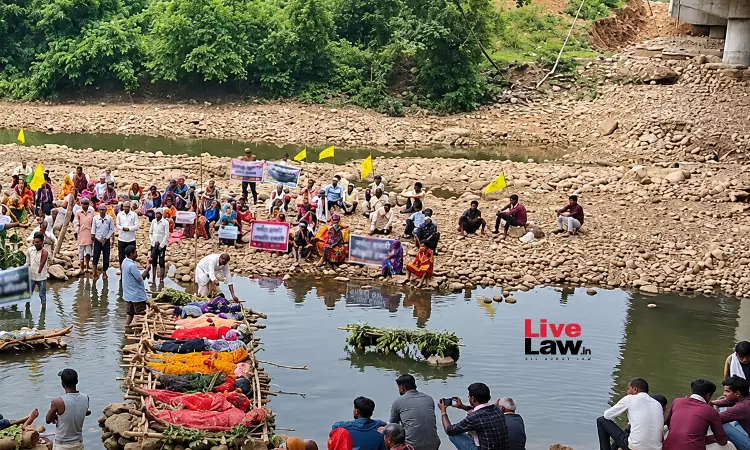
The human cost is equally high, as the displacement of several villages and thousands of families creates severe rehabilitation issues. In Chhatarpur's Palkoha village, displaced tribal families are forced to vacate their homes, yet are hesitant to speak on camera, as documented in the video report by The Red Mike, due to fear of administrative or police reprisal. In response, local villagers launched the 'Chita Andolan' in Kupi village of Chhatarpur district on July 3, 2026, demanding 'Naya Do ya Maar Do' (Give justice or Kill Us) to protest an unfair, inappropriate, and incomplete rehabilitation package.
Gender equality issues also arise from the rehabilitation process. As per the Bhu Arjan Act (Land Acquisition Act), compensation is given to the head of the family, who is mostly male, even when both men and women are displaced. A rehabilitation policy must treat women as equal rights holders rather than mere family members. Further, the project raises serious concerns in relation to the Forest Rights Act of 2006 (Scheduled Tribes and Other Traditional Forest Dwellers Act). This Act mandates that the rights of scheduled tribes and forest dwellers must be determined and recognized before any forest land diversion. Critics argue there has been absolutely no regard paid towards these rights, making procedural fairness and environmental justice highly relevant. Article 51-A(g) also imposes a fundamental duty on all citizens to protect the environment.
Towards Participatory Governance and Environmental Monitoring
The proponents highlight human gains and compensatory actions; however, protests, hunger strikes, and legal actions have continued up to July 2026 due to non-displacement alternatives and the irrevocable destruction of nature. In the case of the Ken-Betwa River Linking Project, the controversy does not have to be seen as an either/or situation where development or environmental concerns take center stage. The present scheme involves clearing the environmental issues once, which means clearing the way and building. In reality, what the government needs to do is monitor the environment and conduct ongoing EIAs using accurate and up-to-date data rather than old assumptions. This will help ensure that all reports are available to the public.
The Tribes are the people who will bear the brunt of this project, and therefore, public consultation and hearing should go beyond mere formalities. The government must involve the local communities, the experts, and the civil society in decision-making process so that it can increase its legitimacy and efficiency. Local voices need not be ignored. The government needs to make sure that development is made possible without violating constitutional promises, environmental sustainability and the rights of the concerned communities. In trying to find a balance between economic development and conservation, the government needs to pursue development along with the principles of sustainable development, accountability, transparency and respect for human rights. Development cannot come at the cost of violation of the rights of the Adivasis. It needs to make sure that there is the rule of law, ecological integrity and justice for those who pay its price. Economic development and environmental justice go together in light of the Constitution.
References:
1. Constitution of India, Articles 21, 48A and 51A(g).
2. Vellore Citizens' Welfare Forum v. Union of India, (1996) 5 SCC 647.
3. Scheduled Tribes and Other Traditional Forest Dwellers (Recognition of Forest Rights) Act, 2006.
5. Ministry of Jal Shakti, Government of India, Inter-Linking of Rivers – Ken-Betwa Link Project.
6. Prime Minister's Office, Government of India, Cabinet Approves Ken-Betwa Interlinking of Rivers Project.
7. Parliament of India, Lok Sabha replies and statements on the Ken-Betwa River Linking Project.
8. Supreme Court-appointed Central Empowered Committee (CEC) reports and observations relating to the Ken-Betwa River Linking Project and the Panna Tiger Reserve.
9. The Indian Express, What does it take to link two rivers? Rs 44,605-crore, complex engineering — and the people by its banks (July 2026).
Author is a fifth-year B.A. LL.B. (Hons.) student at Kalinga School of Law. Views are personal.


