



Replacing MNREGA: Reform Or Retreat From Livelihood Security?
Kuldeep Nagori
27 Dec 2025 11:02 AM IST
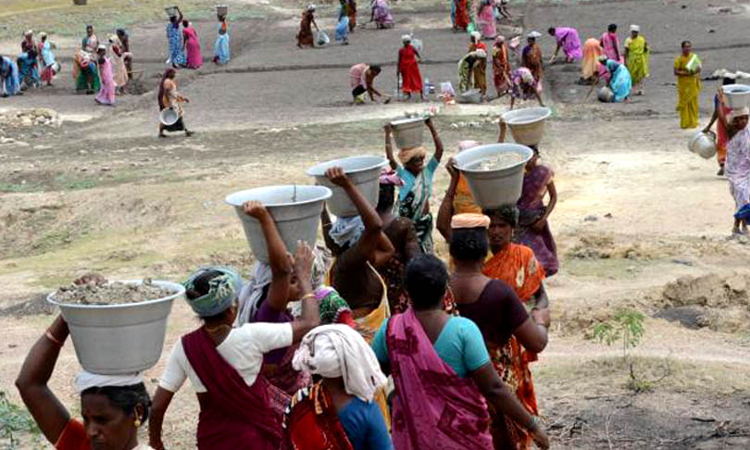
India is the world's most populous country, and a large part of its population continues to live in villages. As per the Census of India 2011, nearly 69 percent of Indians resided in rural areas, and despite increasing urbanisation, millions still depends on rural livelihoods for survival. This makes policies aimed at rural development and employment not just welfare measures, but a necessity for the country's social and economic stability.
MNREGA's Foundation
It was in this context that the Mahatma Gandhi National Rural Employment Act (MNREGA) was introduced in 2005, with the objective of uplifting the rural population by providing assured wage employment and promoting rural development. Enacted as a rights-based legislation, MNREGA drew inspiration from Article 41 of the Constitution, which directs the State to secure the rights to work and public assistance for its citizens. MNREGA stand out as one of India's most successful social welfare programmes, significantly advancing inclusive rural development. Participation data reflect its strong pro-poor orientation, with Scheduled Castes and Scheduled Tribes accounting for a substantial share of person-days generated, while women consistently contributed more than half of total employment. Recognising its transformative impact, the World Bank described MNREGA as a “stellar example of rural development” in its World Development Report 2014.


The Replacement
Recently, the Ruling Government introduced the Viksit Bharat-Guarantee for Rozgar and Ajeevika Mission (G-RAM G) to replace MNREGA stating in its existing form, the scheme is seen as having reached its limits and no longer aligning with the government's broader development priorities. But the reality is that government bring this legislation to move away from a scheme identified with the UPA government. The Ruling Government has chosen to rename and reframe it, a move that seeks to wipe clean the original soul and spirit of a landmark rights-based welfare programme through symbolic rebranding aimed at appealing to people. MNREGA took shape after nearly 13 months of extensive public consultations and was passed by both Houses of Parliament. In contrast, the GRAMG legislation was enacted within 48 hours of parliamentary discussions, amid protests from the opposition in both Houses, reflecting a clear difference in the depth of legislative deliberation.
The Concerning Changes
- MNREGA was largely funded by the Centre. Under MNREGA, the Centre bore the overwhelming share of expenditure, including the full wage cost and a major portion of material. Under the G-RAMG scheme, states are now required to contribute nearly 40 percent of the expenditure, a shift that could strain already weak state finances and may lead some states to scale back their participation in the programme. states are now required to bear a significantly larger share of the costs, substantially increasing their financial burden and potentially affecting their participation in the scheme.
- MNREGA guaranteed at least 100 days of wage employment per year to rural households whose adult members volunteered for unskilled work. GRAMG increases this to 125 days, presenting it as a benefit. However, section 6 bars work during peak agricultural seasons, requiring states to notify up to sixty days annually when no public works can be undertaken. These periods vary across districts, blocks, or agro-climatic zones and must be strictly followed. While aimed at preventing labour shortages in farming, this significantly reduces the actual time available for guaranteed employment. Combined with monsoon disruptions and administrative delays, workers often access far fewer than 125 days. The promise of 125 days may sound generous, but with restriction on when labour can be employed, the scheme risks undermining the very livelihood it claims to support.
- At first glance, raising the employment guarantees to 125 days appears to be a progressive step. However, this change also shifts the purpose of the scheme. According to Section 3(4) of MNREGA, additional days of work were allowed in times of distress such as droughts, natural disasters, or for particularly vulnerable Scheduled Tribes households in forest areas. GRAMG, by making 125 days the standard entitlement, removes this link between extra work and exceptional need, and in doing so, weakens the idea of employment guarantees as a safety net rather than a routine promise.
- The other core difference between the two is, MNREGA operated on a demand driven model, when a worker applies for work in gram panchayat, the state is under a legal obligation to provide work within 15 days, failing which the worker is entitled to an unemployment allowance. GRAMG departs from this framework. Employment under the new scheme is contingent on the prior availability of approved projects, and there is no clear statutory guarantee of work on demand. This shift weakens the enforceability of the right to work and marks a move from a right-based entitlement to a more discretionary, administration led model.
- The new law divides the work into four categories such as water security, rural infrastructure, livelihood related assets and climate resilience. These fixed categories limit the scope of work, which was earlier decided by Gram Panchayats according to local needs. The replacement of MNREGA marks more than a policy shift, it represents a retreat from livelihood security as a legal right.
A Weakened Safety Net
By weakening the demand driven nature of employment, shifting a greater financial burden onto states, and placing restrictions on when work can be provided, the new law risks weakening the economic safety net on which millions of rural households depends for survival. For large sections of rural India already struggling with low incomes, seasonal unemployment, rising costs and climate related distress employment guarantee schemes are not merely welfare measures, but a source of basic economic security. Instead of strengthening this support system, the new framework introduces uncertainty where assurance once existed. The promise of reform rings hollow if it leaves rural workers with fewer opportunities to access work when they need it most. Given the far-reaching consequences for livelihoods and food security, the law calls for wider public discussion, deeper parliamentary scrutiny and serious reconsideration. A law designed to protect rural livelihoods cannot be allowed to gradually undermine the very security it was meant to provide.
Author is a 2nd year student at NLU, Jodhpur. Views are personal.


