



Performative Authenticity: Synchronizing Visual Greenwashing And Unrecognized Eco Labels Under Consumer Protection Law
Vanya Soni
3 Aug 2026 3:00 PM IST
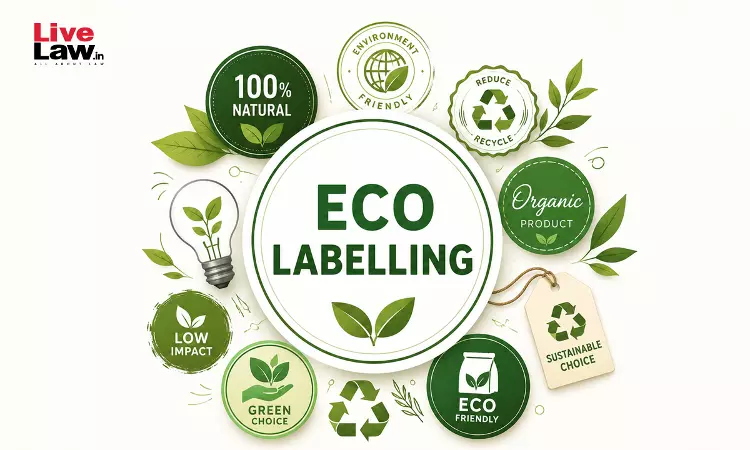
The axiom of corporate sustainability marketing for decades has been to wrap a product in a brown recycling paper, then splashing a sticker of a leaf or a smiling planet on the front, and advertising it in an earthy and green tone. This has now become a business tactic called “performative authenticity”, or the deliberate coordination of visual 'green' claims with unapparent and unacknowledged eco-labels to appear as an authentic environmental steward. This is a clever way for companies to take advantage of consumer eco-anxiety, while knowing full well that they will not be held legally liable for obvious falsehoods in written texts. Historically, consumer protection regulations were unable to control such non-verbal cues. If a company avoids writing such false claims as “100% carbon neutral” or “made with non-toxic substances”, then they could have an endless number of leaves and faux-trust badges they wanted, but as the global marketplace for sustainable products expands, a scam has been turned into a major regulatory challenge, which is visual manipulation.
Consumer protection regulators in the modern world are changing their approach from merely discovering the words towards penetrating the web of visual corporate greenwashing. To meet the demand for aggressive regulatory measures, today's retailing must first be understood. Consumers spend 10-15 seconds looking at the green products or environmental claims when they go shopping in the store. Corporations might then be able to claim the same market premium as truly sustainable brands, but with an implicit imagery that matches the next, so as not to be vulnerable to false advertising claims.


However, this custom is fast dying out in the world. Regulators are starting to realize that the entire message of an advertisement is as important as what it contains. They lack the time, resources, or scientific expertise to carry out a complete life-cycle assessment of the supply chain of a product or interpret long, complicated chemical listings. Instead of Heuristics (mental shortcuts) plays a key role for the human brain to allow for quick decision-making with limited data. Natural forest images and clean water convey a very pre-rational feeling of safety, concern in the company, and ecological purity. Visual greenwashing is used by corporate actors to create their own ad hoc, non-accredited, and eco-labels. The trust seals, typically words of authority but with no real legal significance, such as 'certified eco pure' or planet approved, are specifically designed to look like real third- party certifications, but with no solid scientific basis or independent certification bodies behind them.
Countries globally are coming together to end this lovely façade in writing. The European Union has set out on a very staunch front against 'performative authenticity' with the European Union's empowering consumers for the green transition directive (EU) 2024/825. The framework banned the use of sustainability labels which can not be associated with an official labelling scheme or independent third-party certified labelling bodies. Importantly, this has to be done 'between the lines', to ascertain whether there is a presumed environment from the packaging that can be established by its visual architecture. The Federal Trade Commission (FTC) is undergoing a parallel change in the U.S.A., with its green guides getting updated. A parallel change is taking place in the United States: The Federal Trade Commission (FTC) is updating its green guides. A new enforcement approach is to consider unaccredited or self-created eco-seals as an 'implicit declaration of general environmental benefit. However, using a fake seal for a bogus, unqualified claim is difficult to prove throughout the product's life cycle, and is increasingly being prosecuted as an administrative violation of Section 5 of the FTC Act, which prohibits unfair or deceptive acts. Likewise, the central consumer protection authority has come up with strong guidelines that are dedicated to addressing the concept of greenwashing, particularly visuals, graphics, logos, and colour schemes, all considered to be misleading advertisements and are covered under the guidelines, allowing regulators to impose heavy fines on companies that are using graphics as a cover-up.
Consumers' Protection Ombudsman now focuses on the whole packaging experience, and the onus is now on the corporate legal departments to prove their case. To reduce existing litigation and regulatory risks, corporate counsel will need a robust, three-part verification system prior to any product going to market. They're required to include required evidentiary audits, and if the design team is one that must take this graphic as a definitive, binding commitment to environmental sustainability.
Secondly, they must ensure that 100% of the imagery is removed from self-certification. Businesses need to remove any trust stamps or sustainability logos that are created within the organization or by the marketing team and make sure that all environmental icons used on the retail shelf have a direct link to an independent public or third-party certification body via a transparent digital track.
Finally, they should be context disclosures. If an actual but limited ecological development is to be referred to, the Qualifications should be at the same visual level as the graphic and should be clear, unambiguous, and prominent. The days of a green marketing spin are over in the sense that no corporation has to pay or work to obtain a premium in the sustainability market; instead, the market pays them one. Consumer protection law is undergoing a major paradigm shift and acknowledges that the human mind is highly sensitive to visual exploitation. Global regulators are working to establish a clean bill of goods marketplace with its new packaging rule, which aims for aesthetics evaluation and its zero-tolerance stance on unaccredited eco-lables backing products. With a legal and financial onus to combat if you say the environmental claims of your products are just a sham of functional authenticity, the legal warning is all too clear for today's companies.
Author is a 1st year, B.B.A LL.B (Hons.) student at National Forensic Sciences University, Delhi Campus. Views are personal.


