



Anathema to Life and Liberty: The Supreme Court's Bail Reasoning in Gulfisha Fatima
Aditya Krishna Gupta
13 Jan 2026 12:41 PM IST
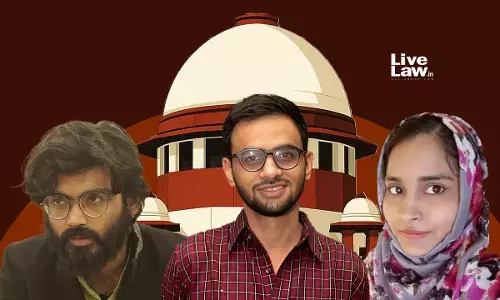
The new year did not turn out to be upbeat for Umar Khalid and Sharjeel Imam, as the Apex Court, in a judgment spanning 142 pages in the case of GULFISHA FATIMA VS STATE (GOVT. OF NCT OF DELHI) 2026 INSC 2, refused bail to the two persons arrayed as accused and their freedom was denied for the umpteenth time. On the contrary, the Court granted bail to the other 5 co-accused, citing the non-seriousness of their role. The constitutional spirit finds a speck of much place in the judgment since considerations have been given to the argument about life and liberty in a bleak manner. To put it in certitude, the decision is a portentous one.
The facts shorn of unnecessary details are summarised hereinafter. The matter that is a batch of 7 special leave petitions arises out of the order of the Delhi High Court, whereby the court declined the grant of bail to the 7 persons arrayed as accused in the case pertaining to the Delhi Riots of 2020. These 7 persons were involved in the cloak-and-dagger that ignited violence in the North-Eastern region of the capital, leaving 53 people dead.


Five years passed since the accused were taken into custody in 2020, and in 2025, the Highest Court of the nation is adjudicating on their bail terms. In the meantime, the trial has not even started yet because the litigation is stuck at the stage of the argument on the charge. 5 years! Indeed, a lot of stress must be amassed on those words because this duration is not only the time that has kept the constitution in abeyance, but is an anathema to the life and liberty of these individuals. The Hon'ble Court did not find it relevant to call for the justification behind the incapacitation of the investigation agencies and the trial court in ensuring the timely end of the trial. A lot of wretched surprises will come around in the article.
Section 43D(5) of the Unlawful Activities Prevention Act, 1976 is made the premise of the contentions, and it becomes quite astonishing that the Court has interpreted the statutory provision as an absolute exception to the grundnorm.
Section 43D(5) states that if the court, after a scrutiny of the case diary and the chargesheet, concludes that a prima facie case is made out against the accused, then in such a case, bail shall not be granted. The neat question that arises here is what remains the role of the person arrayed as an accused in the hearing of the bail application. All the job is already done by the prosecution and the court, contrary to the adversarial system that Indian law follows.
Another inconsistency to be pointed out is that even if the accused gets an opportunity to prove that the prima facie case is not being made out, and in case he is granted bail, then how can the court frame charges against him, since, prima facie, the accused has already proved otherwise in his favour. At the stage of framing charges, additional evidence cannot be sought either. Therefore, it is observed that the Courts in such matters refrain from granting bail. A similar instance is noted in the trial of PMLA cases, where bail is to be given subject to twin conditions.
Therefore, Section 43D(5) could not have been utilised to circumvent Article 21, on which decades of jurisprudence have been dedicated, ensuring the right to fair and speedy trial. The reasoning, perhaps, is tough to countenance. However, the truth remains otherwise in the present case.
Another ground rendered by the two-judge bench was the existence of a plethora of witnesses. The Court accorded to the argument that ample time was needed for the examination of the witnesses. A law student completes a comprehensive law degree in 5 years. On the other hand, 5 years are not enough for the examination of all the witnesses. A response to such an assertion can be nothing less than a refusing nod of the head.
All this is happening when the legal system is witnessing the development of a day-to-day trial method for the speedy conclusion of criminal trials. Now, BNSS calls for 2 years for the conclusion of trials. The provision, as expected, is also appended with a proviso that provides for extension in lieu of reasonable justification. The Sanhita came into force in 2023. The question here to be asked is not why the trial has not been concluded yet, but rather why the trial has not been commenced, insofar as.
What was not expected was that the SC did not give any direction that the trial be commenced as soon as possible, or at least set a deadline subject to conditions. Instead, it extended the custody to another year in disguise of providing an opportunity to the two to approach the court for bail in the next year. Now, anytime, when these 2 individuals approach any lower court for praying bail, the prosecution will be having handy ground for opposing the bail. Unwarranted explanations have been rendered in the judgment.
For the delay, the court blamed the accused only. How can such an argument be even considered by the Apex Court, and how can such be made ground for rejection of the bail? If any person is arrayed as an accused, then he has the absolute right to go for a discharge application, revision jurisdiction and other interlocutory applications to ensure that the trial is not carried out in a way prejudicial to his interest. The Constitution envisages a right to a fair trial. Right to fair trial comes with multiple facets, and it is the right to raise objections which shall be considered the most important pillar.
Section 43D(5) presents the facts preceding, existing and succeeding the acts criminally liable. Very interestingly, these 2 individuals were not named in the main chargesheet. They were added by way of a supplementary chargesheet after the court took cognisance of the matter in 2020. Till 2023, 3 more supplementary chargesheets were filed, and the number of accused kept on adding.
Now, back in 2020, when the main but wholly incomplete chargesheet was filed, it was just an attempt to deny the persons the mandatory bail under section 184 of the Sanhita. For 3 years investigation kept being dragged at a snail's pace. The grey area and misuse of supplementary chargesheets have already been identified. The law is res integra, as is evident from the case of CBI vs Kapil Wadhawan, 2024, SC. But, to the utmost surprise, the fact was not even considered by the SC.
Had the judgment been rendered keeping in mind the deterrence for future hate speech cases, the attempt would be deemed successful. But this judgment would be criticised for a long time, not only for the current denial of constitutionally rendered life and liberty, but also for all those future cases which arise out of speeches which are off course made with the intent of civil disobedience but are turned into hostile protests due to the misinformation and lack of understanding. Certainly, the person who delivered a bona fide speech cannot be considered to be the culprit. But, as per the judgment, the views seem contrary.
Author is Law Student At University School of Law and Legal Studies, LPU
Views Are Personal


