



Call For Abstracts: RGNUL Student Research Review (RSRR) – Volume 11, Issue 2 | Submit By December 15, 2025
LIVELAW NEWS NETWORK
10 Nov 2025 1:10 PM IST
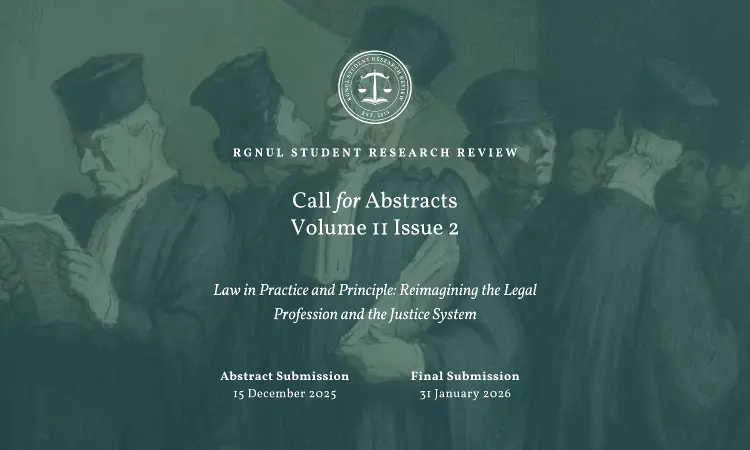
The Rajiv Gandhi National University of Law, Punjab invites submissions for Volume 11, Issue 2 of the RGNUL Student Research Review (RSRR). The upcoming issue is themed “Law in Practice and Principle: Reimagining the Legal Profession and the Justice System.” The journal welcomes original and insightful abstracts from students, academicians, legal professionals, and researchers exploring the evolving dimensions of the legal profession, justice delivery mechanisms, and legal education in India.
About RSRR
The RGNUL Student Research Review (RSRR) is an independent, biannual, student-run, blind peer-reviewed flagship journal based at the Rajiv Gandhi National University of Law, Punjab (RGNUL). Since its establishment in 2013, the objective of RSRR has been to publish comprehensive and interdisciplinary pieces, written by law students, academics, and professionals, on subjects relating to law and social sciences. RSRR publishes longer pieces biannually in its themed journal issues, and shorter pieces on a rolling basis on its online blog. The blog features student submissions, Excerpts from the Experts Series, and the Editorial Column.


Theme
“Law in Practice and Principle: Reimagining the Legal Profession and the Justice System”
About the Theme
From hardbound stacks of law reports to AI-powered case law search engines, the legal profession has seen a massive transformation. Changes brought about by the evolution of society and the blurring of national and geopolitical boundaries have pervasive implications for all professions, including that of Law. In the context of how quickly the field has been evolving and adapting with time, studying the legal system and the legal profession has become more significant than ever.
Perspectives on the Indian legal system and the legal profession are of interest to academicians, lawyers, and policymakers looking to analyse the impact of globalisation on the Indian legal profession and other aspects of the legal profession, such as legal education. We invite scholarship that incorporates elements from the professions of history, sociology, philosophy, and other interdisciplinary perspectives to explore the state of the legal profession in India.
Illustrative Sub Themes
1. Regulation and Reform in the Legal Profession
1.1 Governance of Foreign Law Firms and Cross-Border Practice
1.2 Administrative Burden on Courts
1.3 Overlap between the Advocates Act and the Bar Council of India Rules
1.4 Mutual Recognition Agreements and Global Mobility of Lawyers
1.5 Recognition and Regulation for Non-Advocates under Indian Law
2. Technology, AI and the Legal Practice
2.1 Redefining the Role of Lawyers and Courts in the Age of AI and Automation
2.2 Evidentiary Challenges in e-Courts
2.3 Online Dispute Resolution as an Extension of Courtrooms
2.4 Lawyer Advertising and Digital Self-Promotion
2.5 Data Privacy and Confidentiality in Digital Legal Practice
3. Inclusivity and Access to Justice
3.1 Gender, Diversity and Inclusion in the Legal Profession
3.2 Linguistic Barriers in the Legal System
3.3 Cross-Professional Mobility and Multi-Disciplinary Partnerships
3.4 Institutionalising Pro Bono Work within the Indian Legal Profession
3.5 Workplace Accommodations for Neurodivergent and Disabled Legal Professionals
4. Ethics and Accountability in the Legal Profession
4.1 Ethical Standards and Misconduct in the Indian Legal Profession
4.2 Professional Negligence and Responsibility in the Legal Practice
4.3 Judicial Overview of Legal Misconduct
4.4 Revisiting the Scope and Limits of Legal Confidentiality in India
4.5 Investigative Powers and the Summoning of Lawyers by Enforcement Agencies
5. Modernising Legal Education and Training in India
5.1 Clinical Methods in Legal Instruction
5.2 Decolonisation of Legal Education
5.3 Accreditation and Quality Assurance in Law Schools
5.4 Innovating Legal Education through Digital Pedagogy
5.5 Comparative approaches to reimagining Legal Curriculum
5. Structural Reforms and Challenges in the Indian Judiciary
6.1 Rethinking the Collegium System
6.2 Administrative Justice and Quasi-Judicial Institutions
6.3 Culture of Adjournments in the Indian Judiciary
6.4 Populist Pressure and its Effects on Judicial Decision-Making
6.5 Judicial Immunity and the Limits of Accountability
7. Democratising Legal Punishments
7.1 Restorative Justice and Victim Participation
7.2 Sentencing Disparities and Judicial Discretion
7.3 Prison Reforms and the Right to Dignity
7.4 Role of Public Opinion in Criminal Justice Policy
7.5 Algorithmic Bias in Sentencing
Note: These sub-themes are merely illustrative and not exhaustive. We welcome contributions on any other relevant issues or questions, provided they focus on the institutional, procedural, and systemic dimensions of law and justice rather than on normative arguments concerning the substance of the law.
Submission Guidelines
RSRR invites submissions from students, academics, career researchers, legal practitioners, and judges, amongst others. Authors do not need to have, or be pursuing, a degree in law to submit. There are no stipulations as to the number of authors, but they must reasonably comport with the length of the submission.
Submissions should be original, should not have been published elsewhere, or be under consideration elsewhere for publication. The abstract itself should not contain the name(s) of the author(s), their institutional affiliations, or any other identity markers.
All submitted abstracts shall be subject to a preliminary review, upon which select invitations to submit manuscripts shall be sent out. Upon submission, every manuscript will undergo an internal review by the Editorial Board. If approved by the Board, the manuscript shall be subject to peer review. RSRR reserves the right to reject submissions without review if found to be plagiarised. The Editorial Board reserves the right to solicit a compliant version before review.
Submission Categories
The RSRR accepts manuscripts for the following categories:
1. Articles (5,000 words onwards) undertake a comprehensive and thorough analysis of issues related to the theme of the Journal
2. Case Comments (2,000 words onwards) analyse or critique a recent case law.
3. Legislative Comments (2,000 words onwards) analyse or critique an ideated, proposed, drafted, or enacted piece of legislation, including its impact and normative value.
4. Book Reviews (3,000 words onwards) critically examine books for their content and impact on legal scholarship.
Submission Procedure
All abstracts must be from 200 to 300 words, and submitted in [doc] or [docx] format, with the file entitled 'Name of Author(s) – RSRR Abstract Submission'. Abstracts may be submitted via this form.
Submission Deadline
The deadline for submission is 15 December 2025 by 11:59 PM (IST). Select abstracts shall be invited to submit their final manuscripts. The deadline for submitting final manuscripts shall tentatively be 31 January 2026 by 11:59 PM (IST).
The RSRR shall retain all the copyrights arising out of the publication. All the moral rights shall vest with the author(s). For further details, refer to our copyright policy.
Contact
For any queries, please reach out to us at submissionsrsrr@rgnul.ac.in.
For further details, feel free to contact:
Shagnik Mukherjea: +91 99620 79033 | Murli Manohar Pandey: +91 83684 97893


