



MNLU Mumbai Invites Submissions For LHSS Legislative Review Competition 2026
Law School Correspondent
15 Jun 2026 8:49 PM IST
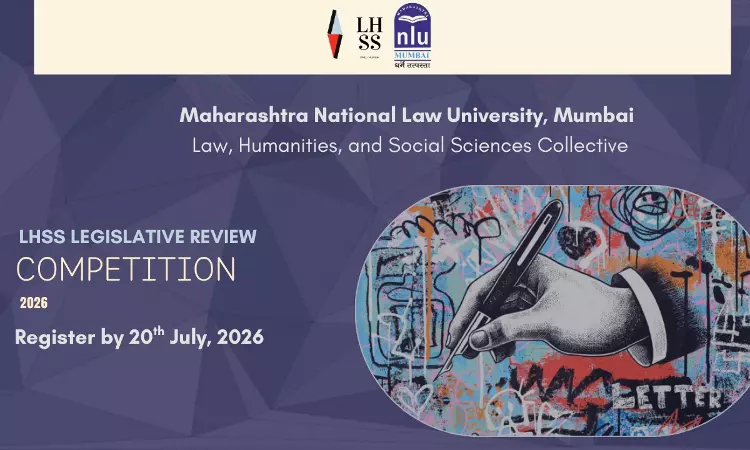
The Law, Humanities and Social Sciences Collective (LHSS) of Maharashtra National Law University (MNLU), Mumbai, has invited registrations for the LHSS Legislative Review Competition 2026.
LHSS seeks to provide a platform for interdisciplinary engagement at the intersection of law, humanities, and social sciences, with a particular focus on perspectives from the Global South.
About LHSS Legislative Review Competition
- Format
- In a legislation review you are expected to examine a legislation (promulgated within the past 2 years, 2024 to 2026), its intent, enforcement, and socio-political impact. The selection of the legislation will be on the basis of the theme provided below. The participants are expected to submit an intersection review of a legislation of their choice in the following manner:
- A brief write up of what the legislative review endeavors to do and what according to you are the highlights of your review (150-200 word summary on the legislation chosen, and key issues identified)
- Review of specific sections or thematic analysis of the areas covered by the legislation
- Recommendations (including but not limited to, suggestions raised in Law Commission Reports, any deletion or amendment, alternative policy approaches etc.)


Please note that the format for each review may differ depending on the legislation selected for review by the participants. The abovementioned structure is indicative in nature, participants have the discretion to deviate from
- Theme
- Law has always been both a promise and a weapon. Across human history, laws have simultaneously proclaimed universal rights and entrenched hierarchies by extending protection to some while systematically exposing others to harm, erasure, and dispossession. The postcolonial world inherited this contradiction wholesale, adopting the institutional architecture of liberal democracy while preserving the structural inequalities that colonialism had engineered. Today, as globalisation accelerates, technology reshapes the exercise of state power, and the Global South asserts new economic and political ambitions. Legislatures across Asia, Africa, and South America are making consequential choices about labour, land, environment, public health, digital governance, and the terms of belonging. These choices will determine the character of democratic life for generations.
India's Immigration and Foreigners Act, 2025 expands state powers to detain and deport with minimal procedural safeguards, but this erosion of due process is not unique to immigration. It reappears in land acquisition legislations which compress consultation timelines and limit judicial challenge, in labour codes that subordinate worker protections to investor convenience, in public health statutes that vest sweeping emergency powers in the executive with limited legislative accountability, and in data governance regimes that prioritise state access over individual privacy.
Across the Global South, the populations most exposed to these legislative choices share overlapping vulnerabilities, they are workers in the informal economy, smallholder farmers dispossessed by commercial agriculture, indigenous communities resisting extractive industries, linguistic and religious minorities navigating majoritarian nationalism, women and gender minorities confronting legal regimes that formalise patriarchal control, and stateless persons denied the basic legal standing required to access any rights at all. These vulnerabilities are the product of colonial legal transplants that were never adequately interrogated and of democratic deficits that insulate lawmaking from the communities most affected by it. Technology has added new dimensions to these dynamics without resolving any of the underlying tensions. Algorithmic systems now inform decisions about welfare eligibility, policing, credit access, and border control. Without adequate and measured intervention, they embed and automate historical biases at scale.
Against this backdrop, participants are invited to review legislations that broadly address the following concernsRights of the Immigrant/Migrant;
a. Labour, Livelihood and Enabling the Dispossessed;
b. State Security vs. Social Security;
c. Claims over Traditional Lands;
d. Digital Welfarism and Surveillance;
e. The Vulnerable Body and Ethics of Care.
Timeline
- Opening of Registration: 15.06.2026
- Last Date for Registration: 20.07.2026
- Last date for Submission: 26.07.2026
- Declaration of Results: 10.08.2026
Registration Fee:
- Single Author: INR 350
- Co-author Group (Two persons per group) : INR 700
Submission Guidelines
- Word Limit: 1500-2500 words
- All submissions must be made via the Google form provided post registration. Submissions sent via email shall not be accepted.
- Co-authorship is permitted (maximum of two authors per submission, including the first author).
- Plagiarism and AI-generated content will be checked rigorously, and any submission found in violation will be rejected without further review. For purposes of plagiarism, the similarity tolerance is 10 percent.
- Submissions should be in MS Word format (.docx or .doc) and named with the title of the review, along with mentioning the specific legislation being reviewed.
- Submissions should not contain any author-identifying information to ensure an unbiased assessment.
- Citation to adhere to 21st Bluebook Citation Style.
Registration
Participants can register via this form.
Prizes*:
a. Best Legislative Review - INR 3,000
b. Runner Up Legislative Review - INR 2,000
c. Top 3 submission to be considered for publication in LHSS Journal | Vol 1, Issue 2 (subject to editorial discretion).
*Prize amounts are per winning entry and would be the same for both individual and group submissions.


