



10 Years Of Juvenile Justice Act: National Consultation At RMLNLU Calls For Stronger Child-Centred Implementation
Law School Correspondent
31 Aug 2026 5:00 PM IST
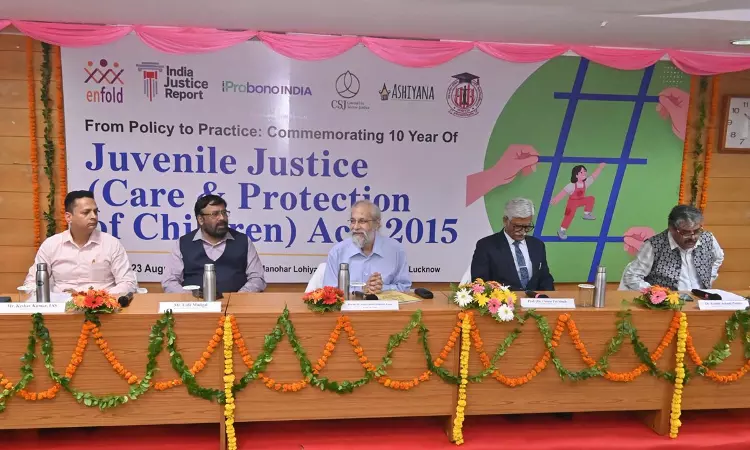
A two-day National Consultation on “From Policy to Practice: Commemorating 10 Years of the Juvenile Justice (Care and Protection of Children) Act, 2015” was held on August 22–23, 2026 at Dr. Ram Manohar Lohiya National Law University (RMLNLU), Lucknow.
Organised by RMLNLU in collaboration with iProbono India, Enfold Trust, India Justice Report, Counsel to Secure Justice, and Ashiyana Foundation, the consultation brought together students, research scholars, government officials, legal practitioners, academicians, child rights activists, and social workers to reflect on a decade of the Juvenile Justice (JJ) Act, 2015 and discuss pathways for strengthening its implementation, particularly in Uttar Pradesh.
Marking ten years of the JJ Act, the consultation provided a platform to assess the legislation's journey, examine developments in law and policy, and critically reflect on the challenges that continue to affect children in conflict with the law. Discussions focused on how the juvenile justice system can move beyond legal safeguards on paper to practices that effectively uphold the rights, dignity, and best interests of every child.


Particular attention was given to the principle of the best interests of the child, the functioning of Juvenile Justice Boards (JJBs), Children's Courts, and Child Care Institutions, as well as mechanisms required to ensure effective restoration, reintegration, rehabilitation, and social re-entry of children who come into contact with the law.
The consultation was inaugurated by Justice (Retd.) Madan B. Lokur, former Judge of the Supreme Court of India. The inaugural session also featured addresses by Prof. (Dr.) Amar Pal Singh, Vice-Chancellor, RMLNLU; Sri Lalit Mudgal, Director, Prosecution Directorate, Uttar Pradesh; Ms. Anupama Nilekar Chandra, Director General (Investigation), National Human Rights Commission; and Justice (Retd.) Sudhir Kumar Saxena. The session commenced with a welcome and context-setting address by Dr. Kumar Askand Pandey, Associate Professor, RMLNLU.
In his inaugural address, Justice Lokur highlighted the need for social audits of institutions functioning under the juvenile justice framework. He observed that issues such as overcrowding in child care institutions, probationary care, and institutional accountability require greater attention to ensure that the objectives of the law are effectively realised.
Prof. (Dr.) Amar Pal Singh emphasised that children are entitled to the full protection of constitutional rights and stressed the need to ensure that these guarantees are meaningfully implemented in practice.
Sri Lalit Mudgal raised important questions regarding the role of Public Prosecutors before Juvenile Justice Boards and pointed to the continuing gap between the intent of the JJ Act and the reality that many JJBs are yet to function as truly child-friendly spaces.
Addressing the consultation, Ms. Anupama Nilekar Chandra emphasised that understanding the factors that lead children into conflict with the law, as well as the causes of recidivism, is essential for improving implementation of the JJ Act. She further noted that child care and juvenile justice remain priority areas for the National Human Rights Commission.
Justice (Retd.) Sudhir Kumar Saxena underscored the importance of a compassionate approach within the juvenile justice system and stressed that children must be treated with care, sensitivity, and dignity. During the programme, the dignitaries also inaugurated the Centre for Child Rights at RMLNLU, established with the support of UNICEF Uttar Pradesh.
Across the two-day consultation, participants examined key implementation issues under the JJ Act, including institutional care, procedural safeguards, inter-agency coordination, and systemic challenges. Discussions consistently emphasised that every stage of the juvenile justice process must remain aligned with the child-centred objectives of the legislation.
A central theme of the consultation was the need to recognise children in conflict with the law as individuals with rights, needs, and the capacity for rehabilitation, rather than viewing them solely through the lens of alleged offences. Participants highlighted the importance of strengthening institutions, improving implementation, and expanding rehabilitation mechanisms to ensure meaningful outcomes for children.
The consultation concluded with a collective call to strengthen accountability, improve institutional and procedural practices, and advance evidence-based reforms within the juvenile justice framework. The deliberations are expected to contribute to future legislative, policy, and institutional reforms aimed at ensuring that the rights, dignity, best interests, and future of every child remain at the centre of the juvenile justice system.


