



“Don't Enter Any Rat Race, There Is Space For Everyone”: Justice Ujjal Bhuyan Addresses Incoming Batch At DBRANLU Sonepat's Deeksharambh 2026
Law School Correspondent
21 July 2026 9:50 PM IST
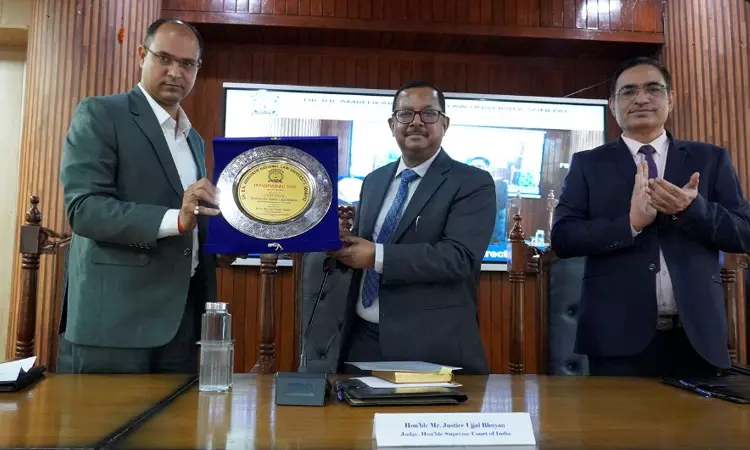
The fifth day of Deeksharambh 2026 at Dr. B.R. Ambedkar National Law University (DBRANLU), Sonepat, featured an address by Justice Ujjal Bhuyan, Judge of the Supreme Court, who attended the induction programme as the Chief Guest and keynote speaker. Addressing the incoming BA LL.B. and BBA LL.B. batch (2026–2031), Justice Bhuyan combined personal experiences, constitutional reflections and advice for students embarking on their legal education.
The session commenced with addresses by Vice Chancellor Prof. (Dr.) Devinder Singh and Registrar Prof. (Dr.) Ashutosh Mishra, who welcomed the new batch and introduced the University's academic vision and institutional support systems. This was followed by an address by Prof. (Dr.) V.K. Ahuja, Director of the Indian Law Institute, New Delhi, who reflected on the distinctive academic culture of National Law Universities, highlighting their rigour, collaborative learning environment and emphasis on intellectual discipline.


A Personal Beginning
Justice Bhuyan began by congratulating the students on securing admission to DBRANLU, noting that it is the only CLAT-affiliated National Law University located in the National Capital Region.
Recalling an incident from his school days, he said that when he was in Class VII, he had told his classmates that he wanted to become a lawyer, a decision that was met with laughter. He remembered that one of his teachers explained to him that the study of law is about understanding its many shades and nuances rather than viewing it as a straightforward discipline.
Reflecting on his professional journey, Justice Bhuyan credited senior advocates who mentored him during his years at the Bar, observing that practical learning complemented formal legal education. He also said that he continues to enjoy interacting with young students and lawyers and referred to DBRANLU as an institution appropriately named after Bharat Ratna Dr. B.R. Ambedkar.
On the Constitution and Dr. B.R. Ambedkar
A significant portion of the address focused on the framing of the Constitution and the contribution of Dr. B.R. Ambedkar as its principal architect.
Justice Bhuyan referred to the Poona Pact, the constitutional incorporation of affirmative action and Dr. Ambedkar's role as independent India's first Law Minister. He observed that no meaningful study of the Constitution is complete without understanding Dr. Ambedkar's life and contributions.
Tracing Dr. Ambedkar's journey, Justice Bhuyan referred to the discrimination he experienced during his childhood, his education in Bombay through a scholarship granted by the Maharaja of Baroda, his higher studies at Columbia University and the London School of Economics, and his distinguished legal career. He also referred to Dr. Ambedkar's enrolment with the Bombay Bar Council in 1923, his recognition as an eminent lawyer, his tenure as Principal of the Government Law College and his decision to decline an offer of judgeship.
Speaking about the Constitution, Justice Bhuyan described the Preamble as embodying its core values and highlighted equality as one of the principles that transformed Indian society by giving voice to historically marginalised communities.
Universities as Spaces for Curiosity
Justice Bhuyan described universities as spaces where ideas converge and emphasised that one of their foremost responsibilities is to cultivate curiosity among students.
Referring to former President Dr. A.P.J. Abdul Kalam, he said educational institutions should encourage students to ask questions freely while teachers should patiently respond to them, describing such engagement as essential to developing scientific temper.
Justice Bhuyan also referred to Rabindranath Tagore's vision in Gitanjali of a nation guided by fearless thought and dignity. He encouraged students to make full use of their years at the university by actively participating in extracurricular activities, remaining informed about national and international developments and reading widely beyond their prescribed legal texts. He observed that law is a constantly evolving discipline and that reading is essential to developing a well-rounded legal mind.
Concluding his address, Justice Bhuyan advised the students not to enter the "rat race", observing that the legal profession offers sufficient opportunities for everyone to find their own path. He encouraged them to approach their legal education with curiosity, integrity and a commitment to constitutional values.


