



AI Cannot Be A Constitutional Escape Route For Human Prejudice: Justice Dinesh Maheshwari At IIT Kharagpur Law School Lecture
Law School Correspondent
8 Oct 2026 2:34 PM IST
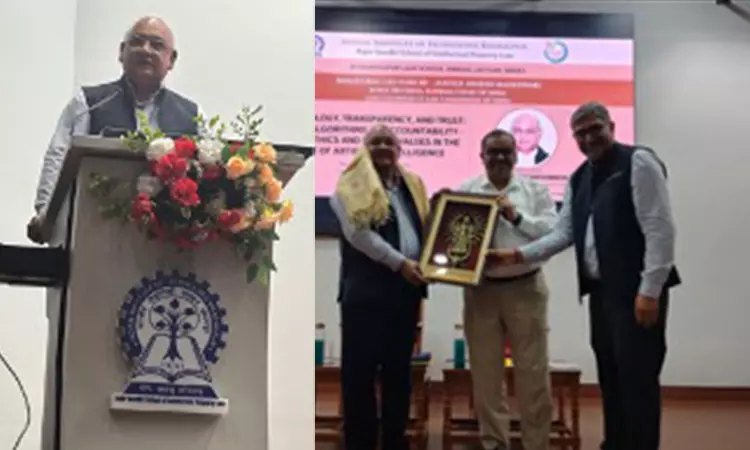
Former Supreme Court Judge and Chairperson of the 23rd Law Commission of India, Justice Dinesh Maheshwari, has said that artificial intelligence must be held to the same constitutional standards as human authority, stressing that responsibility cannot “disappear into the architecture of software.”
Justice Maheshwari was delivering the inaugural lecture of the IIT Kharagpur Law School Annual Lecture Series 2026 at the Ben Gupta Auditorium, Rajiv Gandhi School of Intellectual Property Law (RGSoIPL), IIT Kharagpur, on September 14, 2026. The lecture was on “Technology, Transparency, and Trust: From Algorithms to Accountability: Law, Ethics and Human Values in the Age of Artificial Intelligence.”
The lecture series was launched by RGSoIPL to mark the school's twentieth year and IIT Kharagpur's seventy-fifth year. RGSoIPL was founded in 2006 as India's first and only law school within the IIT system. It ranks sixth among Indian law schools in the National Institutional Ranking Framework (NIRF) and has entered the QS World University Rankings in the 251–300 band this year.
In his welcome address, Dean Prof. Uday Shankar said the school's next chapter belongs to technology-enabled law and “frontier governance”, where change is outpacing regulation. Justice Maheshwari, who spent more than two decades at the Bar and nearly two decades on the Bench, said that while technology and law evolve, human values must remain constant.


“Technology changes faster than law, law changes faster than institutions, but human values must remain the constant,” he said.
He observed that the fundamental legal questions remain unchanged despite the emergence of technology—who holds power, how it is used and who answers when it causes harm. These questions, he said, do not disappear merely because power now operates through code.
Justice Maheshwari said artificial intelligence and law share a peculiar trait, as both can “produce confident answers before anyone has even understood the question.” He urged the audience to ask not only what AI can do but also what it should be allowed to do, while approaching it neither with fear nor blind surrender.
Drawing on the stories of cosmonaut Alexei Leonov, the Silkyara tunnel rescue of 2023 and Krishna in the Mahabharata, Justice Maheshwari highlighted the importance of questioning, adaptation and human judgment.
He said Leonov demonstrated the need to adapt when a system's assumptions break down, while the Silkyara rescue showed the importance of changing the method when the machine itself becomes the problem. The story of Krishna and Karna, he said, showed that the right question can matter more than a faster answer.
“It is the difference between intelligence and mere computation,” he said.
“The future will not belong to man versus machine. It will belong to the man who knows when to trust the machine and when to think beyond it.”
Justice Maheshwari also warned that algorithms can learn what makes people angry and what makes them click, repeatedly feeding them similar content until they “mistake repetition for truth.” He said democracy requires people to be able to think for themselves.
He stressed that constitutional protections apply irrespective of whether discrimination originates from a human being or a machine.
“A constitution does not ask whether discrimination was committed by a human being or by a machine. It asks whether the outcome is arbitrary, unreasonable or discriminatory,” he said.
He further stated that “a machine cannot become a constitutional escape route for human prejudice” and that a citizen denied a benefit is still owed a hearing and a reason.
Invoking the strict-liability rule in Rylands v. Fletcher, Justice Maheshwari insisted on an identifiable chain of responsibility, stating that whoever deploys a powerful tool owns its consequences. Referring to Article 51A(h) of the Constitution, he said citizens should question AI rather than worship or fear it. Digital literacy, he added, is no longer enough; constitutional and ethical literacy are also necessary.
He said good law should become the “safety architecture of innovation” and proposed five questions for any new technology: Can we do it? Should we? Is it lawful? Is it fair? Does it make us more human?
During the question-and-answer session, Justice Maheshwari noted that fake AI citations have now reached the Supreme Court of India, observing that “hallucination” is too soft a word and that responsibility must be fixed.
Addressing young lawyers, he said a machine can gather material, but only a lawyer can hear the client, sift what matters and shape it into an argument fit for court. Fairness to the client, opponent and court, he said, is “non-negotiable.”
“You can do anything,” Justice Maheshwari told the students, “but you cannot give up.”
Concluding the evening, Prof. P.P. Chakrabarti, former Director of IIT Kharagpur, said modern AI “makes solving easy but verification hard.” He warned that those who do not understand how it works risk becoming subservient to it and surrendering their ability to think.


