



Maharashtra National Law University, Nagpur Hosts Two-Day National Conference On NDPS Law
Law School Correspondent
15 April 2026 5:12 PM IST
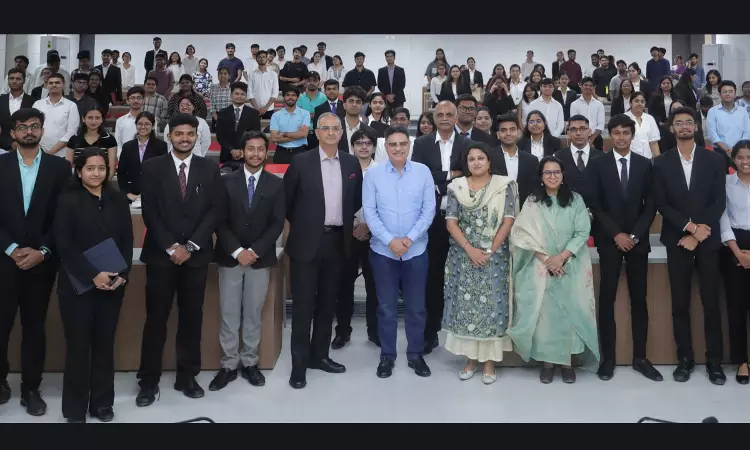
Maharashtra National Law University, Nagpur organised a two-day national conference titled “Four Decades of the NDPS Act, 1985: Jurisprudential Evolution, Contemporary Challenges, and a Roadmap towards a Drug-Free India by 2047” on April 10 and 11, 2026. The conference brought together Senior Advocate Vikram Choudhary, Senior Advocate Tanveer Ahmed Mir, Prof. (Dr.) G.S. Bajpai, IRS Sameer Wankhede, Adv. Mayank Makhija (ED), Adv. Seema Joshi (UNODC), IRS Amit Ghawate (NCB), IPS Harsh Poddar, along with other resource persons and students from across the country.
Inaugural Session
The conference commenced with an introductory address by Dr. Trisha Mittal, Conference Coordinator, who welcomed the dignitaries and participants. She expressed gratitude to Prof. (Dr.) G.S. Bajpai, Vice-Chancellor, National Law University, Delhi; Prof. (Dr.) Vijender Kumar, Vice-Chancellor, Maharashtra National Law University, Nagpur; Shri Deepak L. Bhagwat, Registrar; speakers; members of academia; representatives from enforcement agencies and policy institutions; and the participants and students.


Dr. Trisha Mittal noted that as the Narcotic Drugs and Psychotropic Substances Act, 1985 completes four decades, there is a need for critical reflection on its jurisprudential evolution, institutional mechanisms, and contemporary challenges, and emphasised the importance of a coordinated and multidisciplinary response.
The welcome address was delivered by Prof. (Dr.) Vijender Kumar, Vice-Chancellor, MNLU Nagpur, who highlighted the vision of a drug-free India by 2047 and emphasised that achieving this goal requires collective efforts from legal professionals, policymakers, and citizens.
The Chief Guest, Prof. (Dr.) G.S. Bajpai, addressed the gathering virtually and delivered a keynote on investigation, trial processes, and bail jurisprudence under the NDPS Act, outlining practical challenges and judicial trends in narcotics-related prosecutions.
The inaugural session concluded with a vote of thanks by Dr. Ila Sudame, Co-Coordinator, who acknowledged the support of Prof. (Dr.) Vijender Kumar and Shri Deepak L. Bhagwat, and recognised Live Law as the Media Partner and Vidhi Centre for Legal Policy and Manupatra as Knowledge Partners.
Plenary Session I
The first plenary session focused on law enforcement responses to narcotics trafficking and illicit financial flows. It featured Shri Amit Ghawate, IRS, Additional Director, NCB Mumbai Zonal Unit; Adv. Mayank Makhija, Assistant Legal Advisor and Special Public Prosecutor, Enforcement Directorate; and Adv. Seema Joshi, Criminal Justice Expert, United Nations Office on Drugs and Crime (UNODC).
Shri Amit Ghawate explained the statutory framework of the NDPS Act and the role of the Narcotics Control Bureau, including intelligence gathering, inter-agency coordination, and investigative procedures.
Adv. Mayank Makhija discussed the interrelation between NDPS and PMLA, highlighting how drug trafficking is linked to money laundering and the role of financial investigation in dismantling illegal networks.
Adv. Seema Joshi provided an international perspective on drug policy, highlighting UNODC initiatives, emerging challenges such as synthetic drugs, and the need for a balanced approach involving prevention, treatment, and rehabilitation.
Plenary Session II
The second plenary session addressed rehabilitation and de-addiction as legal and socio-institutional responses. The panel included IPS Harsh Poddar, Superintendent of Police, Nagpur; Mr. Ravi Padhye, Director; Mr. Tushar Natu, Senior Counsellor, Maitraiyee De-addiction Treatment-cum-Rehabilitation Centre; Mr. Naveed Ahmed, Vidhi Centre for Legal Policy; and Dr. Gaurav Kumar Singh, Assistant Professor, AIIMS Nagpur.
IPS Harsh Poddar highlighted changing patterns of drug consumption, particularly among youth, and emphasised the importance of early intervention and awareness.
The discussion emphasised the need to treat addiction as a public health issue and to strengthen rehabilitation-focused approaches within the NDPS framework.
Mr. Ravi Padhye discussed practical challenges in de-addiction, including accessibility and stigma. Dr. Gaurav Kumar Singh highlighted medical and psychological aspects of addiction, while Mr. Naveed Ahmed stressed the need for legal reforms to strengthen rehabilitation mechanisms.
Plenary Session III
The third plenary session focused on criminal proceedings under the NDPS Act and featured Senior Advocate Vikram Choudhary, Senior Advocate Tanveer Ahmed Mir, and IRS Sameer Wankhede.
IRS Sameer Wankhede discussed the evolution of the NDPS Act, enforcement challenges, and emerging threats such as darknet-based drug distribution. He emphasised adherence to due process and evidence-based investigation.
Senior Advocate Vikram Choudhary highlighted the role of defence in ensuring accountability and emphasised the importance of procedural safeguards, evidentiary integrity, and transparency in investigations.
Senior Advocate Tanveer Ahmed Mir discussed constitutional safeguards under Article 21, comparative perspectives from other jurisdictions, and the need for balanced prosecution strategies based on the nature of offences.
Valedictory Session
During the valedictory session, Shri Shivkumar Iyer, Assistant Director (Retd.), National Academy of Customs, Indirect Taxes & Narcotics, was awarded Best Paper Presenter, while Ms. Gauraangi B. Naik, Assistant Professor, Goa University, was recognised as Second Best Paper Presenter.
The conference was organised under the guidance of Faculty Coordinators Prof. (Dr.) Shilpa Jain, Dr. Trisha Mittal, Dr. Divita Pagey, and Dr. Ila Sudame, along with Student Coordinators Mr. Naman Sharma, Mr. Shashwat Raut, Mr. Vineet, Mr. Alen Thomas, and Ms. Nandini.
The conference was conceptualised by Dr. Trisha Mittal and Mr. Naman Sharma, and was conducted through coordinated efforts of the organising team, facilitating dialogue among academia, legal practitioners, enforcement agencies, and policy experts.


