



NALSAR, Telangana Judicial Academy Hold One-Day Training On Juvenile Justice Act, 2015
LIVELAW NEWS NETWORK
3 Feb 2026 11:39 AM IST
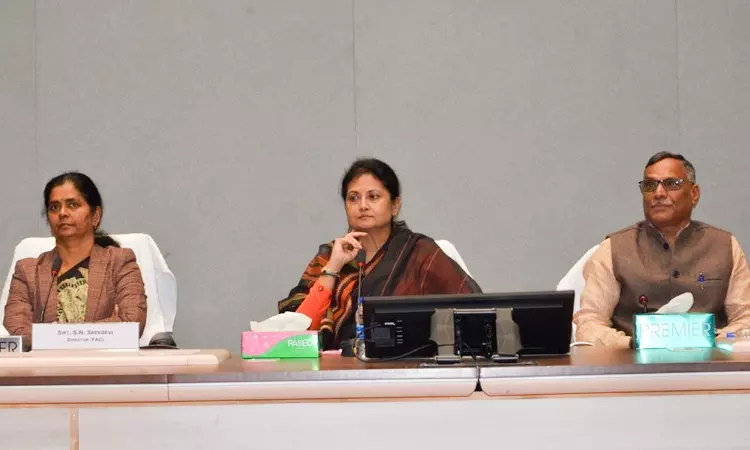
A one-day training programme on the Juvenile Justice (Care and Protection of Children) Act, 2015 was conducted on 31 January 2026 by the Access to Justice for Prisoners Program, NALSAR University of Law, Hyderabad, in collaboration with the Telangana State Judicial Academy.
The programme aimed to promote child-centric juvenile justice procedures in Telangana and strengthen procedural and substantive implementation of the Juvenile Justice Act, 2015. It followed a multi-stakeholder approach involving members of Juvenile Justice Boards (Principal Magistrates and Social Worker Members), police officials, District Legal Services Authorities, advocates, and civil society representatives.
Inaugural Session
The programme was inaugurated in the presence of Smt. Justice Moushumi Bhattacharya, Judge, High Court for the State of Telangana; Prof. Srikrishna Deva Rao, Vice-Chancellor, NALSAR University of Law; and Smt. S. N. Sreedevi, Director (Fac), Telangana State Judicial Academy.
Justice Moushumi Bhattacharya, in her inaugural address, emphasised restoration and reintegration as central to the juvenile justice system and highlighted the need for coordinated action among stakeholders for child protection. She underscored that the juvenile justice system must function as an interventionist framework prioritising timely rehabilitation.


Referring to XXX v. State of UP [2025 SCC Online All 6582], Justice Bhattacharya noted that the Allahabad High Court reiterated the requirement of a fair and rigorous preliminary assessment under Section 15 of the Juvenile Justice Act, 2015, particularly in cases involving heinous offences. She observed that trial of juveniles as adults must remain an exception and requires mandatory expert inputs conducted transparently.
She also cited CCL K v. State of NCT [CRL.REV.P. 436/2022], where the Delhi High Court held that a juvenile tried as an adult cannot be tried jointly with adult co-accused. Referring to a Division Bench decision of the Telangana High Court, Justice Bhattacharya noted that an independent assessment under Section 19 cannot be dispensed with and that a mere observation regarding finality of a JJB order does not constitute a valid assessment.
Justice Bhattacharya further referred to observations of the Punjab and Haryana High Court (2024) that mental capacity alone is insufficient for adult trial designation and that assessments must consider mental and physical capacity, understanding of consequences, and circumstances of the alleged offence. She also cited orders of the Madhya Pradesh High Court emphasising child-friendly forums even in adult trial designations, and the Rajasthan High Court's decision in UV v. State of Rajasthan [2025], holding that bail cannot be denied solely due to adult trial designation.
Addresses By Vice-Chancellor And Director (Fac)
Prof. Srikrishna Deva Rao highlighted the moral obligation to protect children and implement the UN Convention on the Rights of the Child. He identified Section 3 of the Juvenile Justice Act, 2015 as the guiding provision emphasising diversion and restorative justice, acknowledged the establishment of Juvenile Justice Boards across Telangana, and assured institutional support from NALSAR University of Law.
Smt. S. N. Sreedevi described the Juvenile Justice Act, 2015 as a landmark rights-based welfare legislation and stressed that its implementation must prioritise the best interests of the child, improved efficiency, and reduction of pendency.
Capacity Building Sessions
Emerging Jurisprudence And UN General Comment No. 27
The first session, led by Prof. Dr. Murali Karnam, Director, Access to Justice for Prisoners Program, NALSAR, focused on emerging jurisprudence and United Nations General Comment No. 27. Prof. Karnam highlighted the systemic mismatch of applying adult-designed criminal justice systems to children and stressed the need to shift towards child-centred justice.
Referring to the India Justice Report, he noted that approximately 55 per cent of cases fail to adhere to statutory timelines, disproportionately impacting children. He urged stakeholders to prioritise substantive compliance over procedural formalism and called for justice systems that are timely, participatory, and restorative.
Multistakeholder Approach To Juvenile Justice
The second session, designed and led by Dr. Vikram Srivastava, Child Rights Advocate and Founder, Independent Thought, examined the practical functioning of Juvenile Justice Boards in Telangana. Dr. Srivastava emphasised that judicial orders should mark the beginning of a child's rehabilitation and encouraged empathetic, rights-oriented adjudication.
An interactive discussion involving Principal Magistrates, JJB members, probation officers, police officials, lawyers, and social workers highlighted challenges including inadequate infrastructure, staff shortages, quorum issues, delays in Social Investigation Reports, and weak inter-agency coordination.
During the discussion, Ayesha Fatima, JJB Member (Hyderabad), observed that the Board prioritises making children feel at ease and understanding the circumstances that led them into the system.
Suggested collaborative practices included improved coordination, case prioritisation, creation of conducive interaction spaces, and identification of fit persons or institutions within districts.
Data-Driven Insights On Juvenile Justice
A data-focused session was presented by Mr. Valay Singh, Lead, India Justice Report. He noted that as of 31 October 2023, Juvenile Justice Boards nationwide were handling 100,904 cases, with 55 per cent pending.
In Telangana, JJBs handled 5,689 cases between 1 November 2022 and 31 October 2023, of which 3,057 were disposed of and 2,632 remained pending, reflecting a disposal rate of 53.7 per cent. These findings are detailed in the report “Juvenile Justice and Children in Conflict with the Law: A Study of Capacity at the Frontlines, 2025.” Mr. Singh emphasised the need for stronger record-keeping and data collection.
Panel Discussion On Best Interests Of Children
The final session was a panel discussion moderated by Prof. Karnam, comprising Smt. Madhavi, Judicial Magistrate of First Class; Isidore Philip, Director, Divya Disha; Dr. Vikram Srivastava; and Dr. Sunnam Srinivas Reddy, Faculty, Telangana State Judicial Academy.
The panel emphasised that while the concept of the State may be abstract for children, their core needs—rights, dignity, care, and participation—remain constant, and that effective reform requires coordinated action across institutions. Isidore Philip observed that the juvenile justice system must ensure children's access to a continuum of care and protection services.
The programme concluded with a vote of thanks from the Telangana State Judicial Academy.


