



"Around 80% Of Successful People In Law Background Are From First-Generation": NHRC Chairperson Justice V. Ramasubramanian Addresses Incoming Batch At DBRANLU
Law School Correspondent
21 July 2026 10:24 PM IST
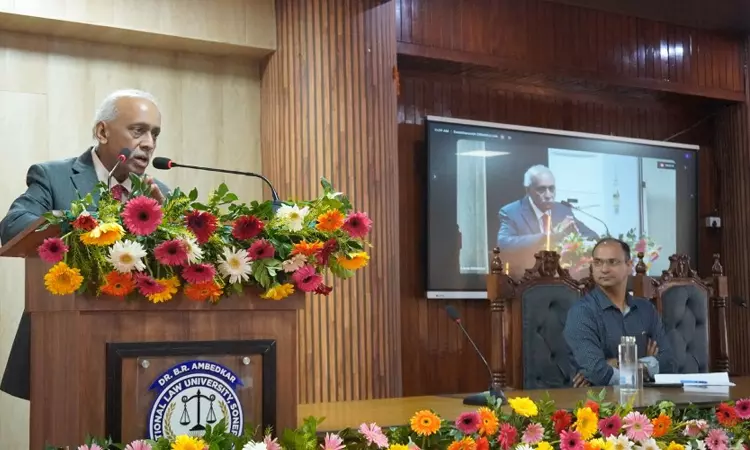
The fourth day of Deeksharambh 2026 at Dr. B.R. Ambedkar National Law University (DBRANLU), Sonepat, witnessed an inspiring address by Justice V. Ramasubramanian, Chairperson of the National Human Rights Commission, who graced the occasion as the Chief Guest. The programme formed part of the University's induction programme for the incoming batch and commenced with the ceremonial welcome of the dignitaries, lighting of the lamp, felicitation ceremony, and welcome address, followed by the keynote address delivered by Justice Ramasubramanian where he underscored the enduring relevance of India's ancient epics in understanding law, ethics, and human behaviour. Referring to the Mahabharata, he observed that it is a timeless repository of human experiences, encompassing every facet of life, from morality, duty, love, sacrifice, and compassion to ambition, conflict, revenge, and justice The session opened with addresses by the Vice Chancellor, Prof. (Dr.) Devinder Singh, and the Registrar, Prof. (Dr.) Ashutosh Mishra, both of whom spoke as part of the induction ceremony, welcoming the new batch into the university and setting the tone for their academic journey ahead. The Vice Chancellor outlined the University's vision and shared the aspirations and values expected of students as they embark on their academic journey. The Registrar highlighted the University's administrative framework and the various institutional support systems available to ensure a smooth and enriching transition into campus life.
Choosing Law with Purpose
Beginning his address, Justice Ramasubramanian encouraged students to reflect deeply on why they had chosen to study law. Drawing comparisons with careers in medicine and engineering, he explained that while law presents diverse professional opportunities and rewarding career prospects, students should not view the profession solely through the lens of financial success. Instead, he urged them to identify a larger purpose that would guide their legal journey, whether as litigators, corporate lawyers, academicians, judges, or public servants. He reminded students that a meaningful legal career is built upon conviction, clarity of purpose, and commitment to justice rather than material rewards alone.


Understanding the True Nature of Law
Justice Ramasubramanian went on to explain that the study of law extends far beyond statutes and courtroom practice. Tracing the evolution of legal systems, he observed that societies have long grappled with questions of right and wrong, but that law emerged to provide an institutional framework capable of resolving increasingly complex disputes. He encouraged students to appreciate that legal problems rarely present straightforward answers and that lawyers must develop the ability to examine competing perspectives with objectivity and intellectual honesty.
Illustrating this idea through the famous "trolley problem" discussed by philosopher Michael Sandel, Justice Ramasubramanian engaged students in a thought-provoking discussion on ethics, morality, and utilitarianism. The exercise demonstrated that legal questions often exist in shades of grey rather than absolute categories of right and wrong, underscoring the importance of careful reasoning in the practice of law.
Law as a Means of Service
Highlighting the social responsibility attached to legal education, Justice Ramasubramanian reminded students that every educated citizen benefits from society's collective investment in educational institutions. He urged the incoming batch to dedicate a part of their professional lives to ensuring access to justice for marginalised and underprivileged communities, observing that the true purpose of legal education is fulfilled only when knowledge is used in the service of society.
The Strength of First Generation Lawyers
One of the most memorable moments of the address came when Justice Ramasubramanian sought to reassure students who might be concerned about entering the legal profession without a family background in law. Reflecting on his own journey as a first-generation lawyer, he remarked that beginning without inherited professional advantages often allows individuals to build their own identity and achievements. He observed that nearly 80 percent of successful law professionals today are from first generation , encouraging students to approach their careers with confidence and determination to break new ground.
Reading Beyond Law
Concluding his address, Justice Ramasubramanian encouraged students to cultivate excellence in communication, literature, and public speaking alongside their legal studies. He stressed that language remains one of a lawyer's greatest strengths, with even the smallest nuances capable of altering legal meaning. Encouraging students to read widely beyond legal texts, he observed that lawyers who immerse themselves in literature, history, philosophy, and allied disciplines are better equipped to excel in the profession.
The session concluded with an engaging interactive discussion during which students posed questions on legal ethics, judicial decision-making, literature, time management, and professional development. Drawing upon his judicial experience, Justice Ramasubramanian responded with practical insights, encouraging students to remain intellectually curious, disciplined, and socially conscious throughout their legal careers.


