



TRC Law College To Host National Seminar On 'Traditional Knowledge & Sustainable Development' On March 13-14, 2026
LIVELAW NEWS NETWORK
14 Feb 2026 12:02 AM IST
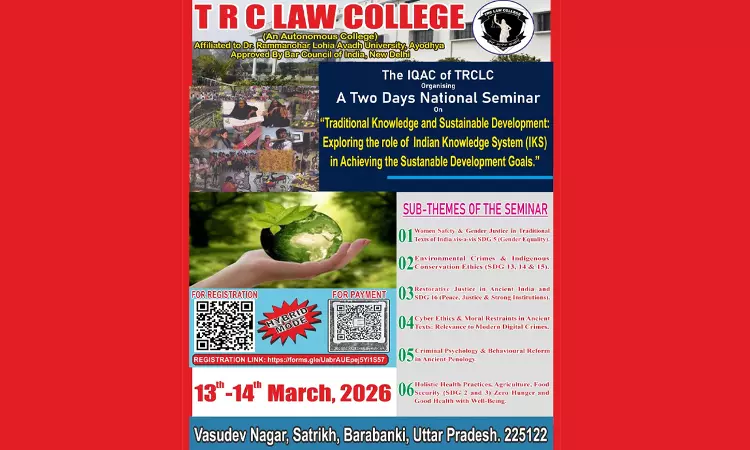
TRC Law College, Barabanki, Uttar Pradesh, will organise a Two-Day National Seminar on “Traditional Knowledge and Sustainable Development: Exploring the Role of Indian Knowledge System (IKS) in Achieving the Sustainable Development Goals (SDGs)” on 13th and 14th March 2026.
The seminar is being organised by the Internal Quality Assurance Cell (IQAC) of the College and aims to examine the relevance of India's traditional knowledge systems in addressing contemporary sustainability challenges, particularly in the context of the United Nations Sustainable Development Goals (SDGs).
About the Institution
Established in 2006 at Satrikh (Saptrishi), Barabanki, TRC Law College is an autonomous institution offering LL.B., B.A. LL.B., and LL.M. programmes. The institution was accredited with a B+ Grade by NAAC in 2023 and is the first law college in Barabanki district.
About the Seminar
The seminar seeks to create academic dialogue on the intersection of Indian Knowledge Systems (IKS), law, sustainability, and governance. It aims to analyse how traditional Indian jurisprudence, community-based governance models, environmental ethics, restorative justice practices, and indigenous knowledge frameworks can contribute to modern policy development and sustainable justice delivery mechanisms.


The discussions will focus on bridging ancient Indian wisdom with contemporary legal and policy frameworks, particularly in areas such as justice systems, environmental conservation, gender equality, climate action, governance, and community dispute resolution.
Awards-
· Best Research Paper Award 2500 Rs.
· Best Presentation (two for each session) 500 Rs.
Note: To compete in the first category, the submission of a full paper as per the guidelines and presentation is mandatory.
About Call for Papers
India's civilizational heritage reflects knowledge systems embedded not only in classical texts but also in social practices, governance models, environmental stewardship and community-based dispute resolution. Long before the modern concept of sustainability and the adoption of the United Nations Sustainable Development Goals (SDGs), Indian traditions developed frameworks promoting ecological balance, ethical conduct and social harmony.
This seminar seeks to examine how the Indian Knowledge System (IKS)—including traditional jurisprudence, restorative justice practices, environmental ethics and indigenous governance models—can contribute to achieving the SDGs, particularly in areas such as justice, peace, gender equality and sustainable development. By fostering interdisciplinary dialogue, the seminar aims to bridge ancient wisdom with contemporary policy frameworks and explore its relevance for sustainable living and justice delivery today.
Objective Of The Seminar
1. To explore the relevance of Indian traditional knowledge systems in achieving the UN Sustainable Development Goals.
2. To analyse the contribution of ancient Indian Justice models of modern criminal Laws.
3. To identify community-based alternatives to punitive justice such as restorative justice, mediation and rehabilitation-oriented criminal jurisprudence.
4. To promote interdisciplinary dialogue between legal experts, environmentalists, scholars of India philosophy and social reformers.
5. To highlight the contribution of Indian traditional knowledge in achieving global sustainability goals.
6. To examine the alignment between IKS and specific SDGs such as health, climate action, peace, justice and education.
7. To encourage interdisciplinary discussion between scholars of law, science, humanities and social sciences.
8. To propose policy recommendations for integrating IKS within governance and development strategies.
Expected Outcomes
1. Revival of indigenous knowledge systems within legal and policy frameworks.
2. Recommendations for integrating restorative justice into current criminal laws.
3. Insightful research outcomes connecting cultural heritage to modern sustainability frameworks.
4. Policy-level suggestions for sustainable justice delivery mechanisms aligned with SDG objectives.
Eligibility
Eligibility for Paper Submission
(a) Paper submissions are invited from:
· Academicians and Faculty members
· Judges, Advocates, Legal Professionals
· Researchers and Scholars
· Postgraduate and Undergraduate students
(b) Co-authorship is permitted maximum of two authors per paper.
Theme
“TRADITIONAL KNOWLEDGE AND SUSTAINABLE DEVELOPMENT: EXPLORING THE ROLE OF INDIANKNOWLEDGE SYSTEM (IKS) IN ACHIEVING THE SUSTAINABLE DEVELOPMENT GOALS (SDG'S)”
Sub Themes of the Seminar
1. Women Safety & Gender Justice in Traditional Texts vis-à-vis SDG 5 (Gender Equality)
· Protection of women in Manusmriti, Arthashastra, Smritis, Buddhist & Jain traditions.
· Women in Indian Knowledge Traditions and Gender Equality
· Evolution from Stridhan and customary protections to modern criminal laws (BNS, POCSO, Domestic Violence Act)
2. Environmental Crimes & Indigenous Conservation Ethics (SDG 13, 14 & 15)
· Protection of forests, rivers and animals in Vedic and tribal laws
· Vedic Ecology, Tribal Wisdom and Natural Resource Management
· Ancient penalties for cattle slaughter, river pollution, deforestation
3. Restorative Justice in Ancient India and SDG 16 (Peace, Justice & Strong Institutions)
· Panchayati Nyaya and Community-Based Dispute Resolution
· Comparison of Dharma-based penal systems with modern rehabilitation laws
· Village Panchayat Systems and Community-Based Governance
· Restorative Justice Models in Ancient Indian Jurisprudence
4. Cyber Ethics & Moral Restraints in Ancient Texts: Relevance to Modern Digital Crimes
· Concept of Sadvritta (ethical conduct) as a behavioural framework against cyberbullying, misinformation or fraud.
5. Criminal Psychology & Behavioural Reform in Ancient Penology
· Mental health considerations in Dandaneeti (penal codes) and their relevance for prison reforms and juvenile justice.
· Ethical and Moral Education in Ancient Texts.
6. Holistic Health Practices, Agriculture, Food Security (SDG 2 and 3: Zero Hunger and Good Health with Well- Being)
· Role of Ayurveda and Yoga in India
· Indigenous Agricultural Practices
Formatting Guidelines
1. Abstract Submission Guidelines
(a) Abstracts shall be:
· Between 250–300 words
· Clearly stating objectives, methodology and key findings.
(b) Abstracts must include:
· Title of the paper
· Name(s) of author(s)
· Institutional affiliation
· Email ID and contact number
(c) Abstract submission does not guarantee acceptance of the full paper.
2. Full Paper Submission Guidelines
(a)Word limit for full paper:
· Minimum: 3,000 words
· Maximum: 6,000 words (including footnotes)
(b) Formatting:
· Font: Times New Roman
· Font size: 12 (text), 10 (footnotes)
· Line spacing: 1.5 (text), single (footnotes)
· Margins: 1 inch on all sides
(c) Citation style:
· ILI mode of citation is must.
(d) The paper shall be submitted in both MS Word (.doc/.docx) & PDF format.
Submission Guidelines
1. Theme and Sub-Themes
· Papers must strictly relate to the main theme or any of the sub-themes of the seminar.
· Interdisciplinary papers connected with law and allied subjects are also encouraged.
· Papers not aligned with the seminar theme shall be rejected without review.
2. Originality and Plagiarism
· Submissions must be original, unpublished and not under consideration elsewhere.
· Plagiarism shall not exceed 15%, excluding references and footnotes.
· Papers found to be plagiarized beyond permissible limits shall be rejected.
· The author (s) shall be solely responsible for the originality of the content.
3. Presentation Rules
· Only registered and approved authors shall be allowed to present papers.
· Each presenter shall be allotted:
v 10–15 minutes for presentation
v 5 minutes for discussion
· PowerPoint presentation is optional but must be concise and academic.
4. Ethical Standards
· Authors must adhere to:
v Academic honesty
v Proper citation and referencing
· Any ethical misconduct shall attract rejection and blacklisting from event.
Registration Fee
1. Registration Fee-
1.1 For Paper presentation
· Academicians and Faculty Members 500 Rs.
· Professionals and Advocates 500 Rs.
· Research Scholars and P.G. Students 400 Rs.
· U.G students 300 Rs.
· Faculty & Student of T R C Law College 300 Rs.
1.2 For participation only 300 Rs.
· Account holder Name T R C Law College
· Bank Name: Union Bank of India
· Account No. : 510331001278603
· IFS Code: UBIN0910660
· Branch: Vijay Nagar Barabanki
Registration Process
1. All participants have to register online through provided link after making the payment of Registration Fee.
2. The Abstract must be sent via e-mail on trclcseminar@gmail.com after completing the registration process.
3. A mail of confirmation would be sent to the participant after review process.
4. At least one author of an accepted paper must complete registration.
5. Failure to register shall result in exclusion from presentation and publication.
6. Registration fees, once paid, shall be non-refundable.
Registration and Submission Deadline
1 | Date of Registration commencement | 10/02/2026 |
2 | Last date of registration | 28/02/2026 |
3 | Last Date of Abstract Submission | 01/03/2026 |
4 | Date of Acceptance of Abstract | 02/03/2026 |
5 | Last Date of Full Paper Submission | 10/03/2026 |
Submission Procedure
· After receiving the mail of confirmation the author (s) have to submit full paper before the deadline via e-mail on trclcseminar@gmail.com as earliest as possible.
· After submission of full paper the author (s) will receive the acknowledgement from organising committee.
Contact Information
Organising Committee
Chief Patron Patron
Dr. Sujeet Chaturvedi Dr. Ashwani Kumar Gupta
(Chairman, Governing Body) (Principal T R C Law College)
Organising Secretary
Veer Vikram Singh
(Assistant Professor)
Deputy Organising Secretary Deputy Organising Secretary
Dr. Avinash Mishra Mr. Naveen Singh
(HoD, PG Department) (Assistant Professor)
Student Coordinators
Mr. Aaditya Narayan Jaiswal
Mrs. Vanya Pandey
Miss. Shreya Tripathi
Mr. Pushpendra Chandra Tiwari
Miss. Pooja Patel
Contact
1 | Mr. Aaditya Narayan | 9555839191 |
2 | Miss. Vanya Pandey | 9532210656 |
3 | Miss. Shreya Tripathi | 7017125812 |
Official Links
1 | ||
2 | Registration Link | |
3 | College Website |


