



Kerala Law Academy Invites Papers For 33rd International Seminar On Good Governance And Artificial Intelligence In The Digital Era
Law School Correspondent
6 Nov 2026 11:01 AM IST
The Kerala Law Academy Law College (KLA), established in 1966, is a Centre for legal studies, legal research, and law reforms. Its acclaimed peer-reviewed Research Journal has been published continuously since 1977. The College, affiliated with the University of Kerala, offers Undergraduate programmes including five-year integrated courses in B.A. LL.B., B.Com. LL.B., B.B.A. LL.B., and B.Sc. (Information Technology) LL.B., the LL.B. Unitary three-year course, and post-graduate programmes comprising LL.M. (Administrative Law), LL.M. (International Law), and M.B.L. (Master of Business Law).
About the International Seminar
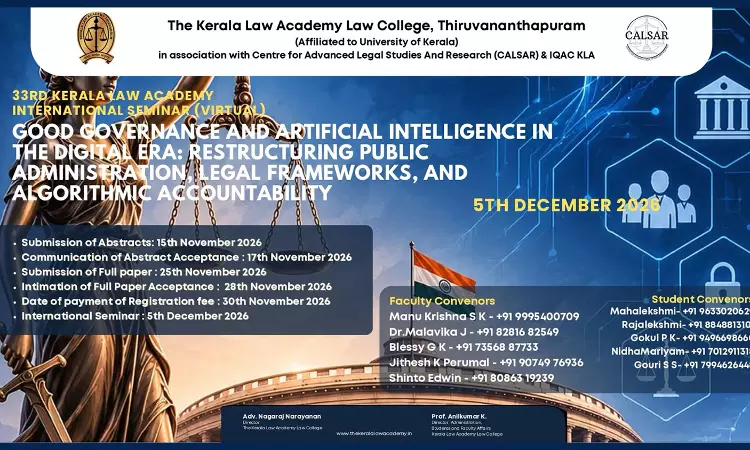
The 33rd INTERNATIONAL SEMINAR on "Good Governance and Artificial Intelligence in the Digital Era: Restructuring Public Administration, Legal Frameworks, and Algorithmic Accountability" aims to provide a multidisciplinary platform for academicians, researchers, legal practitioners, policymakers, technology experts, research scholars, and students to deliberate on the emerging legal, administrative, and technological challenges of modern governance.


Good governance forms the foundational bedrock of democratic societies, anchored in classical administrative values of transparency, accountability, equity, public participation, and the rule of law. However, the rapid integration of emerging technologies, particularly Artificial Intelligence (AI), automated decision-making systems, machine learning models, and big data analytics is fundamentally transforming the architecture of state action, criminal justice administration, law enforcement, and public service delivery. While technological innovation offers unprecedented administrative efficiency, predictive capabilities, and streamlined governance, it simultaneously introduces complex constitutional and legal dilemmas, including algorithmic bias, opaque decision-making processes ("black-box" systems), data privacy infringements, and diluted institutional accountability.
In this context, the seminar seeks to critically examine the paradigm shift from classical administrative philosophy to contemporary digital governance. It evaluates international regulatory benchmarks, comparative frameworks (such as the EU AI Act and global public sector standards), and the constitutional and statutory landscape in India including digital governance statutes and data protection laws. Furthermore, the conference encourages rigorous academic engagement with operational domains such as smart policing, criminal justice reform, and automated public administration, fostering resilient, transparent, and rule-of-law-oriented legal frameworks for an AI-driven society.
Mode: The International Seminar will be conducted entirely in online mode.
Sub-Themes
I. Classical Governance & Administrative Evolution
Evolution and Philosophy of Good Governance: From Classical Thought to Contemporary Paradigms
Core Pillars of Public Administration: Transparency, Accountability, Equity, and Rule of Law
Administrative Discretion, Separation of Powers, and Democratic Governance Frameworks
Public Interest, Citizen Participation, and Democratic Legitimacy in State Action
Historical Transformation from the Welfare State to the Regulatory and Digital State
Administrative Law Principles and the Control of Arbitrary State Power
Ethics, Integrity, and Anticorruption Frameworks in Public Administration
Good Governance as a Fundamental Right: Constitutionalism and Human Rights Perspectives
Judicial Review of Administrative Action and the Maintenance of Institutional Checks and Balances
II. Conceptual Foundations of Artificial Intelligence & Algorithmic Governance
Evolution, Architecture, and Technological Development of Artificial Intelligence
Integration of Artificial Intelligence in Public Administration and E-Governance Infrastructure
Algorithmic Decision-Making: Automated Administrative Procedures and Due Process
Transparency, Explainability, and Resolving the "Black-Box" Challenge in Public Systems
Algorithmic Bias, Systemic Discrimination, and the Guarantee of Equal Protection
Accountability, Transparency, and Answerability in Autonomous Public Systems
Debates on Legal Personality, Agency, and Liability Regimes for Artificial Intelligence
Automated Welfare Distribution, Social Security, and Citizen Rights Protection
Reconciling Administrative Discretion with Automated Decision-Making Systems
III. Smart Policing, Criminal Justice, and Law Enforcement Technologies
Artificial Intelligence in Law Enforcement and Smart Policing: Balancing Security and Rights
Facial Recognition Technology (FRT), Mass Surveillance, and Public Order Maintenance
Predictive Policing Algorithms and Constitutional Protections Against Profiling
Digital Evidence, Automated Forensics, and Procedural Fairness in Criminal Trials
AI Integration in Criminal Justice Administration and Judicial Decision Support Systems
Privacy, Surveillance Architecture, and State Power in High-Tech Law Enforcement
Automated Risk Assessment Tools in Pre-Trial Bail, Sentencing, and Parole
Legal and Ethical Oversight of Law Enforcement and Specialized Security AI Systems
IV. International & Comparative Perspectives on Governance & AI Regulation
Global Governance Principles for Responsible, Safe, and Human-Centric AI
Comparative International Regulatory Approaches: Analyzing EU, US, UK, and Asian Models
The European Union Artificial Intelligence Act: Risk-Based Compliance and Global Implications
Global Standards for Algorithmic Accountability and Public Sector AI Deployment
Transnational Data Flows, Data Sovereignty, and International AI Governance Treaties
International Ethical Guidelines, Soft Law Frameworks, and Cross-Border Standards
Cross-Border Jurisdictional Challenges in Regulating Global Multinational Technology Entities
Comparative Judicial Approaches to Technological Governance and Rights Enforcement
V. Legal and Institutional Governance Framework in India
Constitutional Foundations of Digital Governance and AI Regulation in India
Administrative Law Principles Applied to Automated State Action and E-Governance
Digital Governance Initiatives: Digital India, India Stack, and National AI Strategies
Digital Personal Data Protection Act, 2023 (DPDP Act) and Public Sector Data Processing
Data Principal Rights, Fiduciary Responsibilities, and State Exemptions under the DPDP Act
Current Institutional Approaches and Regulatory Bodies for Technology Governance in India
Interplay Between the Information Technology Act, DPDP Act, and Emerging Deepfake Policies
Judicial Interventions and Rights-Based Jurisprudence in Indian Digital Governance
Institutional Readiness, Regulatory Infrastructure, and Capacity Building for AI-Led Governance
VI. Advanced Cross-Cutting Issues in Digital Governance
Empirical Studies on Stakeholder Perceptions, Institutional Practices, and Public Trust in AI
Ethical Frameworks for Artificial Intelligence in Public Sector and Civic Applications
Sustainable Digital Governance, Environmental Footprint of AI, and ESG Goals
Public-Private Partnerships (PPP) in Building National AI and Digital Governance Infrastructure
Cybersecurity, Vulnerability Management, and Data Breach Protection in Public Platforms
Digital Identity Systems, Aadhaar Architecture, and State-Citizen Interaction Dynamics
Towards a Rights-Based, Inclusive, and Future-Oriented Legal Framework for the AI Era
Note: The above sub-themes are illustrative and not exhaustive. Authors may submit papers on any topic aligned with the central theme of the seminar.
Publication Opportunity
Selected research articles will be published in the Seminar Book with ISBN.
Guidelines for Paper Submission
Papers must align with the theme of the International Seminar.
The paper must be in Times New Roman, heading - 14 pt, Text - 12 pt, A4 size, single line spacing, justified, not exceeding 2500 words including title, author details, and footnotes.
Authors are encouraged to follow The Bluebook (20th ed.) citation style. Footnotes must be in Times New Roman, 10 pt, and inserted using the Word footnote option. Speaking footnotes are discouraged.
An abstract not exceeding 250 words must be submitted for consideration. The abstract should contain a synopsis of the paper, proposed subtitles, reference materials, and a brief conclusion reflecting the author's perspective.
The abstract must be mailed to 33rdklainternationalseminar@gmail.com on or before 15TH NOVEMBER 2026, accompanied by a cover page stating:
Title of the Paper
Sub-Theme
Name of Author(s)
Name of Institution/Organization
Official Designation
E-mail Address
Postal Address
Contact Number
Submission must be in Word format. References need not be provided separately and must be included as footnotes.
Precedents may be italicized but not bold.
All subheadings must be left-aligned and in bold.
Papers will be screened by a committee. Approved full papers will be accepted for presentation. Intimation will be made via email.
The final paper must include a cover page with Name, Designation, Discipline and Year of Study (if applicable), Address, E-mail ID, and Contact Number.
The main title in the final paper should also contain the author's Name as a byline, accompanied by a footnote with Discipline and Year of Study (if applicable) and Designation. Abstracts and papers must be written and presented in English.
Only one paper per participant is permitted. Multiple submissions will lead to disqualification. Co-authorship is permitted up to two authors.
Papers must be original and not previously published or under consideration elsewhere. Plagiarism will result in immediate disqualification.
Publishing charges, if any, for the proceedings shall be borne by the author.
A soft copy of the publication will not be provided unless an extra payment of Rupees 200 is made, and for a hard copy, Rupees 600 is to be paid additionally.
Submission Procedure
Kindly send the abstract on or before 15'TH NOVEMBER 2026 to 33rdklainternationalseminar@gmail.com
Important Dates
Submission of Abstract: 15TH NOVEMBER 2026
Communication of Abstract Acceptance: 17TH NOVEMBER 2026
Submission of Full Paper: 25TH NOVEMBER 2026
Intimation of Full Paper Acceptance: 28TH NOVEMBER 2026
Date of Payment of Registration Fee: 30TH NOVEMBER 2026
Date of the Seminar: 5TH DECEMBER 2026
Registration Fees and Payment Details
Paper Presentation (Single Author): ₹1000
Co-Authorship: ₹1200
Seminar Participation: ₹250
Contact Details
Faculty Convenors:
Manu Krishna S K - +91 9995400709
Dr. Malavika J - +91 82816 82549
Blessy G K - +91 73568 87733
Jithesh K Perumal - +91 90749 76936
Shinto Edwin - +91 80863 19239
Student Convenors:
Mahalekshmi- +91 9633020629
Rajalekshmi- +91 8848813101
Gokul P K- +91 9496698660
Nidha Mariyam- +91 7012911318
Gouri S S- +91 7994626448


