



Aligarh Muslim University Law Graduates Urge BCI To Process Pending Enrolment Applications Amid Regulatory Dispute With University
LIVELAW NEWS NETWORK
18 Nov 2026 12:46 PM IST
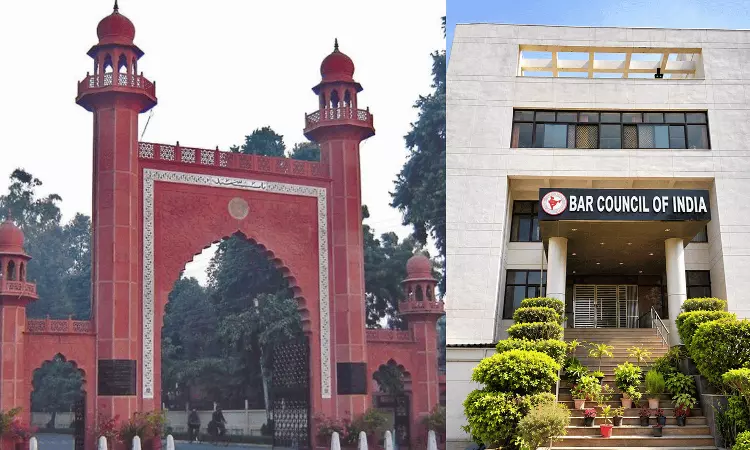
Graduates of the 2021-26 B.A. LL.B. (Hons.) batch of the Faculty of Law, Aligarh Muslim University (AMU), have written to the Bar Council of India (BCI) urging immediate processing of their pending applications for enrolment as advocates before the concerned State Bar Councils.
In a collective representation (dated November 12), addressed to BCI Chairman Manan Kumar Mishra and Secretary Srimanto Sen, the graduates have alleged that several applications submitted in August 2026 have remained pending for over two months despite completion of the requisite formalities.
They attributed the delay to administrative and regulatory issues between the BCI and AMU, particularly concerning the University's recognition status and alleged non-payment of inspection or other requisite fees.
Contending that their professional careers cannot be held hostage to a dispute between two institutions, the graduates have urged the BCI and the concerned State Bar Councils to decide their applications individually and without further delay.


"The professional future of hundreds of law graduates cannot be held hostage to an administrative, financial or regulatory dispute between two institutions," the representation states.
The graduates claim that they had successfully completed the five-year integrated law course after fulfilling all academic requirements and subsequently submitted individual applications for enrolment, including before the Bar Council of Delhi, along with the requisite documents and certificates.
Several of them have also cleared the All India Bar Examination conducted in June 2026.
However, they alleged that no decision had been taken on their applications, nor had any individual deficiency been communicated to them or any order passed explaining the legal basis for withholding their enrolment.
The representation argues that the affected graduates are neither parties to the dispute between the BCI and AMU nor responsible for any alleged institutional non-compliance, financial default or administrative lapse attributed to the University.
To support their demand, the graduates have relied upon the Karnataka High Court's judgment in Shiva Shankara S. and Others v. Karnataka State Bar Council 2001 wherein the HC had examined the refusal of enrolment to law graduates of the University Law College, Bangalore, on the ground that its five-year law course had not separately obtained approval or recognition from the BCI.
The representation points out that the High Court distinguished between a college affiliated to a University and a University Law Department forming an integral part of the University itself.
It states that the Court held the orders refusing enrolment to be "wholly without authority or jurisdiction" and contrary to the Advocates Act, 1961 and the BCI Rules, and accordingly quashed them.
The graduates have also relied upon the Full Bench judgment of the Madras High Court in P. Raji v. The Secretary, Bar Council of Tamil Nadu & Puducherry 2018 which dealt specifically with enrolment applications being kept pending by a State Bar Council.
Referring to the judgment, they submitted that wrongful denial of enrolment, or even delay in deciding an application, causes immense prejudice to an applicant.
The representation argues that the Full Bench recognized that such delay affects the right to equality and the right to practise a profession of choice under Article 19(1)(g) of the Constitution. It also noted that an advocate's seniority is determined with reference to the date of enrolment under Section 17(3) of the Advocates Act.
The representation further highlights the Full Bench's observation that the Enrolment Committee must decide applications with utmost expedition and, where it proposes to refuse an application, refer the matter to the BCI along with the grounds supporting the proposed refusal.
The graduates contend that keeping their applications pending without identifying individual deficiencies or passing reasoned decisions is contrary to these principles.
The representation also refers to the Supreme Court's judgment in Stuti Sharma v. Manav Bharti University & Others.
The case concerned a student who had completed her B.A. LL.B. course but could not obtain her remaining marksheets and degree due to discrepancies in the University's admission disclosure records. The University had admitted that the omission of her name was attributable to a clerical error committed by its previous administration.
The Supreme Court allowed the appeal and directed the University to issue the remaining marksheets, degree and other relevant documents within four weeks.
Relying on the principle that students cannot be made to suffer for institutional errors or omissions over which they have no control, the AMU graduates argued that they too cannot be penalised for alleged administrative or regulatory non-compliance between the University and the BCI.
They have additionally referred to the Rajasthan High Court's judgment in Surendra Khinchi v. Bar Council of Rajasthan 2026 which dealt with enrolment applications kept pending on account of Bar Council elections.
The Court directed the Bar Council of Rajasthan to dispose of all pending enrolment applications, recognising the impact of such delays on applicants' right to livelihood.
The graduates have referred to Sections 6(1)(a), 17, 24, 25 and 26 of the Advocates Act, 1961, arguing that the statutory framework does not contemplate indefinite pendency of enrolment applications without a decision.
They have also referred to Sections 7(1)(g), (h) and (i), which empower the BCI to exercise supervision over State Bar Councils, promote legal education, prescribe standards and recognise Universities whose law degrees qualify for enrolment.
The representation further referred to Articles 14 and 19(1)(g) of the Constitution to argue that unexplained administrative inaction deprives eligible graduates of a fair opportunity to pursue their chosen profession.
The graduates have called upon the BCI and the concerned State Bar Councils to immediately process all pending applications and individually determine the eligibility of each applicant.
They have specifically sought disclosure of the recognition or approval status of AMU's Faculty of Law applicable to the 2026 academic batch and the period during which the graduates pursued their course.
If any legal impediment is perceived, they have demanded that the precise statutory provision, factual basis and order relied upon be communicated to the concerned applicant, with an opportunity to respond, followed by a reasoned decision.
The representation ends by stating that in the event of continued inaction, the graduates would approach the High Court under Article 226 of the Constitution, seeking appropriate writs, including a writ of mandamus for time-bound disposal of their enrolment applications.


