



- Home
- /
- News Updates
- /
- Chennai Court Dismisses PMK Founder...
Chennai Court Dismisses PMK Founder Ramadoss' Plea To Freeze Mango Symbol For Upcoming Election, Gives Liberty To Approach ECI
Upasana Sajeev
27 March 2026 11:00 AM IST
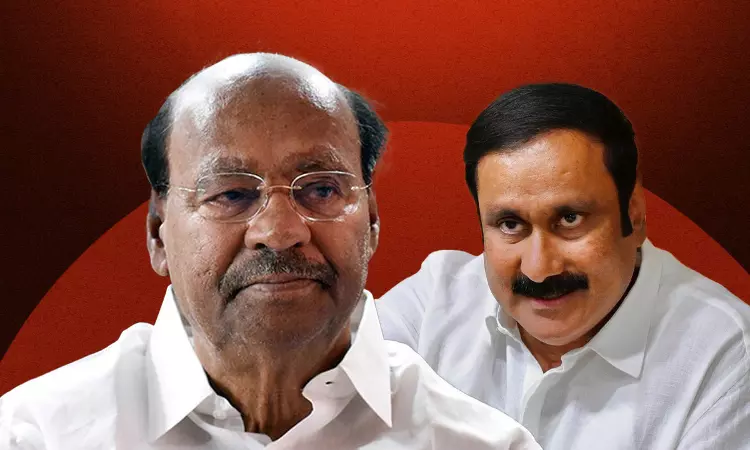
The Chennai City Civil Court, on Thursday, dismissed an application filed by Pattali Makkal Katchi (PMK) founder Dr S Ramadoss, seeking direction to the Election Commission of India to freeze the “Mango” symbol for the upcoming assembly elections in the State. Judge M Dharmaprabhu dismissed two interim applications filed by the PMK founder seeking to freeze the symbol and...
This is a premium content
Available exclusively to
Our subscribers
Subscribe Premium 
INR 1099+GST
Your support helps us to bring you more content at
an affordable subscription scheme !!!
All payment options available
The Chennai City Civil Court, on Thursday, dismissed an application filed by Pattali Makkal Katchi (PMK) founder Dr S Ramadoss, seeking direction to the Election Commission of India to freeze the “Mango” symbol for the upcoming assembly elections in the State.
Judge M Dharmaprabhu dismissed two interim applications filed by the PMK founder seeking to freeze the symbol and challenging the order of the ECI allotting the symbol to Anbumani faction.
It may be noted that in February, Ramadoss had approached the Madras High Court seeking to quash an earlier communication sent by ECI to Anbumani informing that the party has been allotted “Mango” symbol for the upcoming 2026 elections. He also called upon the ECI to issue a fresh communication to Ramadoss' address.
In his second plea, Ramadoss sought directions to the ECI to freeze the party's "Mango" symbol for the upcoming assembly elections in view of the pending disputes regarding the party's President position.
The High Court dismissed both the petitions, directing the parties to work out their remedies before the civil court.
Though Ramadoss approached the Supreme Court against this order, the Supreme Court agreed with the view taken by the High Court and directed the parties to approach the Civil court which could decide into the party rivalry. Following this, the civil court decided the issue.
The court noted that the election process had already commenced in the State, schedule for polling had been fixed and in certain constituencies, the stage of scrutiny had also been completed. The court noted that once the process of election had begun, the courts should exercise extreme circumspection and refrain from passing orders which may interfere, interrupt, or stall the electoral process.
The court noted that a temporary injunction, under Order XXXIX Rules 1 and 2 could be granted only when there exists a prima facie case, when there is a balance of convenience and when there was a likelihood of irreparable injury.
The court noted that Ramadoss' entire claim was based on the assertion that the founder has assumed office of the President of the Party by virtue of resolutions allegedly passed by certain committees, including Special Administrative Committee. However, the court noted that the very existence of the authority was disputed by the Ramadoss faction and it was argued that the bye laws of the party does not recognise any such body. The court noted that such rival claims and disputed questions of fact could not be adjudicated at interlocutory stage.
The court also noted that Ramadoss had not filed any document to show that there was any General Body Meeting through which he was elected as the party president.
The court further noted that if the relief sought for by Ramadoss is granted, it would have the effect of restraining or altering the allotment of an electoral symbol and would inevitably impinge upon the ongoing election process.
Thus, noting that no prima facie case has been made out, the court dismissed the interim applications filed by Ramadoss.
“In view of the foregoing discussion, this Court is of the considered opinion that the Plaintiff has failed to satisfy the prima facie case, the balance of convenience, and irreparable injury would be caused to him if the reliefs sought are declined at this stage. While arriving at such a decision, this Court also takes note of the fact that the Plaintiff, in these petitions, seek for freezing of the 'Symbol' and staying of the allotment of the 'Symbol' to the Plaintiff's Party himself. On the contrary, any interference at this juncture would have the effect of disrupting the ongoing election process, which this Court is not inclined to do,” the court said.
The court, however, gave liberty to Ramadoss to approach the Election Commission with an appropriate application, as permissible under law.
Case Title: Pattali Makkal Katchi v. The Election Commission of India
Case No: I. A. No. 11 of 2026 and I. A. No. 12 of 2026 in O. S. No. 664 of 2026

Upasana Sajeev
Upasana Sajeev is a Principal Correspondent with LiveLaw, covering Madras High Court

