



- Home
- /
- News Updates
- /
- Strengthen ADR Framework To Realise...
Strengthen ADR Framework To Realise Aspirations Of India-UK FTA, Ensure Level Playing Field For All Entities: CJI Surya Kant
LIVELAW NEWS NETWORK
11 Jun 2026 10:14 AM IST
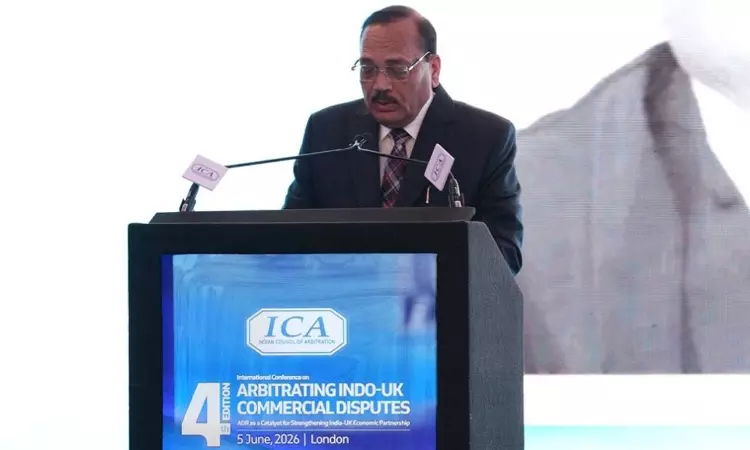
Chief Justice of India Justice Surya Kant on Friday stressed the need to strengthen the Alternate Dispute Resolution (ADR) framework to realise the aspirations of the India-United Kingdom Free Trade Agreement (FTA), stating that trade agreements alone cannot sustain commercial partnerships without a robust dispute resolution architecture.Speaking at the 4th Edition of the International...
This is a premium content
Available exclusively to
Our subscribers
Subscribe Premium 
INR 1099+GST
Your support helps us to bring you more content at
an affordable subscription scheme !!!
All payment options available
Chief Justice of India Justice Surya Kant on Friday stressed the need to strengthen the Alternate Dispute Resolution (ADR) framework to realise the aspirations of the India-United Kingdom Free Trade Agreement (FTA), stating that trade agreements alone cannot sustain commercial partnerships without a robust dispute resolution architecture.
Speaking at the 4th Edition of the International Conference on "Arbitrating Indo-UK Commercial Disputes" in London, Justice Surya Kant observed that the India-UK FTA, concluded last year, is expected to increase bilateral trade between the two countries by an estimated USD 34 billion annually in the near future.
The conference, organised by the Indian Council of Arbitration (ICA), was held on the theme "ADR as a Catalyst for Strengthening the India–UK Economic Partnership."
Addressing the gathering, Justice Surya Kant said, "We need to strengthen the institutional arbitration that are required to ensure that party autonomy remains a guarantee of procedural fairness rather than a source of procedural contestation."
Referring to the India-UK FTA, the Chief Justice remarked that while the agreement reflects an aspiration of extraordinary ambition, such ambitions are ultimately realised through commercial contracts and effective dispute resolution mechanisms.
"But ambitions are realized in contracts, not in communiqués. The Indo-UK economic partnership cannot be strengthened by trade agreements, tariff schedules, and investment announcements alone. It also needs an ADR architecture that converts commercial confidence into day-to-day practice," he said.
Justice Surya Kant emphasised that commercial corridors are strengthened when businesses are assured that, in the event of disputes, they will not be priced out, delayed out, or forced into processes over which they have little control.
Highlighting the evolving nature of Indo-UK trade, he noted that future commercial growth would increasingly be driven by pharmaceutical suppliers, fintech firms, clean energy businesses, digital platforms, and mid-market manufacturers rather than large conglomerates alone.
"If our ADR mechanisms work only for disputes large enough to justify high fee or large legal teams, that might fail the very commercial partnership that are meant to support. We must, therefore, introspect how to ensure equal level playing field for all," he said.
Advocating informed neutrality in arbitration, Justice Surya Kant proposed the establishment of a joint Indo-UK arbitrator accreditation and cross-training programme to create a pool of practitioners familiar with both legal ecosystems.
He also suggested developing a swift dispute resolution protocol for technology licensing disputes, fintech partnership breakdowns, and similar commercial disagreements. According to him, such a framework should be acceptable and affordable to all stakeholders and should include capped fees, a primarily documentary procedure, online hearings where appropriate, a short mediation window, and a defined timeline for final determination.
The Chief Justice further underscored the importance of integrating arbitration and mediation through well-designed hybrid protocols. Noting that many Indo-UK disputes arise within continuing commercial relationships such as joint ventures, distribution networks, technology partnerships, and infrastructure contracts, he observed that preserving commercial relationships is often more valuable than securing a winning award.
Referring to India's Mediation Act, 2023 and the growing mediation culture in the United Kingdom, Justice Surya Kant said that both jurisdictions possess a strong foundation for developing effective hybrid dispute resolution mechanisms, while emphasising the need for safeguards relating to confidentiality and impartiality.
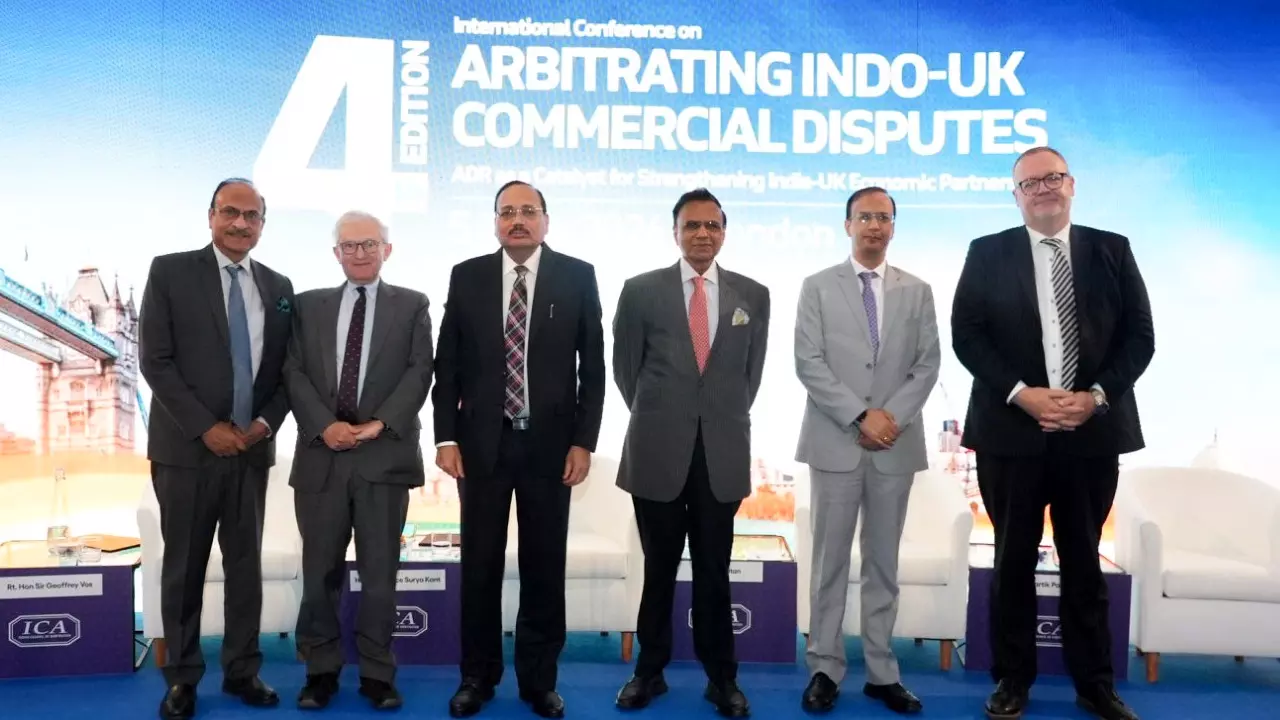
Delivering the keynote address, Rt. Hon. Sir Geoffrey Vos, Master of the Rolls and Head of Civil Justice of England and Wales, spoke about the evolving role of technology and artificial intelligence in dispute resolution and highlighted the importance of maintaining trust, fairness, and efficiency within legal systems.
Mr. Kartik Pande, Deputy High Commissioner of India to United Kingdom, stated that the Indian Government remains fully committed to promoting ADR for faster resolution of disputes.
Mr. Brett Dixon, Vice President, The Law Society of England and Wales, emphasised the significance of legal cooperation, institutional engagement, and effective dispute resolution mechanisms in strengthening business confidence and commercial partnerships.
Dr. NG Khaitan, President, ICA and Senior Partner, Khaitan & Co, said that India has emerged as one of the safest destinations for business and stressed the importance of arbitration in ensuring expeditious resolution of commercial disputes. He also noted that judgments of Indian courts are cited across the world.
Mr. Arun Chawla, Director General, ICA, described arbitration as a "silent infrastructure of growth" and observed that both India and the United Kingdom are investing in strengthening their arbitration systems.
The Indian Council of Arbitration (ICA), established in 1965 by the Government of India and FICCI, is one of India's leading arbitral institutions and works towards the promotion and development of arbitration, conciliation, mediation, and other forms of alternative dispute resolution.
Tags


