



- Home
- /
- News Updates
- /
- DSLSA Launches Legal Empowerment...
DSLSA Launches Legal Empowerment Initiatives Including PLV Handbook, Health-Based Outreach & Victim Facilitation Centres
LIVELAW NEWS NETWORK
24 March 2026 5:38 PM IST
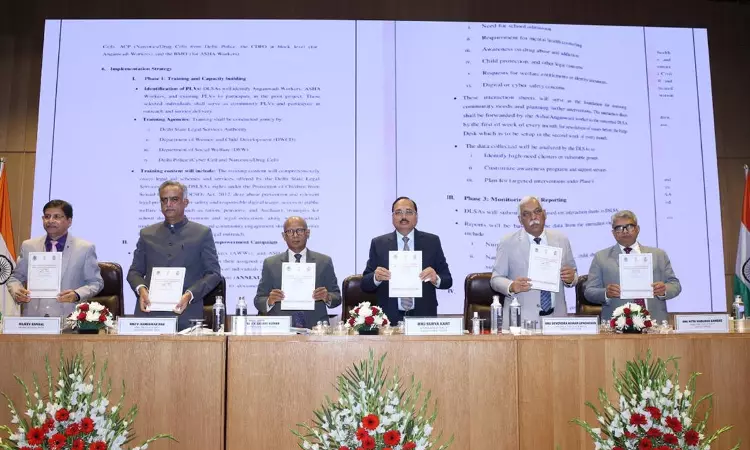
The Delhi State Legal Services Authority (DSLSA), on 23rd March 2026, launched a series of transformative initiatives at the Auditorium, S–Block, High Court of Delhi, New Delhi.The initiatives were unveiled under the guidance of Mr. Justice Surya Kant, Chief Justice of India & Patron-in-Chief, NALSA, in the presence of Mr. Justice P. V. Sanjay Kumar, Judge, Supreme Court of India;...
This is a premium content
Available exclusively to
Our subscribers
Subscribe Premium 
INR 1099+GST
Your support helps us to bring you more content at
an affordable subscription scheme !!!
All payment options available
The Delhi State Legal Services Authority (DSLSA), on 23rd March 2026, launched a series of transformative initiatives at the Auditorium, S–Block, High Court of Delhi, New Delhi.
The initiatives were unveiled under the guidance of Mr. Justice Surya Kant, Chief Justice of India & Patron-in-Chief, NALSA, in the presence of Mr. Justice P. V. Sanjay Kumar, Judge, Supreme Court of India; Mr. Justice Devendra Kumar Upadhyaya, Chief Justice, High Court of Delhi & Patron-in-Chief, DSLSA; Mr. Justice V. Kameswar Rao, Judge, High Court of Delhi & Executive Chairman, DSLSA; Mr. Justice Nitin Wasudeo Sambre, Judge, High Court of Delhi; Mr. Chetan Sharma, Additional Solicitor General of India; and Mr. N. Hariharan, President, Delhi High Court Bar Association.
The event was further attended by the Registrar General, High Court of Delhi; Registrar (Vigilance), High Court of Delhi; Principal District & Sessions Judges/Chairpersons of DLSAs and other judicial officers of the Delhi Judiciary; Member Secretary and other officers of the National Legal Services Authority; Member Secretary, DSLSA, along with Secretaries of DSLSA and DLSAs; officials from the Departments of Health and Family Welfare and Women and Child Development; as well as ASHA and Anganwadi workers who are to be trained as Para Legal Volunteers.
The inaugural ceremony commenced with a welcome address by Mr. Justice V. Kameswar Rao, followed by the keynote address by Mr. Justice Devendra Kumar Upadhyaya, who emphasized the importance of these initiatives in the justice delivery system. Mr. Justice Surya Kant delivered the presidential address, highlighting the vision of inclusive and accessible justice.
Handbook–cum–Field Diary for Para Legal Volunteers – 2026
DSLSA unveiled a comprehensive PLV Handbook serving as a practical guide for community-level legal facilitation. It covers the structure of legal services institutions (NALSA, SLSA, DLSA), eligibility for free legal aid, and the role of PLVs in legal awareness, FIR registration, victim support, arrest rights, and access to compensation.
The handbook simplifies constitutional rights, criminal and civil laws, and rights-based legislations, including RTI, consumer protection, disability rights, transgender rights, matrimonial laws, and laws relating to offences against women and children. It also explains procedures such as FIR registration, cyber complaints, labour laws, and missing child laws through concise formats, flowcharts, and tables.
Scheme for Community Legal Empowerment through Health & Childcare Platforms
DSLSA also launched a pilot project integrating legal awareness with public health and childcare systems by training ASHA and Anganwadi workers as Para Legal Volunteers, leveraging their grassroots reach and trust. These PLVs will conduct door-to-door awareness, identify vulnerable individuals and legal needs, and facilitate access to legal aid and welfare schemes.
The initiative incorporates structured data collection through interaction sheets for targeted, evidence-based outreach, supported by District-Level Coordination Committees for inter-departmental collaboration. It also includes legal awareness sessions, help desks at Primary Health Centres and Anganwadi Centres, and quarterly mega service camps providing integrated access to legal aid, healthcare, counselling, and welfare services.
Scheme for Legal Assistance & Free Medical Treatment to Victims through DLSA Facilitation Points
In a step towards victim-centric justice, DSLSA is set to establish Facilitation Centres in government hospitals to provide immediate legal aid alongside free medical treatment. These centres will ensure prompt medical care, legal assistance, counselling, support in documentation, and coordination among hospitals, police, and legal services authorities.
Special focus is placed on victims of offences against women and children, ensuring sensitive and timely assistance from the first point of contact.
The programme concluded with a vote of thanks by Mr. Rajeev Bansal, Member Secretary, DSLSA.
These initiatives mark a significant step towards advancing the constitutional mandate of equal access to justice. By integrating legal services with community and healthcare systems, DSLSA aims to develop a sustainable and citizen-centric model of legal empowerment.
Tags


