'If Not Punished, Gau Mata Will Go Extinct': Gujarat Court Awards Life Term To 3 In Cow-Slaughter Case; Cites Manusmriti, Vedas
Sparsh Upadhyay
29 Oct 2026 3:43 PM IST
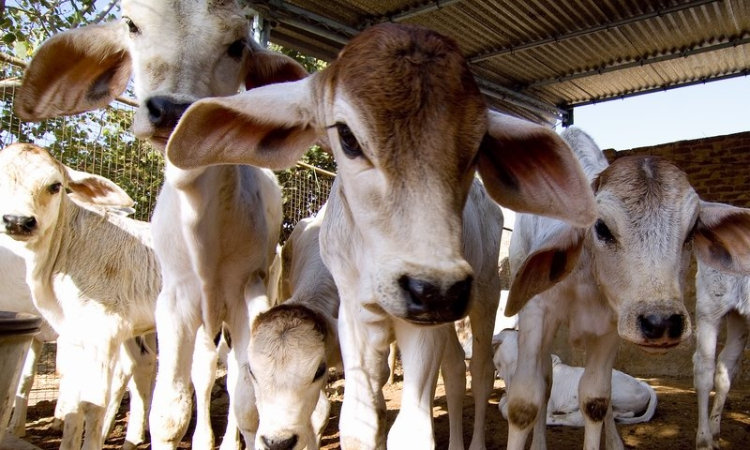
The court cited the Manusmriti and Vedas, noting that the Rigveda describes cows as 'Adhanya', meaning they should not be killed.
Observing that if such accused are not punished according to law, "Gau Mata will become extinct from the earth" over time, a Sessions Court in Gujarat's Kalol (Gandhinagar) on Monday sentenced 3 men to life imprisonment in a cow-slaughter case involving the seizure of 277 kg of beef.
The Court also imposed a ₹2 lakh fine on each convict. It awarded them 10 years of rigorous imprisonment and a fine of ₹1 lakh each for another offence under the Gujarat Animal Preservation Act, 1954. The sentences will run concurrently.
In his 76-page judgment written in Gujarati, Additional Sessions Judge Brijeshkumari Rameshwarsinh Rajput, discussed the religious and cultural significance of cows, referring to Hindu scriptures, including Manusmriti and the Vedas.
The Court observed that Manusmriti recognises the cow (cattle wealth/Godhan) not merely as an animal, but as a “pillar” of society and religion.
It further referred to the responsibility for protecting cattle and maintaining cows and also discussed the significance attributed to cows in Hindu religious texts.


The court also referred to the Rigveda, stating that the cow is described as “Adhanya”, meaning that it should not be killed. The judgment also reproduces the Sanskrit verse:
"त्वं माता सर्वदेवानां त्वं च यज्ञस्य कारणम्।
त्वं तीर्थं सर्वतीर्थानां नमस्तेऽस्तु सदानघे॥"
"You are the mother of all deities, and you are the source and cause of all sacred yajnas. You are the holiest of all sacred waters and pilgrimage sites. O ever-pure, innocent and auspicious one, I always bow to you"
Against this backdrop, the Court said that it was deciding the present case on merits, keeping in view the importance of cows.
Case in brief
As per the prosecution's case, the 3 accused slaughtered cows for financial gain and were involved in handling and selling the meat on August 22, 2024, at a house in Kalol taluka of Gandhinagar district.
The prosecution alleged that the accused had acted together to slaughter cows illegally and that approximately 277 kg of beef, valued at ₹55,400, had been recovered from the spot.
It was also alleged that from the spot, knives, an axe, a weighing scale, ropes and vehicles were seized and the total value of the such seized property was ₹3,61,540.
The prosecution alleged that the accused had assisted one another in the offence and that the meat was intended for sale.
On the other hand, it was the case of the 3 accused that the complaint had been lodged before the FSL report confirmed the meat was beef and that the seized tools and vehicles had not been properly examined.
Court's observations
The Court, however, found that the prosecution had proved the allegations against the three accused beyond a reasonable doubt by the reliable evidence of the complainant, members of the raiding team, independent panch witnesses and a veterinary doctor.
The Court noted that cow heads, legs, skin and other remains were found at the spot, where the accused were caught cutting cows and separating the meat.
It found that the recovery of 277 kg of meat and the FSL report were also consistent with the prosecution's case. The Court thus concluded that the evidence established that the cows had been slaughtered by them at the premises and that the meat was intended for sale
The Court's observation that "Gau Mata" appears to be extinct appears separately in the court's sentencing discussion, where it referred to the manner in which the cows' mouths, stomachs, legs, and skin had been cut.
"… despite being aware of the consequences, the accused brutally killed cows, which are like mothers, cut off their mouths, stomachs, legs and skins, and were caught red-handed while extracting 277 kg of beef from the cows and preparing to sell it. If such accused, who have cruelly cut the body parts of cows into pieces and separated them, are not punished in accordance with the law, then, over time, Gau Mata will become extinct from the earth", it said.
It added that it "appears necessary" to punish the accused in accordance with the punishment prescribed by law.
Though the counsel for the accused sought the benefit of probation, the court rejected the request, observing that the offences carried a sentence exceeding 10 years and that the accused could not be granted probation in the circumstances.
Therefore, the court sentenced Wasim, Mohammed Rafique and Ashfaq alias Salman to rigorous imprisonment for life under Section 8(2) of the 1954 Act as amended bhy Gujarat Gujarat Animal Preservation (Amendment) Act, 2017. Each was also fined ₹2 lakh.
The court further sentenced them to 10 years of rigorous imprisonment and imposed a fine of ₹1 lakh each under Section 8(4), in relation to Sections 6(a) and 6(b).
The court acquitted 2 other accused (Ghulam Moin Mustaq Ahmed Qureshi and Vitthal alias Bhupat Senma) as they were accorded the benefit of doubt.
The court found that the prosecution had not established the charges against them. In particular, it noted the absence of oral or documentary evidence showing that Vitthal was present at the scene when the incident occurred or that the alleged meat had been sold to the fifth accused.
The first accused, Lalabhai Manilal Senma, had died. The court recorded that, had he been alive, the evidence would have established the case against him beyond reasonable doubt.