



- Home
- /
- News Updates
- /
- Internet Is Boundless, Judges Must...
Internet Is Boundless, Judges Must Be Equipped With Knowledge To Handle Evolving Cyber-Crime Landscape: Justice Moushumi Bhattacharya
Malavika Prasad
3 May 2026 5:57 PM IST
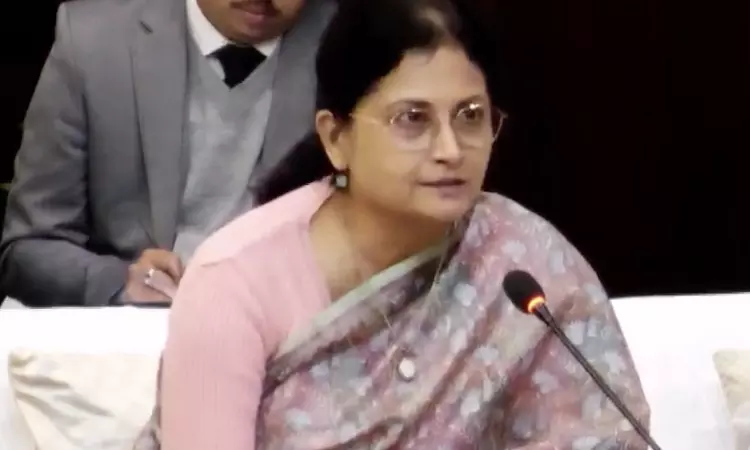
Internet has boundless borders and judges must be equipped with the knowledge to handle the evolving landscape of cyber crime threats, including digital arrests, hackling, ransomware threats, said Telangana High Court judge Justice Moushumi Bhattacharya on Saturday (May 2)Justice Bhattacharya was speaking at a session which was a part of Sikkim High Court's 'National Conclave on Technology...
This is a premium content
Available exclusively to
Our subscribers
Subscribe Premium 
INR 1099+GST
Your support helps us to bring you more content at
an affordable subscription scheme !!!
All payment options available
Internet has boundless borders and judges must be equipped with the knowledge to handle the evolving landscape of cyber crime threats, including digital arrests, hackling, ransomware threats, said Telangana High Court judge Justice Moushumi Bhattacharya on Saturday (May 2)
Justice Bhattacharya was speaking at a session which was a part of Sikkim High Court's 'National Conclave on Technology and Judicial Education'. The topic for the session pertained to 'Curriculum Globalization and Transnational Law'
The statement came in response to a question posed by Meera Furtado, General Secretary CLEA and Head of Business and Humanities, International Study Centre, University of Sussex, who was moderating the session along with Bombay High Court judge Justice Somasekhar Sundaresan.
Furtado asked that as cross border disputes increase how can judicial training help judges handle issues like commerce, environment law, cyber crime while staying grounded in domestic law and whether there is scope to tap into synergies in common wealth jurisdiction.
On the topic of handling cyber crime cases, Justice Bhattacharya said:
"In relation to cyber crime, we are all aware of these trans border, boundless internet's borders where the crimes are committed. Forget about Jamtara, forget about localised hotspots of cyber crime. But what about cyber crimes, identity theft, hacking, ransom ware threats which is giving to potential evolving threat landscape where we have to be equipped with that knowledge of how to handle these kinds of cyber arrest, digital arrest, how to deal with this. If we look at Budapest Treaty on Cyber Crime. The law commission took it up in 2019 as first comprehensive cyber crime perspective...We still find that it's a fragmented world when it comes to enforcement of these...for example look at digital evidence standards, authentication and admission of digital of digital records. If you have a criminal case, are there any uniform norms as to whether you will admit a certain digital evidence. Or how to interpret cyber crime treaties, data convention norms, theft of data. These are very pressing issues".
With respect to Commerce, Justice Bhattacharya said the issues therein pertain to contract breaches, IP violations, Regulatory conflicts, Intra group transfer policy disputes, Trade related disputes.
She said, "Judicial gap, what I have felt in my court, is we have maybe a basic awareness that we are global citizens but we also have a structured statute to follow. We also don't really have the time band width where we have a knowledge base of what for example WTO says on bilateral treaty disputes, emerging digital trade norms...Judicial curriculum when it comes to commerce we should look at conflicts of law and private international law".
Giving an example, the judge said, that when a parent leaves a foreign country and comes to India by reason of divorce or separation and the child wants to be taken back by the other parent who is in the USA and in such a situation if a court keeps passing orders then what happens to the enforcement of such orders.
"What about the extent of which we can pass orders and ensure that those orders are implemented? At best we can say, go to the local jurisdictional court and file a guardian and wards OP and seek relief of custody. Even if that is done, what is the power of the court? Particularly in a habeas corpus writ petition. Where the jurisdiction is extremely limited and we cant go to the extent of deciding rights of custody. I think that's a gap or a need where judges should be given some sort of a training in private international law, a structured training on treaty obligations...We all have a loose idea that India is not part of the Hague Convention but then because India is not part of it, what is the advantage and fall out of that, as judges of courts sitting in India," the judge said.
With respect to the arena of Environment the judge said that we are all very alive to issues such as river contamination, noxious gasses and organic pollutants. The judge said that while states have artificial boundaries, however questioned if we can be control these pollutants from transgressing the borders and entering the neighbouring state.
The judge pondered that if a neighbouring state files a complaint against the state from where the pollutant originated, then what are the laws which can be applied to prevent or bring that offending state into some sort of an obligation.
The judge further said:
"I looked at some international treaties, where the words used are 'as appropriate', 'to the extent possible', 'it is an endeavour to prevent trans-border environmental harm'. Basically these treaties are rendered toothless. Because the moment you say 'endeavour, to the extent possible' you are basically not bringing offending state down to its knees and ensuring obligation or way of imposing penalty. I think this is the curriculum which is calling for some sort of structured training and teaching to judges where as soon as problem comes before us we have at least an awareness, or at least we can ask the lawyers in front of us to show us a treaty, act or norm and assist the court. Even to ask those questions to the lawyers you need to be aware of the data base or knowledge base which is available which we can tap into".
In her opening remarks the judge in her address spoke about why we are confronted with this phenomenon-cross border legal challenges. This is so, the judge said, is because globalisation has restructured international legal borders in two fundamental ways–through proliferation of specialised international legal regimes in trade, human rights, and environment and through rising authority of intergovernmental organizations and transnational companies.
"For judiciary it is not an abstract phenomenon anymore but something which we have to look at in the enforcement of international contracts or arbitration. But in also in very personal issues. Like a child who has been kept in a foreign jurisdiction with the father and the mother has travelled to India and she is not able to get back her child. What do we do in those cases? comity of courts. Those are the questions we have to see," the judge added.
Tags

Malavika Prasad
Malavika Prasad is a Desk Editor with LiveLaw

