



- Home
- /
- News Updates
- /
- Justice Vikram Nath Inaugurates 3rd...
Justice Vikram Nath Inaugurates 3rd Zonal Workshop On Role Of Law Students In Advancing Social Justice
LIVELAW NEWS NETWORK
1 Jun 2026 10:43 AM IST
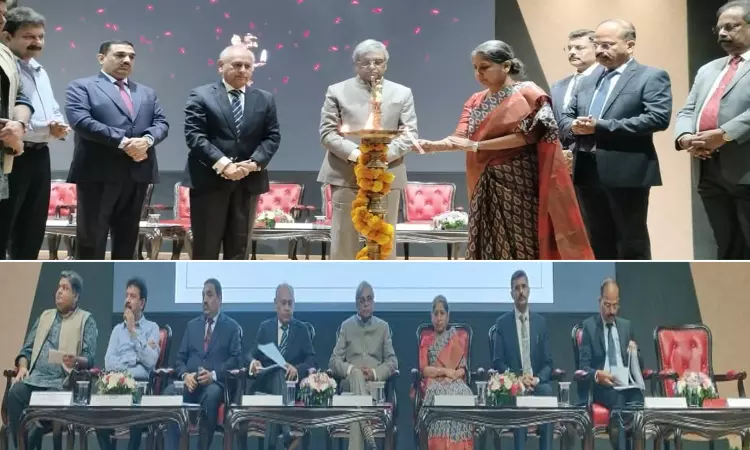
The Karnataka State Legal Services Authority (KSLSA) and Karnataka State Law University, in association with M.S. Ramaiah College of Law, organised the 3rd Zonal Workshop on the theme “From Classroom to Courtroom: Law Students as Catalysts for Social Justice” on May 31, 2026, at the M.S. Ramaiah College of Law Auditorium, MSRIT Campus, Mathikere, Bengaluru.The workshop focused on the role...
This is a premium content
Available exclusively to
Our subscribers
Subscribe Premium 
INR 1099+GST
Your support helps us to bring you more content at
an affordable subscription scheme !!!
All payment options available
The Karnataka State Legal Services Authority (KSLSA) and Karnataka State Law University, in association with M.S. Ramaiah College of Law, organised the 3rd Zonal Workshop on the theme “From Classroom to Courtroom: Law Students as Catalysts for Social Justice” on May 31, 2026, at the M.S. Ramaiah College of Law Auditorium, MSRIT Campus, Mathikere, Bengaluru.
The workshop focused on the role of law students and legal educational institutions in promoting access to justice and legal awareness through legal aid initiatives and outreach programmes. The programme also included technical sessions on legal services camps, legal aid clinics in law colleges, and the objectives of the Legal Services Authorities Act, 1987.
Justice Vikram Nath, Judge, Supreme Court of India and Executive Chairman, National Legal Services Authority (NALSA), inaugurated the workshop. Justice Vibhu Bakhru, Chief Justice, High Court of Karnataka and Patron-in-Chief, Karnataka State Legal Services Authority, presided over the programme.
Justice Anu Sivaraman, Judge, High Court of Karnataka and Executive Chairperson, Karnataka State Legal Services Authority, was present at the event. Other dignitaries included Sanjiv Pandey, Member Secretary, National Legal Services Authority; K.S. Bharath Kumar, Registrar General, High Court of Karnataka; H. Shashidhara Shetty, Member Secretary, KSLSA; Prof. (Dr.) C. Basavaraju, Vice Chancellor, Karnataka State Law University; M.R. Anandaram, Secretary, GEF (ENGG. & G.S), Director, RIM & RCL; and Prof. (Dr.) Uma Mahesh Satyanarayan, Principal, M.S. Ramaiah College of Law (Autonomous), Bengaluru.
In his introductory address, H. Shashidhara Shetty highlighted the importance of legal awareness and equal access to justice, particularly for rural and disadvantaged communities. He also emphasised the role of Legal Services Clinics established in law colleges under the Legal Services Authorities Act, 1987, where law students can participate in legal aid, awareness programmes and village outreach activities.
Delivering a special address, Justice Anu Sivaraman stated that the journey from classroom to courtroom is a transition from learning law to serving society. She highlighted that law students play a vital role in promoting social justice through legal aid, awareness programmes and community outreach activities. She further stressed that legal education should develop not only legal knowledge but also ethics, empathy, constitutional values and social responsibility. She also emphasised the importance of practical training, continuous learning and professional integrity, and appreciated the contribution of law students through Legal Services Clinics and KSLSA initiatives.
In his presidential address, Justice Vibhu Bakhru spoke about the objective of strengthening Legal Services Clinics in law colleges and encouraging law students to participate in legal service activities. He stressed that students should go beyond classroom learning and actively engage in legal awareness camps, village visits and community programmes to help people understand their rights and government schemes, particularly in rural and marginalised areas. He observed that justice is not confined to courts but is also achieved through the spread of legal awareness in society.
In his inaugural address, Justice Vikram Nath underscored the importance of legal education extending beyond classrooms and becoming a tool for justice, equality and social change. Referring to Article 39A of the Constitution and the Legal Services Authorities Act, 1987, he emphasised the need for free legal aid and equal access to justice for all. He also appreciated the efforts of KSLSA in organising legal awareness programmes and Legal Services Clinics in law colleges, which provide students with practical exposure through legal aid camps, village outreach and awareness activities. He stated that legal education should develop socially responsible and ethical professionals who use law to serve people and promote justice, particularly for the poor and marginalised.
According to the report, around 1,300 participants, including law students and faculty coordinators from 97 law colleges in the Bengaluru zone, attended the workshop. Technical sessions were subsequently conducted by resource persons on various subjects.
Tags


