



- Home
- /
- News Updates
- /
- 'We Have Ethical Duty Not To Engage...
'We Have Ethical Duty Not To Engage In Certain Conduct': Barrister Dr Venkat Iyer Speaks At Event On 'Legal Regulation Of Hate Speech'
K. Salma Jennath
13 March 2026 6:06 PM IST
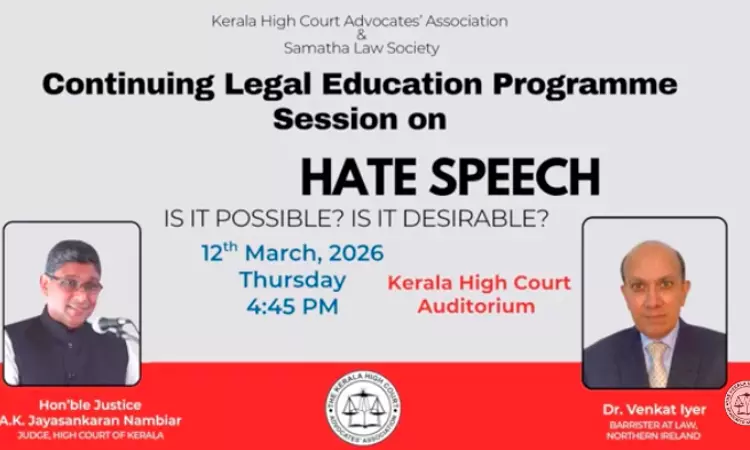
Dr. Venkat Iyer, Barrister in Ireland, had the occasion to speak on the topic 'Legal Regulation of Hate Speech: Is It Possible? Is It Desirable?' in an event, organized by the Kerala High Court Advocates' Association (KHCAA) and Samatha Law Society. The event was held at the High Court auditorium as part of the Continuing Legal Education Programme.Dr. Justice A.K. Jayasankaran Nambiar gave...
This is a premium content
Available exclusively to
Our subscribers
Subscribe Premium 
INR 1099+GST
Your support helps us to bring you more content at
an affordable subscription scheme !!!
All payment options available
Dr. Venkat Iyer, Barrister in Ireland, had the occasion to speak on the topic 'Legal Regulation of Hate Speech: Is It Possible? Is It Desirable?' in an event, organized by the Kerala High Court Advocates' Association (KHCAA) and Samatha Law Society. The event was held at the High Court auditorium as part of the Continuing Legal Education Programme.
Dr. Justice A.K. Jayasankaran Nambiar gave an insightful introductory remark on the topic, touching upon the conflict between Constitutional law and Criminal law on the subject of restriction on free speech.
Dr. Venkat Iyer began his speech by making clear his stance on regulation of 'hate' speech. According to him, it is possible as well as desirable to regulate hate speech up to a certain point. He pointed out that though there exists no concrete definition of the term, there is a need for a better understanding of the same, especially in divided societies.
“I recognise that this topic has particular resonance in deeply divided societies, including societies like India. Therefore, there is a need for a better understanding of what we actually mean by hate speech and therefore, to address possible remedies, we should, in particular, avoid knee-jerk reactions. Now, you might find an incident which bothers you which would be one of hate being mongered. That should not make you adopt a knee-jerk reaction and do something that will seriously harm the landscape of free speech.”
Dr. Iyer then went on to paint a picture of what can and what may not constitute as 'hate speech'. He took the example of someone wearing the offensive robes of the Klu Klux Klan, glorifying the holocaust, leaving a pig carcass or a cow carcass in front of a mosque or Hindu temple, the burning of the flag, etc. He felt was that the concept is not just limited to words but includes actions, attires or symbols, glorification of certain events, burning of objects, etc.
He emphasized that each of us have an ethical duty not to engage in certain type of conduct even if these actions are not prohibited by law. This ethical duty is particular important in the issue of hate speech.
“Each one of us has an ethical duty to not to engage in certain conduct. Even if that conduct is allowed by the law or is not prohibited by the law. Ethical aspect is to be emphasised, particularly, in relation to hate speech. There is also another advantage, which is that if you say that it is unethical to cause offense needlessly, then you are also sending a very good signal to society and that signal is all of us need to behave ethically. If we do, then the problem will be diminished in very significant volumes.”
Dr. Iyer also pointed out a solution to address the issue of hate speech and encourage ethical behaviour by 'naming and shaming'.
“One way of encouraging that trend of behaving ethically is this tactic naming and shaming. There are many countries where there is no law which prohibits somebody from saying something but there is a tremendous amount of shame attached to such conduct. When that happens on a scale throughout society, it will take a long time in countries like India, but when it happens on a long scale or volume, then automatically, may be a generation or two down the line, will restrain itself from causing offence needlessly and gratuitously. Causing offence gratuitously is something totally discouraged.”
He then expressed his opinion that there may even be certain occasions that warrant necessity to cause offence to someone else but not “willy nilly” or “gratuitously”. He said that speech should be prohibited only when there is serious and identifiable harm. He highlighted that the touchstone of free speech in a democracy happens not by curbing speech but by permitting others to challenge it.
“I am not in favour of marginalising any group or I am not favour of assaulting the dignity of any group in society, willy nilly. But sometimes, I may say go something which some persons might consider to be an affront to their dignity. Whether or not what I say is reasonable or not, I should be allowed to say it but with an important caveat: Others should be allowed to challenge me. That is the way we would advance freedom and democracy. If somebody challenges me, I'll become even more aware of my responsibility to defend what I've said reasonably.”
He also touched upon the issue of 'cancel culture', which he opined, was fast becoming a problematic attitude in many parts of the world, though not as much in India.
He concluded his speech by highlighting the role and responsibility of the media and the judiciary in advancing and promoting free speech.
“If you do not have a free and fair media, you can kiss goodbye to freedom and democracy. Media should be allowed, for example, to report a speech that may be uncomfortable to many people on grounds of hate or whatever. But, of course, media have to be responsible as well. So there are certain occasions where media will have to paraphrase what a particularly provocative politician has said but informing the public that something of this nature has been said, which is not healthy for our society… If you do not have a competent, well-resourced, non-corrupt judiciary, again, you can kiss goodbye to any concept of democracy or rule of law. You can have a wonderful Constitution, but if the judiciary doesn't deliver, there is no hope at all.”
Justice Jayasankaran Nambiar provided a bird's eye view of how the legal landscape in India developed in terms of free speech and its restrictions. He mentioned that there is a rise of intolerance in society and hate speech is just another manifestation of that intolerance in the society. He said that though there is no definition of 'hate speech' in the Constitution, it speaks about the fundamental right to speech and expression as well as the reasonable restrictions that can be imposed on this right.
The judge referred to two cases of the Apex Court in Shaheen Abdulla v. Union of India & Ors. and Ashwini Upadhyay v. Union of India wherein the State government concerned was directed to register suo motu FIRs and proceed against those persons whose speech had the effect of bringing about a marginalisation in society.
He remarked that these judicial pronouncements reinforced the idea brought in by the Law Commission to curtail speech that marginsalised groups in the society:
“So, with that, you had a kind of judicial enforcement of that recommendations that were mentioned in Law Commission's report but in 2023, you also had two different things happening. One, the Constitutional Bench judgment in Kaushal Kishore and you also had the new set of criminal laws in our country, the IPC now came to be replaced with another penal code with a rather difficult name, the Bharatiya Nyaya Sanhita (BNS). The content was more or less the same but the suggestions of the Law Commission probably found expression in the new provisions of the BNS.”
Justice Nambiar then went on to give the audience an idea of the apparent conflict between Constitutional law and Criminal law that was created in 2023 with the Apex Court decision in Kaushal Kishore v. State of Uttar Pradesh and the introduction of the new penal law.
“So now you have the BNS, which contains these clauses which criminalise acts or speech, which has the propensity to bring about a marginalisation in society. But that's where the catch is. Because when you look at the judgment in Kausal Kishore, it says very clearly, you cannot add to the reasonable restrictions under 19(2) and then it went on to say something more important. The majority judgment. It said while you cannot add to the express restrictions in 19(2), you cannot bring in concepts like dignity of individual, etc. into the scope of the restrictions. In other words, you cannot say in the interest of protecting the dignity of an individual or a section of society, or a class or persons, reasonable restrictions can be imposed… After Kausal Kishore and the amended provisions of the BNS, you have a slight lack of sync between the Constitutional law on the one hand and the penal law on the other. And why this matters is because, when it comes to a conflict between the two, the Constitutional right must prevail. So, you cannot curtail a Constitutional right by a statutory provision even if it amounts to criminalising such speech.”
He remarked that the answer to the questions presented in the day's topic may lie in the dissenting view expressed by Justice Nagarathna in Kausal Kishore's case itself.
“Is it desirable to have a law against hate speech and even if it is desirable, is it possible, legally? I think the key to that question would lie in the partly dissenting judgment of Justice Nagarathna in Kausal Kishore itself. Because she devised a very innovative way of getting over the rigour of the majority judgment. What she said was very simple. She said that do not see these restrictions that you are imposing as reasonable restrictions on the Fundamental Right under Art. 19(1)(a). If you have speech that answers to the offences under the BNS, use it for the purposes of restricting or reducing the scope of ambit of Fundamental Right itself. In other words, don't see yourself as having an absolute Fundamental Right of speech and expression subject to reasonable restrictions. You don't have an absolute Fundamental Right, you have a Fundamental Right only to the extent that it does not offend the criminal provisions.”
Justice Nambiar stressed upon the need to balance Fundamental Duties and Fundamental Rights as well as the conflicting fundamental rights of two persons. He pointed out that in a country like India whose legal system is founded upon 'dharma' or duty, the chapter on Fundamental Duties was introduced in the Constitution at a much later point of time but time has come for us to give its due importance to the Fundamental Duties as well.
“I think the time has come for us to realise that you can't have a Fundamental Right divorced of your Fundamental Duties. Therefore, ultimately, it's a question of balancing your rights and duties. Think of it that way. If that is the understanding, if that is the idea that we can live with, then many things fall into place. Why? Because, dignity of an individual, which also has to be protected. After Puttaswamy, dignity has been read into Article 21. Whenever you make a speech that has the propensity to affect the dignity of another individual, what you are effectively saying is, here is my Fundamental Right under Article 19(1) coming into conflict with someone else's Fundamental Right under Article 21…Something like your jurisprudential argument of 'your freedom stops where my nose begins'.”
He concluded his speech by signifying the importance of self-regulation and internalization of constitutional concepts by every individual to unlock the key to effective regulation of hate speech. Only with the understanding that one's own rights are to be balanced with our own duties and the rights of others can a solution be found.
“Maybe the key to an effective regulation of hate speech lies in our internalisation of the idea that whatever freedoms our Constitution may have guaranteed to us, those freedoms come within an inherent restriction or inherent limitation based which corresponds to our Constitutional obligations to the fellow citizens…That understanding must come because of a self-regulation, because of an internalisation of constitutional concepts by every individual in our society. When you do that, you are also adhering to a very important principle in our Constitutional law, our Constitutional psyche, which is Constitutional morality. And I suspect that this is Constitutional morality that is seen under Article 19(2) as reasonable restriction that can be imposed on free speech in the interest of morality. When the Constitution says morality, it refers to Constitutional morality. That is also laid by the judgment in Puttaswamy and the Sabarimala judgment also. So, when you talk about restrictions on free speech, ultimately, it's a balancing of rights.”
Adv. Vinay V., Vice-President of KHCAA, gave the welcome speech and Adv. Peeyus A. Kottam, KHCAA President, delivered the President's address. Adv. Rekha Vasudevan, Secretary, Samatha Law Society proposed the vote of thanks.
Tags
K. Salma Jennath
Salma Jennath is a Principal Correspondent with LiveLaw, covering Kerala High Court

