Sultanpur Court Says Defamation Complaint By BJP Office-Bearer Against Rahul Gandhi May Have Been Politically Motivated
Sparsh Upadhyay
26 Oct 2026 7:13 PM IST
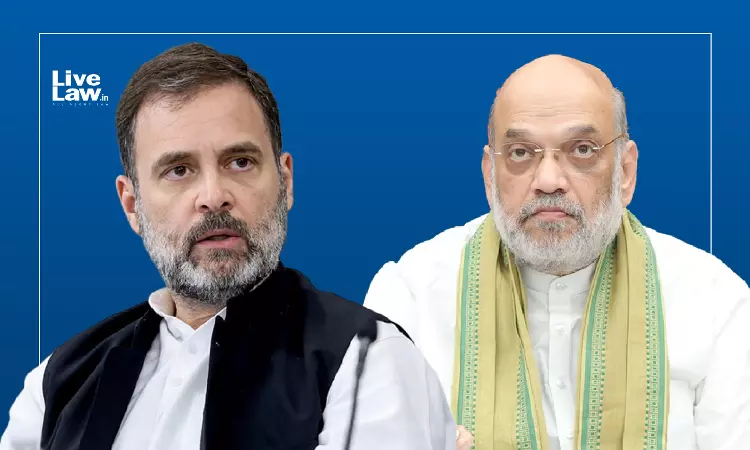
Court says complaint narrative appeared "prima facie suspicious, unrealistic and uncorroborated" and may have been politically motivated.
Acquitting Congress leader and Leader of Opposition in the Lok Sabha Rahul Gandhi in a criminal defamation case over his alleged 2018 remarks referring to then BJP president Amit Shah as a "murder accused", the MP/MLA court in Sultanpur district observed that the complaint appeared prima facie 'suspicious', 'unrealistic' and 'uncorroborated', and that it may have been instituted for political or other motives.
Additional Chief Judicial Magistrate Shubham Verma also found that the complainant Vijay Mishra, a BJP office-bearer, was not an "aggrieved person", at whose instance the defamation proceedings against Gandhi could be maintained.
In its 49-page judgment, the court observed that the complaint's narrative, when considered as a whole, appeared to have been brought merely for the purpose of instituting proceedings, by any means possible, which was contrary to the intent of the law.


The court observed thus:
"...the manner in which the facts/events have been described in the complaint prima facie appears to be suspicious, unrealistic and uncorroborated, and to indicate that the complaint has been instituted, with political or other motives, by any means possible, merely for the purpose of instituting the complaint, which is wholly contrary to the intent of the law".
The court made these observations after it examined the complainant's case and the circumstances in which the complaint was pursued.
Case in brief
The defamation case, filed by BJP Leader Vijay Mishra in 2018, accused Gandhi of making 'objectionable' comments against Shah at a press conference in Bengaluru. He had allegedly called Shah, the then BJP President, a "murder accused".
It was the complainant's case that Gandhi had attacked BJP president Amit Shah in a political rally ahead of the Karnataka election in 2018, by referring to Shah as a murder accused. Gandhi was accused of making the following statement.
"People in India forget that the president of BJP is a murder accused. That's the truth. The party that talks about honesty, decency, has a person who has been accused of murder as president".
Mishra alleged that the remarks were defamatory. However, Gandhi disputed the allegations as his stance was that his statement had been presented out of context.
Gandhi's reference was understood to be an accusation regarding the allegations that Mr Shah was involved in the extrajudicial killing of Sohrabuddin Sheik, a petty criminal, in 2005.
Sultanpur Court's observations
The court stated that the facts before it did not appear prima facie natural and suggested 2 possible explanations: either the complainant (Mishra, a BJP leader) was oversensitive, or the complaint had been instituted for political or other motives.
The judgment states thus:
"Either the complainant is of an overly sensitive nature, or the present complaint has been instituted out of political or other ulterior motives, as argued by the learned counsel for the opposite party".
The Court added that this conclusion is further reinforced by the statements made by the complainant and the witnesses during their oral examination/cross-examination, which revealed that the complainant has given interviews to the media and television channels regarding this case, which were broadcast nationwide, and that the matter has also been published in newspapers.
Furthermore, the court also examined the contention as to whether Gandhi's alleged remarks had lowered Mishra's reputation in the estimation of others.
It noted that the alleged imputation was primarily against Amit Shah and, at most, partly concerned the BJP. It noted that there was no direct or indirect imputation against Mishra (the complainant) personally.
Referring to the 4th Explanation to Section 499 of the Indian Penal Code, the court said an imputation harms a person's reputation only if it lowers that person's moral or intellectual character in the estimation of others.
In this regard, it noted that Mishra and all the witnesses examined in support of the complaint were BJP members. The complainant had neither examined any independent member of society nor specifically alleged that the remarks had lowered his reputation in the eyes of such persons.
The court also noted that although the complaint alleged that one party member humiliated another by showing him the video containing Gandhi's remarks, witnesses Ram Chandra Dubey and Anil Mishra, who allegedly watched the video with the complainant, did not claim to have felt humiliated.
"...there is a complete absence of evidence regarding the fact that the complainant's moral and intellectual character was lowered in the estimation of others", the court observed.
It also noted that the complainant and the witnesses examined are members of the same organisation/ BJP and hence, they stood on the same footing.
The court also rejected the argument that Mishra could maintain the complaint merely because he was a BJP office-bearer. It observed that the BJP had not authorized him to file the complaint on its behalf and he had not pleaded any such authorization.
The Court said that if it accepts this argument, it would mean every BJP office-bearer and member could institute proceedings over the alleged statement, resulting in 'innumerable' cases being filed.
In a society governed by the rule of law, the court observed, a legal position that gives rise to or supports multiple proceedings cannot be recognized by law or the courts.
It added that such an approach was particularly impermissible in criminal defamation proceedings, in view of the requirements under Section 199 of the Code of Criminal Procedure.
The court accordingly held that Mishra could not maintain the complaint simply as a member or office-bearer of the BJP, particularly when the alleged remarks were not directed at him personally.
In view of its findings, the court acquitted Gandhi of the charge.