



- Home
- /
- News Updates
- /
- 'I'd Rather Die Than Be Called A...
'I'd Rather Die Than Be Called A Coward Judge': UP Judge Claims Serious Cases Recalled From His Court To Benefit Mafia, Criminals
Sparsh Upadhyay
8 Sept 2026 8:14 AM IST
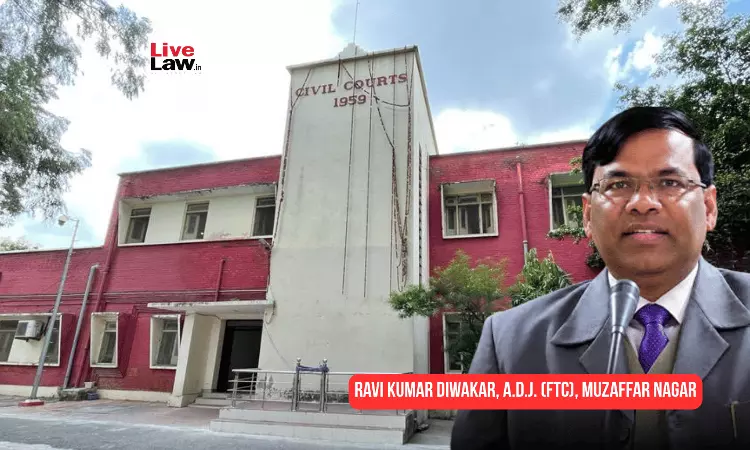
In a striking set of observations, UP Judge Ravi Kumar Diwakar on Monday (September 7) claimed that serious cases were recalled from his court to benefit mafia and criminals, as he said that he was "deeply hurt and saddened" by the conduct. He added that he would rather die than be called a "coward judge".The observations came in a judgment in which Judge Diwakar, Additional District and...
This is a premium content
Available exclusively to
Our subscribers
Subscribe Premium 
INR 1099+GST
Your support helps us to bring you more content at
an affordable subscription scheme !!!
All payment options available
In a striking set of observations, UP Judge Ravi Kumar Diwakar on Monday (September 7) claimed that serious cases were recalled from his court to benefit mafia and criminals, as he said that he was "deeply hurt and saddened" by the conduct. He added that he would rather die than be called a "coward judge".
The observations came in a judgment in which Judge Diwakar, Additional District and Sessions Judge, Muzaffarnagar, awarded the death penalty to one Nadeem for deliberately burning his wife (Shahzadi) alive. The court held that the manner in which Nadeem killed his wife was "extremely brutal and barbaric" and fell within the "rarest of rare" category.
The judge alleged that the reason behind the recall of case files was to "save mafias/gangsters/criminals". He said he knew the complete details of why it had happened but considered it inappropriate to disclose them at that point as he remarked that "there is also the dignity of the office".
It may be noted that last month as many as 97 pending cases involving murder and other serious offences were recalled from his court, days after he awarded 22 death sentences in 10 different cases over a four-month period.
More details here: 97 Murder, Serious Crime Cases Recalled From Muzaffarnagar Judge After 22 Death Sentences In 4 Months
'Deeply Hurt and Saddened'
In the 38-page judgment, which contains a substantial portion of the judge's observations on various issues, Judge Diwakar said he could not help but express his personal views.
He remarked that although a person may deceive the world, he cannot deceive his own conscience. He further said that when those who had behaved with him would look into their own conscience, they would never be able to forgive themselves.
The judge then alleged that such conduct of withdrawing cases from his court was intended to "save mafias/gangsters/criminals".
He added that following the withdrawal, a message was conveyed to him through "a mafia/gangster from the west". According to the judge, the message was that only the case files had initially been removed and that if he pursued the matter or made any comment, influence would be used to get his court changed or have him transferred out of the district because of "contacts at higher levels".
Judge Diwakar further stated that major mafias and strongmen in western Uttar Pradesh have caste and political protection and networks extending "quite high and far".
'I Would Rather Die Than Be Called A Coward Judge'
The judge said his parents had taught him from childhood to fear God and no other person.
He observed that if he became afraid of "bahubalis/mafias/criminals", it would be in conflict with the public's expectation that judges remain impartial, fearless and are able to discharge their judicial functions without fear. In a significant remark, he remarked thus:
"I would rather die than be called a coward judge. As long as I can follow my principles, I will continue in service; otherwise, I will resign".
He also asserted that as long as he occupied the judicial chair, the authority to take a decision/judgment "will be solely mine".
The judge went on to link judicial independence with the Rule of Law and democracy. He observed thus:
"For any democratic country, it is a serious crisis when judges are unable to administer justice due to the fear, pressure or influence of mafias/gangsters/criminals".
According to him, such a situation causes the social and legal system to collapse, allowing mafias, gangsters and criminals to become fearless while weaker and innocent persons become 'scapegoats'.
He warned that where mafia influence becomes dominant, the Rule of Law could be replaced by "जिसकी लाठी उसकी भैंस" (might is right), weakening the democratic foundations of the State.
He further observed that such an environment could discourage companies and foreign investors, adversely affecting economic development.
Judge Diwakar stressed that the poor and weak suffer when the system does not function honestly or according to law and rules. He stated thus:
"In the eyes of law, all persons are equal. The same law cannot be applied differently to two persons".
He questioned whether mafias, strongmen and criminals should effectively face a different legal regime from ordinary citizens. The judge further observed:
"Today, the world needs justice more than charity. In the absence of justice, freedom has no meaning".
He said people may not necessarily object to strict rules but object when there is no equality in justice, when justice is given to one person but not another.
On the merits of the case
While determining Nadeem's punishment, Judge Diwakar also made observations on love and the relationship between husband and wife.
The judge referred to the story of Adam and Eve, noting that they were husband and wife and that Adam loved Eve despite the hardships they faced.
He then referred to the famous stories of Laila-Majnu and Shirin-Farhad, observing that they demonstrate that love does not involve taking another person's life. He noted that in the Laila-Majnu story, Majnu ultimately gave his own life in grief after Laila's death, rather than taking anyone else's life.
He added that the husband-wife relationship is based on love and affection. He observed that the stories of Laila-Majnu and Shirin-Farhad show that "in love, someone's life is not taken".
Judge Diwakar contrasted these stories with the present case, where Accused-Nadeem deliberately poured kerosene on his wife, Shahzadi, and burnt her to death.
The court also highlighted the betrayal inherent in the offence, observing that the person from whom Shahzadi expected “security, trust and protection” was her husband, who deliberately set her on fire and caused her death.
Death Penalty Awarded
The court found that Nadeem deliberately poured kerosene on Shahzadi and set her on fire.
It observed that Shahzadi was in a vulnerable and helpless condition and held that the manner of killing was “अत्यंत निर्मम एवं पाश्विक” (extremely brutal and barbaric). The court said that showing sympathy towards such an offender could create a precedent where a husband could burn his wife alive and still receive judicial sympathy.
The court then posed a question to the "great people of India" as to how a person who burns an "abla nari" (helpless woman) alive should be treated by the court and whether such a person deserves sympathy.
Answering the question itself, the court said that such a person was "not at all" entitled to sympathy and that the maximum punishment (death penalty) was the appropriate punishment.
The court further observed that the killing was not merely a deprivation of life but an act that seriously violated the victim's human dignity.
Judge Diwakar ultimately found the case to fall in the category of Rarest of Rare, and accordingly, he awarded the accused the death penalty under Section 302 IPC, along with a ₹1 lakh fine.
Towards the end of the judgment, Judge Diwakar directed that a copy of the decision be sent to the Chief Secretary, Uttar Pradesh Government, with directions to ensure that in serious Sessions cases, where the State is the complainant and conducts the prosecution on behalf of the victim, the District Government Counsel (Criminal) is given an opportunity to place his case if such Sessions records are transferred from one court to another without any reason and with the intention of benefiting criminals, strongmen or accused persons.
The judge said this would be necessary in accordance with the principles of natural justice, so that in future "criminals/mafia/bahubalis" cannot choose a court of their preference.
About Judge Diwakar
Judge Diwakar has been posted in Muzaffarnagar since November 2025. He first came into the spotlight in 2022 while serving as a civil judge in Varanasi when he ordered a videographic survey of the Gyanvapi Mosque premises in Varanasi.
Judge Diwakar came back into the spotlight in March 2024 when he hailed Chief Minister Yogi Adityanath as a prime example of a "religious person" holding a seat of power in the State. He also likened CM Adityanath to the idea of a 'Philosopher King' as outlined by Plato in his Socratic dialogue, Republic.

Sparsh Upadhyay
Sparsh Upadhyay is an Associate Editor with LiveLaw.

