



- Home
- /
- News Updates
- /
- 'Not Guilty But Won't Contest Trial...
'Not Guilty But Won't Contest Trial In Sarla Bhat Killing Case': Yasin Malik To TADA Court, Seeks Capital Punishment
LIVELAW NEWS NETWORK
4 Sept 2026 4:57 PM IST
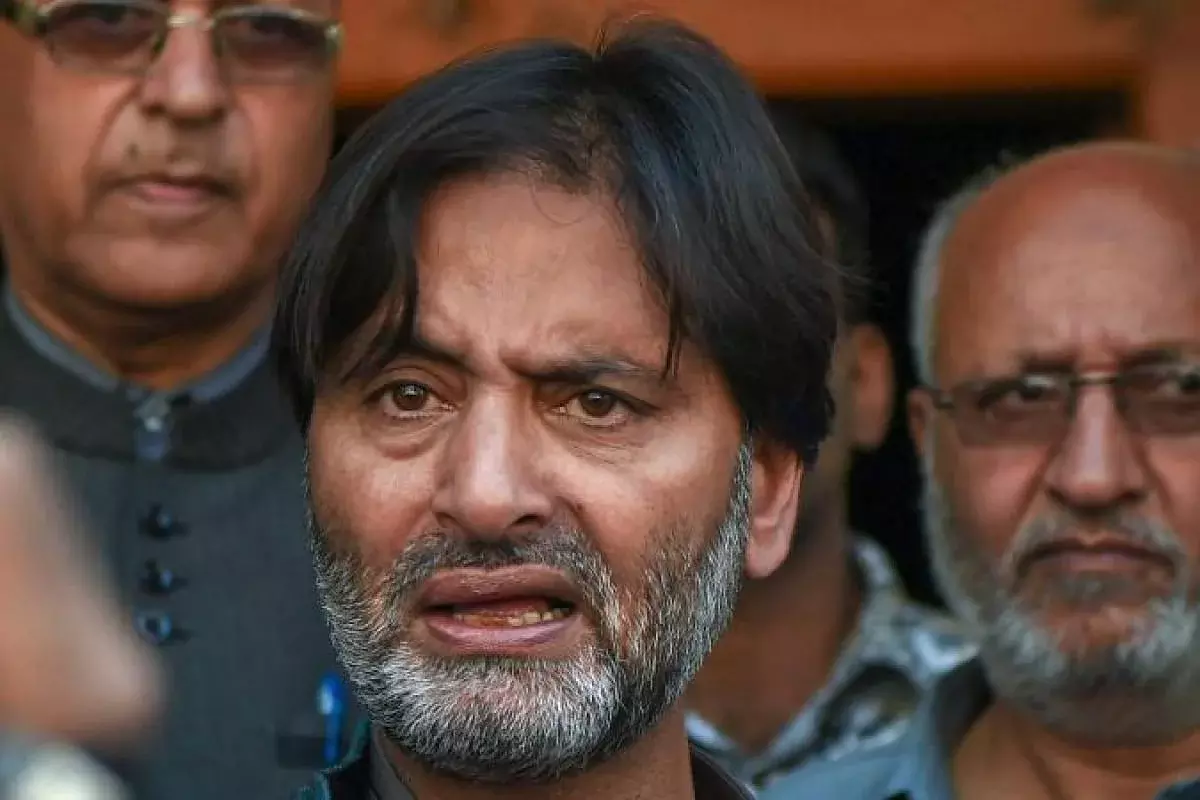
Jailed Jammu Kashmir Liberation Front (JKLF) chief Yasin Malik has denied any involvement in the 1990 abduction and killing of Kashmiri Pandit nurse Sarla Bhat, while telling the Special TADA/POTA Court in Srinagar that he has decided not to contest the trial proceedings further and has instead requested that the court award him capital punishment.Malik has maintained that his decision not...
This is a premium content
Available exclusively to
Our subscribers
Subscribe Premium 
INR 1099+GST
Your support helps us to bring you more content at
an affordable subscription scheme !!!
All payment options available
Jailed Jammu Kashmir Liberation Front (JKLF) chief Yasin Malik has denied any involvement in the 1990 abduction and killing of Kashmiri Pandit nurse Sarla Bhat, while telling the Special TADA/POTA Court in Srinagar that he has decided not to contest the trial proceedings further and has instead requested that the court award him capital punishment.
Malik has maintained that his decision not to contest the proceedings should not be treated as an admission of guilt or acceptance of any prosecution allegation. In his 25-page affidavit, he describes himself as having been falsely implicated more than three decades after the incident and questions the prosecution's case, the material relied upon against him and the delay in bringing him into the case.
The affidavit was filed in response to the chargesheet submitted by the State Investigation Agency (SIA) in June 2026 in connection with the killing of Sarla Bhat, a nurse at Sher-i-Kashmir Institute of Medical Sciences (SKIMS), who was abducted and killed in April 1990. The SIA has named Malik among the accused and alleged his involvement in the conspiracy behind the killing.
Malik states that he was arrayed as an accused more than three decades after the occurrence, describing the development as a matter of “shock and disbelief”. He has asserted that, in his understanding, the proceedings arose from political circumstances and decisions and that he had been falsely implicated.
He has also questioned the material now relied upon by the prosecution, particularly an alleged handwritten note purportedly issued in the name of JKLF and recovered from the scene of occurrence. According to Malik's affidavit, the note allegedly claimed responsibility for the killing and mentioned the names of Javaid Mir, Sheikh Abdul Hamid and Mohammad Yasin Malik.
Malik states that on June 2 and 3, 2026, three SIA officers visited him at Central Jail No. 7, Tihar, pursuant to an order of the competent court. According to his affidavit, the officers confronted him with two principal allegations: the alleged handwritten JKLF note and the prosecution theory that Sarla Bhat had been suspected of passing information to security forces and that Malik had ordered her killing.
Malik has categorically denied the latter allegation. He states that Sarla Bhat was “an innocent civilian” and rejects the suggestion that she was working covertly for security forces or was responsible for the April 8, 1990 raid at Narwara. He further disputes the allegation that the killing was ordered as an act of revenge.
A central part of Malik's defence in the affidavit concerns his physical condition at the time of Sarla Bhat's killing.
He states that he suffered life-threatening injuries on April 8, 1990, after falling from a fifth-floor building during a security operation and remained unconscious for a prolonged period. Malik claims that he was widely reported to have died and argues that the prosecution theory that he directed Bhat's killing on April 19, 1990 is incompatible with his medical condition and hospitalisation at the relevant time.
Malik also claims that he first came to know about Sarla Bhat's murder on February 21, 1991, while he was in judicial custody, and that he had neither heard of her nor been aware of the incident before that date.
Questions Why He Was Not Prosecuted Earlier:
The affidavit also questions why Malik was not named or prosecuted in relation to the Sarla Bhat case when he and other JKLF members were being arrested and investigated during the 1990s.
Malik argues that the prosecution's present narrative was constructed decades after the occurrence and claims that it finds no support in the contemporaneous record or in the conduct of investigating agencies at the relevant time. He has characterised the prosecution version as a narrative developed after the passage of several decades to implicate him.
These assertions form part of Malik's defence and are not findings of the court; the allegations contained in the SIA chargesheet remain subject to adjudication in the pending criminal proceedings.
Says He Will Not Contest Trial, But Denies Guilt
The most striking part of the affidavit concerns Malik's decision regarding the trial itself. After setting out his objections to the prosecution case, Malik states,
“Considering my personal circumstances and after deep reflection, I have decided not to contest the trial proceedings further.”
He immediately qualifies the decision by stating that it “shall not be treated as an admission of any prosecution fact, guilt or acceptance of the allegations made against me”, while simultaneously requesting capital punishment.
Affidavit Also Refers To His Past Interactions With Political Leadership:
A substantial portion of the affidavit deals with Malik's account of his interactions, during periods of imprisonment and thereafter, with political and intelligence officials and representatives associated with India-Pakistan peace efforts.
He refers to meetings and communications involving the governments of Atal Bihari Vajpayee and other political figures, as well as his alleged interactions with officials during his imprisonment and medical treatment abroad. These claims are presented by Malik as part of his account of his political journey and the circumstances surrounding his prosecution.
The final portion of the affidavit is styled as a “Declaration of Conscience”, in which Malik states that he bears no hatred towards anyone and that he has placed his account, memories and conscience before the court.


