


Supreme court
PC Act | Mere Recovery Of Tainted Currency Notes Not Enough To Convict Public Servant Without Proof Of Bribery Demand: Supreme Court
While holding that stamp vendors qualify as 'public servants' for invoking the Prevention of Corruption Act proceedings against them, the Supreme Court clarified that mere recovery of tainted money is not sufficient to establish guilt under the Act unless the demand for such money is also proven. The Court said that mere acceptance of illegal gratification without proof of offer by...
Explained| Why Supreme Court Set Aside JSW's Resolution Plan For Bhushan Steel & Power Ltd
The Supreme Court in its recent decision to set aside the Resolution Plan submitted by JSW Steel for Bhushan Steel and Power Ltd, flagged the various procedural non-compliances done by the Resolution Professional and lack of commercial wisdom exercised by the Committee of Creditors (Coc)Holding that the Resolution Plan of JSW was illegal and contrary to the provisions of the Insolvency...
S.22 Specific Relief Act | Refund Of Advance Payment Cannot Be Granted Without Specific Prayer In Plaint : Supreme Court
The Supreme Court clarified that a relief of refund for an 'advance payment' as part of the sale consideration cannot be allowed unless a prayer seeking such a relief was included in the plaint. The Court said that it would be impermissible for the Court to suo moto grant such a relief if not included in the plaint. The Court asserted that by way of an amendment to the pleadings, which can...
'Where Did Mahatma Gandhi Start Salt Satyagraha?': Supreme Court Slams UP PSC For Giving Ambiguous Answers, Orders Re-Evaluation
The Supreme Court has ordered the Uttar Pradesh Subordinate Services Selection Commission (UPSSSC) to re-evaluate the answer sheets for the 2021–2022 Revenue Lekhpal examination, citing ambiguity in certain questions and answer keys that affected the outcomes for over 8,000 candidates competing for 8,085 vacancies. In doing so, the bench comprising Justices Sudhanshu Dhulia and K...
'Creating Fake Order Is Contempt Of Court' : Supreme Court Upholds Conviction Of Litigant Who Forged HC Order
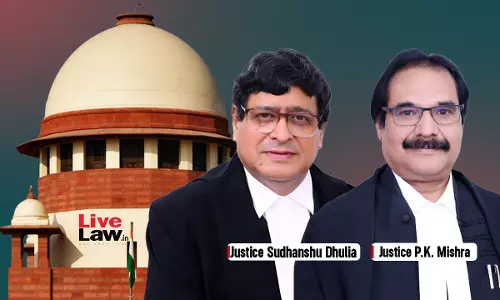
The Supreme Court upheld the conviction of a litigant for criminal contempt for forging an order of the High Court to secure a stay on the execution of a decree in a suit related to the recovery of possession and rent from the litigant. The bench comprising Justices Sudhanshu Dhulia and Prashant Kumar Mishra heard the case where the appellant forged three interim orders and presented them...
Courts Have Duty To Direct Executive To Review Working Of Statutes & Audit Statutory Impact : Supreme Court
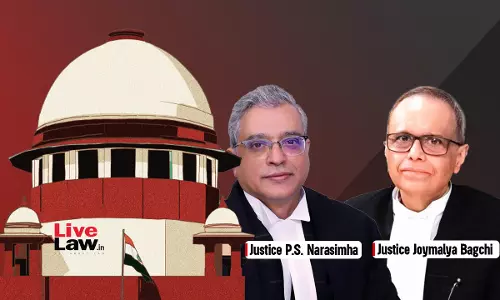
The Supreme Court has held that auditing and assessing the implementation of a statute is an integral part of the Rule of Law. The Court stated that the judiciary has both the power and the duty to direct the executive to conduct a performance audit of laws to ensure that their objectives are being met.However, such a direction should be based on a finding that the statute has,...
Forfeiture Of 'Earnest Money' Is Not Penal In Ordinary Sense So As To Apply Section 74 Contract Act : Supreme Court
The Supreme Court today (May 2) upheld the forfeiture of earnest money deposited as part of the Advance Sale Agreement by the purchaser with the seller upon the purchaser's failure to pay the balance consideration amount. The Court rejected the purchaser's argument that there cannot be a forfeiture of the earnest money deposited with the seller. Instead, it said that Rs. 20 lakhs paid by...
Supreme Court Criticises Arbitration Bill 2024 For Not Recognising Power To Implead Non-Signatories, Urges Union To Make Changes
The Supreme Court today (May 2) expressed its dissatisfaction with the continued absence of explicit statutory recognition for the power of arbitral tribunals to implead or join non-signatory parties. The Court noted with concern that, despite earlier omissions in the Arbitration and Conciliation Act, 1996, the newly proposed Arbitration and Conciliation Bill, 2024, which seeks to overhaul...
Stamp Vendors Are 'Public Servants' Under Prevention Of Corruption Act; Liable For Bribery Over Stamp Paper Sale : Supreme Court
In a notable judgment, the Supreme Court on Friday (May 2) held that stamp vendors fall within the definition of "public servants" under the Prevention of Corruption Act, 1988 and hence, can be proceeded under the PC Act for the corrupt practices.The Court held that it was the nature of the duty being discharged by a person which assumes paramount importance when determining whether such a...
RP Act | Supreme Court Refuses To Interfere With HC View That S.81 Limitation Can't Be Satisfied By Presenting Defective Election Petition
In an election dispute, the Supreme Court today upheld a view taken by the Gujarat High Court that mere "presentation" of a defective election petition, without removal of defects within the limitation period of 45 days, is not satisfactory compliance of Section 81 of the Representation of the People Act, 1951.A bench of Justices Surya Kant and N Kotiswar Singh passed the order in a...
Subsequent Purchaser, Though Not 'Necessary Party' In Specific Performance Suit, Can Be Impleaded As 'Proper Party' : Supreme Court
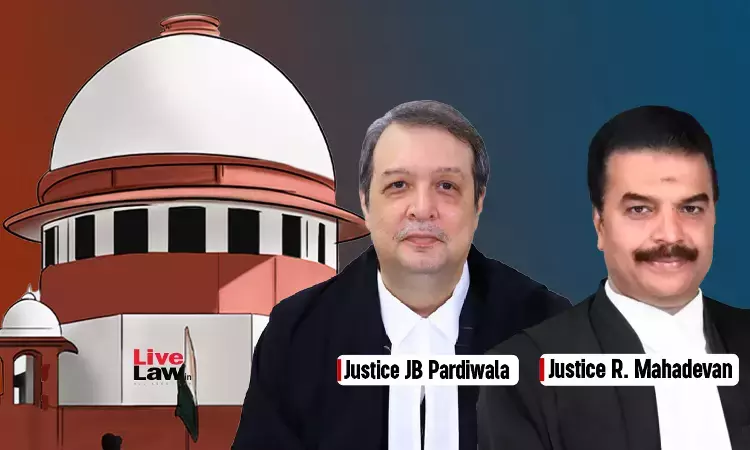
The Supreme Court recently ruled that in a suit for specific performance of an agreement to sell, a subsequent purchaser may not be a 'necessary party' but can be a 'proper party' if their rights are affected by the adjudication of the dispute. The bench comprising Justices JB Pardiwala and R Mahadevan was hearing the case where the Appellant (who was stranger to the suit) sought impleadment...