


Supreme court

S.34 Arbitration Act | Respect Arbitral Autonomy; Judicial Interference Should Be Minimal : Supreme Court
The Supreme Court reiterated that the courts cannot go beyond the scope of Section 34 of the Arbitration & Conciliation Act, 1996 (“Arbitration Act”) while deciding an application for setting aside of an award."the role of the court under Section 34 of the 1996 Act is clearly demarcated. It is a restrictive jurisdiction and has to be invoked in a conservative manner. The reason is...
Central Excise Tariff Act | Test Reports Justifying Reclassification Must Be Disclosed to Manufacturer : Supreme Court
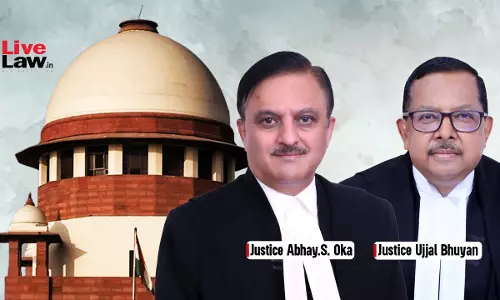
The Supreme Court ruled that when a test report forms the basis for reclassification of the petrochemical products, necessitating a higher duty, than the copy of such test reports ought to be furnished to the manufacturer-taxpayer. The bench of Justices Abhay S. Oka and Ujjal Bhuyan set aside the ₹2.15 crore central excise duty demand against M/s Oswal Petrochemicals Ltd., holding that...
Supreme Court Refuses To Quash FIRs Against TN Thowheed Jamath Members Over Objectionable Speech; Allows Clubbing Of Cases
The Supreme Court recently refused to quash the FIRs filed against two members of the Tamil Nadu Thowheed Jamath over allegations of making objectionable statements and threatening judges following the Karnataka High Court's verdict in the hijab case.A bench comprising Justice Vikram Nath and Justice Sandeep Mehta observed :"At the outset, we must note that the language used by the petitioners...
Prosecution Cannot Contradict A Court Witness With Previous Statements Made To Police; But Court Can : Supreme Court
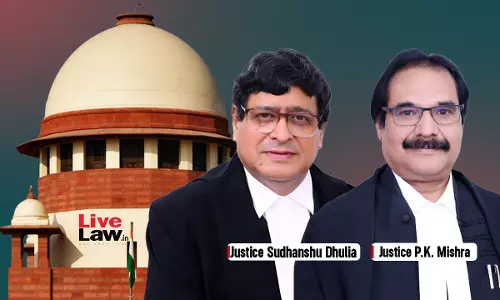
The Supreme Court has stated that a "Court Witness" - a person summoned by the Court as a witness invoking its powers under Section 311 CrPC and Section 165 of the Evidence Act - cannot be cross-examined by the prosecution using the witness's previous statements made to the police.A bench comprising Justice Sudhanshu Dhulia and Justice Prashant Kumar Mishra observed :"Court witnesses can...
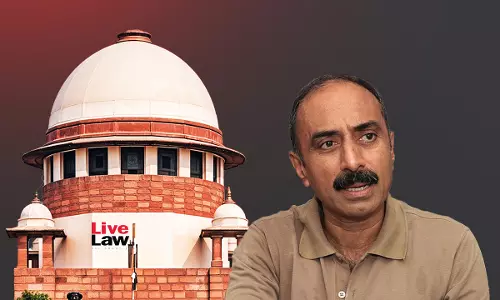
Supreme Court Refuses To Suspend Life Sentence Of Sanjiv Bhatt In 1990 Custodial Death Case
The Supreme Court today rejected the application filed by expelled Gujarat IPS officer Sanjiv Bhatt seeking to suspend the life sentence imposed on him in a custodial death case of 1990.A bench of Justices Vikram Nath and Sandeep Mehta refused to release Sanjiv Bhatt on bail. However, the bench directed that the hearing of his criminal appeal be expedited."We are not inclined to enlarge...
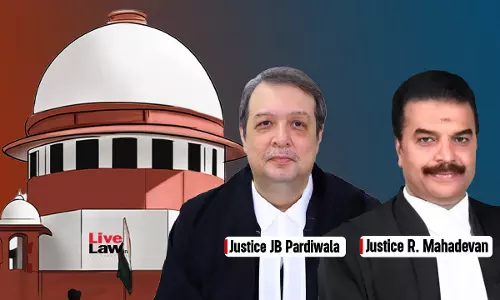
Commercial Courts Act | Limitation Period Starts From Pronouncement Of Judgment & Not Receipt Of Copy : Supreme Court
The Supreme Court held that the limitation period for filing an appeal under the Commercial Courts Act, 2015, commences from the date of pronouncement of the judgment and that a party cannot insist that the limitation starts only from the date of receiving a copy of the judgment.The Court clarified that while Order XX Rule 1 of the CPC places a duty on the court to provide a copy of the...
S. 311 CrPC | Court Can Permit Examination Of Additional Witness As Prosecution Witness If Prosecution Ought To Have Called Them: Supreme Court
The Supreme Court today(April 28) held that an additional witness summoned as per Section 311 of the Code of Criminal Procedure can be examined as a Prosecution Witness if the Court finds that such a person ought to have been examined as a prosecution witness but was omitted due to oversight.The Court also held that the powers under Section 165 (judge's power to put questions or order...
Evidence Of Hostile Witness Cross-Examined By Prosecution Can't Be Discarded Fully; Court Must Assess What Can Be Accepted : Supreme Court
While confirming the convictions of eleven accused persons in the 'Kannagi-Murugesan' honour killing case from Tamil Nadu, the Supreme Court held that just because a witness has supported some, though not all, aspects of a case, it would not automatically mean that the witness has to be declared as 'hostile'.A bench comprising Justices Sudhanshu Dhulia and PK Mishra dismissed the appeals filed...

TN Honour Killing Case : Supreme Court Upholds Life Sentence Of Police Inspector For Fabricating Evidence Against Dalits
In the horrific 'Kannagi-Murugesan' honour killing case which took place in Tamil Nadu in 2003, the Supreme Court, while confirming the convictions of nine persons, also upheld the conviction of two police officers, who were accused of fabricating evidence.A bench comprising Justice Sudhanshu Dhulia and Justice Prashant Kumar Mishra rejected the appeals of K.P. Tamilmaran and M. Sellamuthu,...

When Joint Hindu Family Property Is Partitioned, Shares Of Parties Become Their Self-Acquired Properties : Supreme Court
The Supreme Court recently reaffirmed that following the partition of a joint family property, the individual shares allotted to each co-parcener become their self-acquired property."After the joint family property has been distributed in accordance with law, it ceases to be joint family properties and the shares of the respective parties become their self-acquired properties," the...
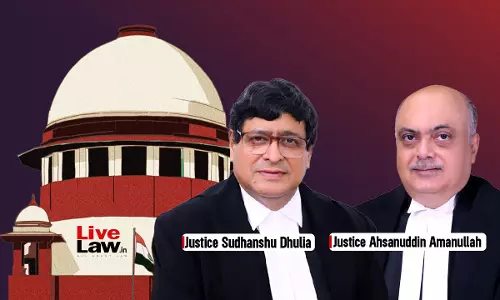
'Sharia Court', 'Court Of Kazi' Etc Have No Legal Recognition; Their Directions Not Binding: Supreme Court
The Supreme Court reiterated that a 'Court of Kazi', 'Court of (Darul Kaja) Kajiyat','Sharia Court' etc., by whatever name styled, have no recognition in law and any direction given by them is not enforceable in law.A bench comprising Justice Sudhanshu Dhulia and Justice Ahsanuddin Amanullah referred to the 2014 judgment in Vishwa Lochan Madan v Union of India,which held that Shariat Courts...