


Supreme court


Landlord's Family's Needs Also Count As 'Bona Fide Requirement' For Tenant's Eviction : Supreme Court
The Supreme Court on Thursday (April 24) observed that the eviction is not restricted to the bona fide need of the landlord, even the landlord's family requirement would qualify as bona fide need for eviction of the tenant. “It is well settled that the bona fide requirement for occupation of the landlord has to be liberally construed and, as such, even the requirement of the family...
High Courts Should Not Repeatedly Grant Interim Bail To Same Accused; Either Grant Regular Bail Or Deny: Supreme Court
While granting bail to an accused, the Supreme Court observed that High Courts should not routinely grant interim bail to the same applicant again and again. Either the Court should grant regular bail or deny the same, but insofar as interim bail, the relief shall be granted only in specific exigencies as an exception."Though, it may be necessary in some cases to grant interim bail to take...
Land Acquisition | Delay In Filing Appeal No Reason To Deny Land Losers Fair Compensation : Supreme Court
The Supreme Court observed that a delay in filing an appeal against a land acquisition compensation award would not be a reason to deny just, fair, and reasonable compensation to the landowners. “Delay is not a reason to deny the land losers their compensation, which is just, fair and reasonable for the land they have lost.”, the court observed. The bench comprising Justices Sanjay...

In Suit For Cancellation Of Deed & Recovery Of Possession, Limitation Of 3 Years Applies As Cancellation Is Main Relief : Supreme Court
The Supreme Court has reiterated that where a composite suit had been filed for cancellation of the sale deed and of possession, the limitation period would have to be adjudged from the primary relief of cancellation which is 3 (three) years, and not the ancillary relief of possession which is 12 (twelve) years.Reference was made to Rajpal Singh v. Saroj (2022) 15 SCC 260, which observed :...
Retired Judges' Medical Reimbursement To Be Borne By State Of First Appointment Or Retirement : Supreme Court
The Supreme Court recently (April 15) cautioned State Governments that non-compliance with its orders on medical facilities for retired High Court Judges, their spouses, and other dependants could invite action under the Contempt of Courts Act, 1981. “We are putting the State to the notice that if we find non-compliance, action under the Contempt of Courts Act, 1981 will be initiated”,...
S.362 CrPC Can Be Used Only To Correct Clerical Errors : Supreme Court Criticises Allahabad HC For Modifying Murder Conviction
The Supreme Court recently disapproved of the Allahabad High Court invoking Section 362 of the Code of Criminal Procedure to modify the High Court's judgment in a criminal appeal by converting the conviction under Section 302 IPC (murder) to Section 304 Part II (culpable homicide not amounting to murder).The Court underscored that as per Section 362 of the CrPC, only clerical errors in a...
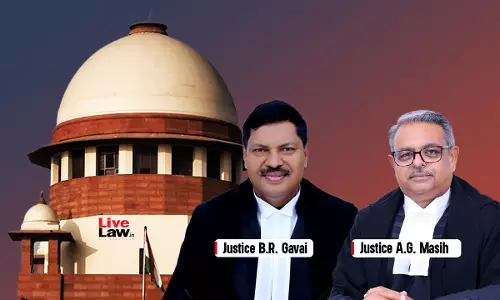
When One Judge Has Held Party Guilty Of Contempt, Another Judge Of Same HC Can't Take Contrary View : Supreme Court
The Supreme Court has held that once a Judge of a High Court has held a party guilty of contempt, another Single Judge of the same Court cannot re-examine whether contempt was actually committed. "When one Judge of the same Court has taken a particular view holding the Respondent to be guilty of contempt, another Judge could not have come to afinding that the Respondent was not guilty...
Prospective Accused Cannot Challenge Order For CBI Investigation : Supreme Court
The Supreme Court observed that it is not open for the prospective accused to challenge the underway investigation. Holding thus, the Court dismissed the appeal challenging the Karnataka High Court's decision to order an investigation by the Central Bureau of Investigation (“CBI”).“Therefore, we are of the considered view that once an FIR is registered and investigation has taken...
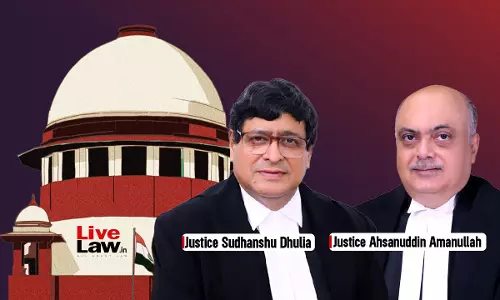
Magistrate's Cognizance Order Can't Be Faulted Only Because It Wasn't A Reasoned Order : Supreme Court
The Supreme Court reiterated that a Magistrate's order taking cognizance of a police report cannot be faulted only because it was not a reasoned order. If the cognizance is taken after recording a finding regarding the existence of a prima facie case based on a reading of the case records, explicit reasons are not required.Holding thus, the bench comprising Justices Sudhanshu Dhulia...