


Supreme court
Supreme Court Sets Aside TN Governor's Decision To Reserve 10 Bills For President's Assent; Says He Acted Without Bona Fides
The Supreme Court today (April 8) held that the action of the Tamil Nadu Governor Dr RN Ravi withholding assent for 10 bills, the oldest of them pending since January 2020, and reserving them to the President after they were re-enacted by the State Legislature is "illegal and erroneous" in law and liable to be set aside.Any consequential steps which might have been taken by the President on...
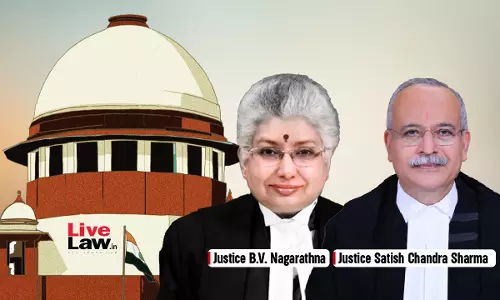
Insurance Claim Cannot Be Denied For Breach Of Impossible Condition : Supreme Court
The Supreme Court held that an insurance company cannot reject a claim on the grounds of breach of a condition in the contract that was impossible to fulfill. A bench comprising Justices B.V. Nagarathna and Satish Chandra Sharma upheld the insured's marine claim, which New India Assurance Co. Ltd. had rejected on the grounds that the insured breached a condition requiring the voyage to start...
SEBI Can't Pass Multiple Orders On Same Cause Of Action; Res Judicata Principle Applies : Supreme Court
Reiterating that the principle of res judicata applies to quasi-judicial proceedings, the Supreme Court today (April 7) upheld the Securities Appellate Tribunal's decision, which held that SEBI's subsequent disgorgement order was barred by res judicata, as its earlier order had not directed disgorgement. The Court invoked the principle of constructive res judicata (as per Explanation IV...
Landlord-Tenant Relationship Ends Only With Eviction Decree; Mesne Profits To Be Calculated From Decree Date: Supreme Court
The Supreme Court recently observed that under the Maharashtra Rent Control Act, 1999, it is the settled law that the relationship of landlord and tenant comes to an end only upon the passing of the decree of eviction.“As the decree of eviction was passed under the Maharashtra Rent Control Act, 1999, the settled position of law is that only on the decree of eviction being passed,...
Appointment To Public Posts Cannot Be Done On Hereditary Basis : Supreme Court
The Supreme Court recently ruled against the hereditary appointments in the public service. The Court said that the appointment to the public posts cannot be done on hereditary basis, and such an appointment violates Articles 14 and 16 of the Constitution.Holding so, the bench comprising Justice Dipankar Datta and Justice Manmohan upheld the Patna High Court's decision which had struck down...
Writ Courts Can Suo Motu Strike Down Subordinate Legislation Which Violates Fundamental Rights & Biding Precedents : Supreme Court
The Supreme Court recently held that Writ Courts have the authority to exercise suo motu powers to strike down subordinate legislation if it violates fundamental rights enshrined in the Constitution, rendering it void and unconstitutional.The Court observed that it saw no reason to not concede the power to suo motu declare a subordinate legislation invalid, on the ground of its being...
Death Penalty In Child Rape-Murder Case Set Aside; Supreme Court Flags Illegal Admission Of Confession, Lapses In DNA Evidence
The Supreme Court recently overturned the conviction of a man accused of raping and causing the death of a minor, observing that the trial was conducted in a flawed and irregular manner. The Court noted that the trial judge had improperly allowed the investigating officer to narrate the accused's confessional statements during his examination-in-chief and admitted those statements...
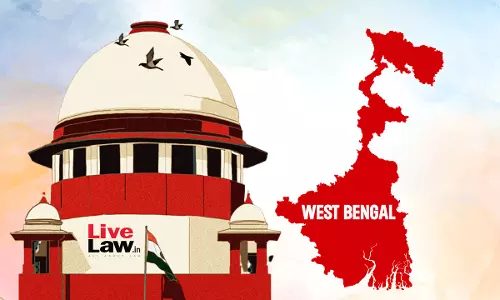
'Eligibility Cut-Off Is Application Deadline When Not Specified' : Supreme Court Grants Relief To D.El.Ed Candidates Of 2020-22 In WB
The Supreme Court granted relief to several candidates who pursued the Diploma in Elementary Education (D.El.Ed) course in the 2020-2022 batch in West Bengal by overturning a Calcutta High Court judgment which held them ineligible to apply for the post of Assistant Teachers in primary schools.The High Court had held that since these candidates had not obtained the course completion...
Section 18 Of Limitation Act Applies To Public Premises Act : Supreme Court
In a case involving liability for demand raised under the Public Premises (Eviction of Unauthorised Occupants) Act, 1971, the Supreme Court recently applied Section 18 of the Limitation Act and granted benefit of extension of limitation to the lessor noting that there was acknowledgement of liability by the licensee within the limitation period of 3 years."The respondents cannot argue that...