Supreme court
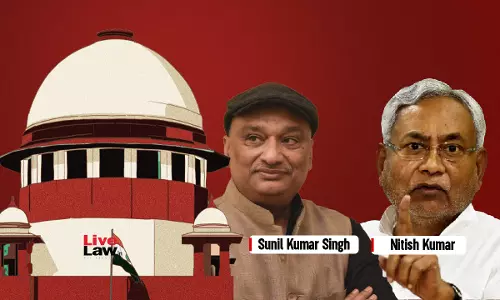
''Highly Excessive' : Supreme Court Quashes Bihar Legislative Council's Decision To Expel RJD MLC For Comments Against Nitish Kumar
The Supreme Court today set aside the decision of the Bihar Legislative Council to expel RJD MLC Sunil Kumar Singh for making defamatory words against Bihar Chief Minister Nitish Kumar.Although the Court observed that Singh's conduct was "abhorrent" and "unbecoming", it held the punishment of expulsion to be "highly excessive" and "disproportionate." The expulsion violated not only Singh's...

GST Act | Can Time Limit To Adjudicate Show Cause Notice Be Extended By Notification Under S.168A? Supreme Court To Consider
The Supreme Court is to decide whether the time limit for adjudicating show cause notice and passing an order can be extended by the issuance of notifications under Section 168-A of the GST Act. This provision empowers the Government to issue notification for extending the time limit prescribed under the Act which cannot be complied with due to force majeure.“The issue that falls for...

'Child A Competent Witness' : Supreme Court Summarizes Law On Child Witness Testimony
The Supreme Court today (February 24) overturned the acquittal of a man accused of murdering his wife, ruling that his seven-year-old daughter's testimony was credible. The Court found the accused guilty based on circumstantial evidence and held that his failure to explain the circumstances of his wife's death, which occurred within the four walls of his house with only their daughter...
Courts Should Not Lightly Interfere With Personal Liberty : Supreme Court Sets Aside HC Order Cancelling Bail
The Supreme Court, while setting aside a High Court ruling cancelling bail of an accused under an attempt to murder charge, observed that an individual's liberty is a precious right under the Constitution, and courts should be cautious before interfering with it. Elaborating, the Court said that since there was no evidence showing that the accused's conduct after bail warranted deprivation of...

Prevention Of Corruption Act | Preliminary Inquiry Not Mandatory Before Registering FIR Against Public Servant : Supreme Court
The Supreme Court recently observed that a preliminary inquiry is not mandatory before registering an FIR against a public servant under the Prevention of Corruption Act. Moreover, the accused cannot have a vested right to claim preliminary inquiry before FIR registration in corruption cases. “it is perspicuous that conducting a preliminary inquiry is not sine qua non for registering a...

Supreme Court Weekly Round-up: February 10, 2025 To February 16, 2025
Nominal IndexCitationsHitesh Verma v. M/S Health Care At Home India Pvt. Ltd., Diary No. – 29293/2019 2025 LiveLaw (SC) 176Marippan & Anr. v. State Represented By The Inspector of Police 2025 LiveLaw (SC) 177AC Chokshi Share Broker Private Limited v. Jatin Pratap Desai & Anr. 2025 LiveLaw (SC) 178Lalita v. Vishwanath & Ors., Criminal Appeal No. 1086 of 2017 2025 LiveLaw...

Physical Presence Not Necessary In Domestic Violence Act Proceedings : Supreme Court Quashes Magistrate's Order To Extradite Husband From US
The Supreme Court (on February 20) observed that, in proceedings under the Domestic Violence, there is no requirement for a party to be personally present as such proceedings are quasi-criminal in nature. Elaborating, the Court said that such proceedings have no penal consequences except when there is a breach of a protection order, under Section 31 of the Act. In the present case,...
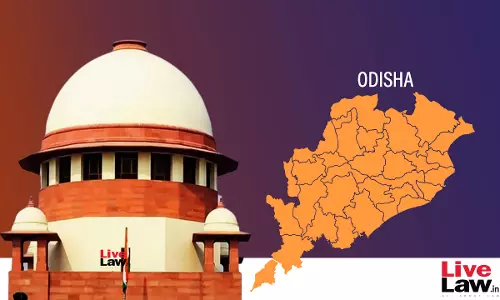
Odisha Pension Rules | Job Contractors Not Entitled To Pension For Pre-Regularisation Period Unlike Work-Charged Employees : Supreme Court
The Supreme Court has held that 'work-charged employees' are distinct from 'job contractors' when it comes to pensionary entitlements under the Odisha Pension Rules 1992.Explaining the distinction between the work-charged employee and employees working on a job contract, the Court observed:"There is a clear distinction between the employees who are in work-charged establishment vis¬à¬vis...

Foreigners Tribunal Cannot Sit In Appeal Over Its Own Judgment & Reopen Concluded Issue Of Citizenship: Supreme Court
The Supreme Court recently held that a Foreigners Tribunal has no power to reopen a case by sitting in appeal over its own concluded judgment.The Court set aside an order of the Foreigners Tribunal which reopened an inquiry into the citizenship of a person, despite its earlier judgment which held the person to be. an Indian citizen.As per brief facts, the Foreigners Tribunal passed an order...
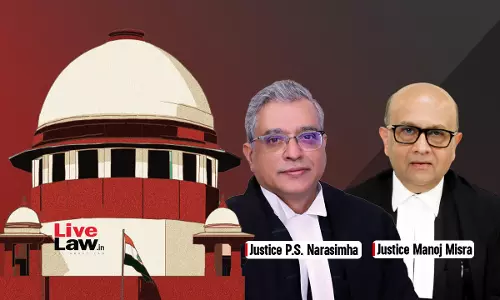
Courts Should Avoid Interference When Appointing Authority Has Accepted Equivalence Of Qualifications: Supreme Court
The Supreme Court yesterday (on February 21), observed that, while recruiting, if the appointing authority has not objected to the candidate's qualifications and there is no glaring difference between the specified qualification and the candidate's qualification, the Court's interference by setting aside the appointment is unwarranted. It is the appointing authority which has to...

Know The Law | Distinction Between 'Equitable Mortgage' And 'Legal Mortgage' : Supreme Court Explains
The Supreme Court recently explained the distinction between a legal mortgage and an equitable mortgage. The Court explained that a legal mortgage (in this case, mortgage by deposit of title deeds) is created when property rights are transferred to the mortgagee (lender), granting the mortgagee an enforceable right over the property in case of default. In contrast, an equitable mortgage...