


Supreme court

Did NOIDA Authorities Pay Excess Compensation To Landowners? Whether NOIDA Lacks Transparency? Supreme Court Asks SIT To Probe
The Supreme Court on Thursday (January 23) constituted a Special Investigation Team (SIT) to investigate whether the officers of the New Okhla Industrial Development Authority (NOIDA) paid excess land acquisition compensation to certain land owners.The Court also asked the SIT to examine "whether the overall functioning of NOIDA lacks transparency, fairness and commitment to the cause of...
Order VII Rule 11 CPC | Plaint With Multiple Reliefs Cannot Be Rejected Just Because Some Reliefs Are Barred : Supreme Court
The Supreme Court observed that when a Plaint includes multiple reliefs, it cannot be rejected solely because one of the reliefs is barred by law, as long as the other reliefs remain valid. According to the Court, the plaint cannot be partially rejected under Order VII Rule 11 of CPC.“If the civil court is of the view that one relief (say relief A) is not barred by law but is of the view...
S. 16 Arbitration Act | Challenge To Arbitral Tribunal's Jurisdiction Impermissible After Submitting Statement Of Defence : Supreme Court
The Supreme Court affirmed the principle that the jurisdiction of the arbitral tribunal cannot be challenged after the submission of the statement of defence. A bench of Justices Abhay S Oka and Ujjal Bhuyan was hearing a case in which the respondent had objected to the jurisdiction of the Arbitral Tribunal after submitting its statement of defence. The Arbitral Tribunal rejected the...
Indefinite Suspension Not Permitted; Consider Reinstatement Of Tihar Jail Officials Suspended In Unitech Case: Supreme Court
Dealing with an application filed in the Unitech case, the Supreme Court today directed the competent authority to decide within 4 weeks the issue of reinstatement of 32 Tihar jail officials, who were suspended pursuant to its 2021 order for extending undue help and assistance to ex-Unitech promoters Sanjay Chandra & Ajay Chandra while they were in jail.A bench of Justices Surya Kant and...

Testimony Of Witness Shouldn't Be Discarded Merely Because Of Relation With Victim : Supreme Court
The Supreme Court (on January 22) observed that being a victim's close relative does not automatically make a witness “interested” or biased. Distinguishing between an interested witness and a relative witness, the Court said:“The term "interested" refers to witnesses who have a personal stake in the outcome, such as a desire for revenge or to falsely implicate the accused due to enmity...

NDPS Act | Bald Allegation Of S. 52A Non-Compliance Won't Result In Acquittal Unless Foundational Facts Of Non-Compliance Proved : Supreme Court
The Supreme Court reiterated that unless the foundational facts of non-compliance of Section 52A of the NDPS Act are not proved by the accused, he cannot assert a bald allegation that the conviction for possessing contraband cannot be sustained due to non-compliance of Section 52A. The bench comprising Justices JB Pardiwala and R Mahadevan was hearing the case where the accused was booked...
NDPS Act | Prosecution Must Establish Contraband Was Seized From 'Conscious Possession' Of Accused : Supreme Court
The Supreme Court reiterated that to prove offences under the Narcotic Drugs and Psychotropic Substances Act (NDPS Act), the prosecution must establish that the contraband was seized from the 'conscious possession' of the accused."Conscious possession refers to a scenario where an individual not only physically possesses a narcotic drug or psychotropic substance but is also aware of its...
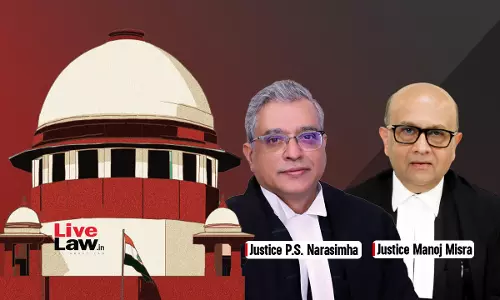
Arbitration Act | Courts' Jurisdiction Under Sections 34 and 37 Do Not Extend To Modifying Arbitral Award: Supreme Court Reiterates
Recently, the Supreme Court affirmed the principle laid down in National Highways Authority of India vs. M. Hakeem & Another that the jurisdiction of the Courts under Sections 34 and 37 of the Arbitration & Conciliation Act, 1996 (1996 Act) will not extend to modifying an arbitral award.The bench comprising Justices PS Narasimha and Manoj Misra was hearing the case dealing with the...
Village Police Patil Not Police Officer; Confession To Him Admissible As Extra Judicial Confession : Supreme Court
The Supreme Court recently reiterated that an extra-judicial confession is a “weak type” of evidence and thus requires a great deal of care and caution. Where extra-judicial confession is surrounded by suspicious circumstances, its credibility becomes doubtful and would lose its importance., the Court said while placing its reliance upon Balwinder Singh vs. State of Punjab (1995) 4...


MSMED Act | Is Writ Maintainable Against MSEFC Award? Can MSEFC Members Act As Arbitrators ? Supreme Court Refers To Larger Bench
The Supreme Court today (Jan. 22) opined that the party aggrieved by an order/award of the Micro and Small Enterprises Facilitation Council (MSEFC) passed under Section 18 of the Micro, Small, and Medium Enterprises Development Act, 2006 (“MSME Act”) can file a writ petition under Article 226 of the Constitution before the High Court. However, upon noting that a contrary view was...