


Supreme court
Plaintiff Seeking Specific Performance Of Agreement To Sell Must Also Show Availability Of Funds : Supreme Court
The Supreme Court recently upheld the High Court's decision denying Specific Relief to the plaintiff because he was not able to prove his readiness and willingness to perform the contract. The bench comprising Justice JB Pardiwala and Justice R Mahadevan observed that for the contract to be concluded, the plaintiff shall not only aver about his readiness and willingness to perform the...

NGT Cannot Outsource Its Opinion To Committees & Base Its Decision On Such Opinions : Supreme Court
The Supreme Court recently criticised the National Green Tribunal for 'outsourcing' its opinion to a committee and basing its opinion only on the findings of the committee."The NGT is a tribunal constituted under the National Green Tribunal Act of 2010. A tribunal is required to arrive at its decision by fully considering the facts and circumstances of the case before it. It cannot outsource...
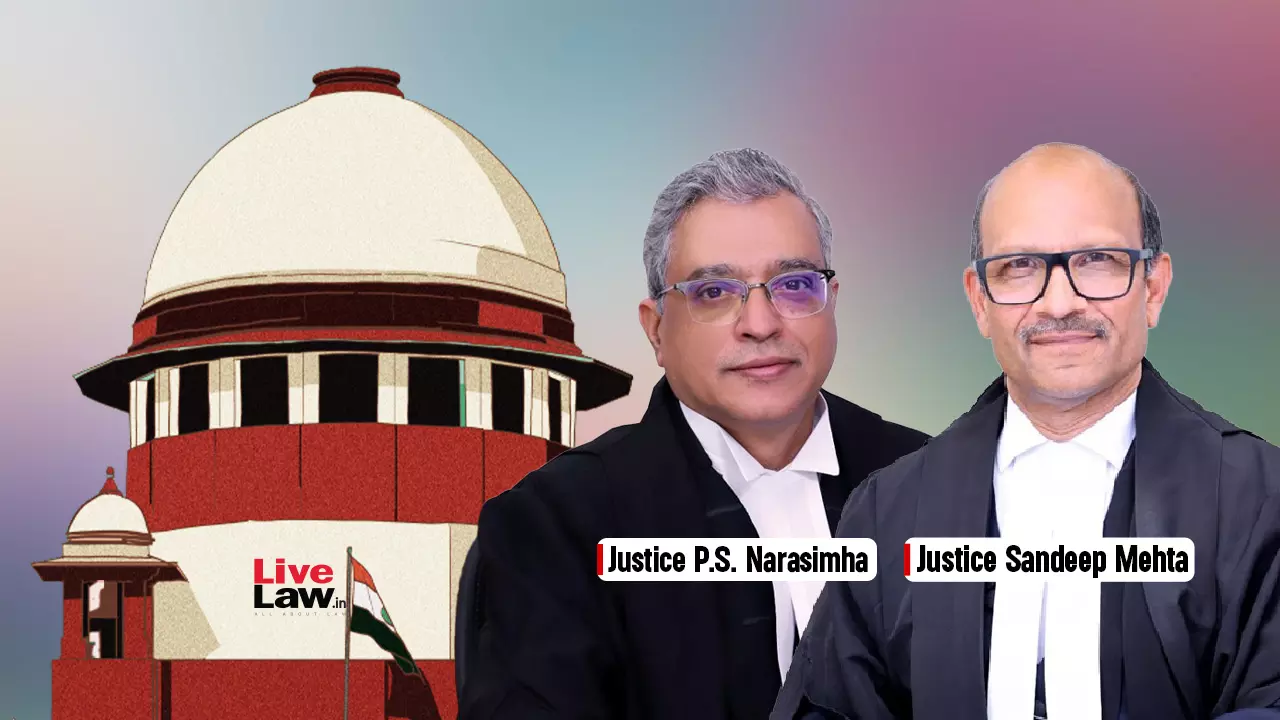
Arms Act | Prohibition On Buttondar Knife Applies Only If Knife Was For 'Manufacture, Sale Or Possession For Sale Or Test' : Supreme Court
The Supreme Court yesterday quashed the Arms Act case against the person accused of possessing a buttondar knife. The bench comprising Justices PS Narasimha and Sandeep Mehta heard the case, in which the appellant was accused of possessing a buttondar knife (having dimensions 31.5 cms in length (blade length of 14.5 cms and handle of 17 cms) and width of 3 cms), violating the Arms Act, 1959,...
Supreme Court Allows West Bengal BJP Leader Kabir Shankar Bose's Plea For CBI Probe Of Assault Cases Against Him
The Supreme Court on Wednesday (December 4) ordered a CBI investigation into two assault and sexual harassment cases arising from an incident on December 6, 2020, against West Bengal Bharatiya Janata Party (BJP) leader Kabir Shankar Bose.A bench of Justice BV Nagarathna and Justice Pankaj Mithal delivered its judgment today in the writ petition filed by Bose alleging that false criminal...
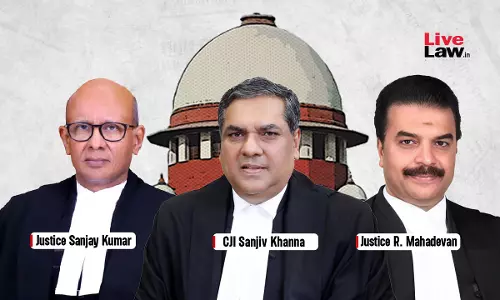
'Need To Preserve Temples With Utmost Care' : Supreme Court Appoints Retired HC Judge For Election Of Kerala's Oachira Temple Management
In a plea related to the management and administration of Oachira Parabrahma Temple in Kerala, the Supreme Court appointed a former Kerala High Court Judge as an Administrator to conduct a fresh election for the administration and management of the subject temple and its allied institutions, in a free and fair manner. The bench comprising CJI Sanjiv Khanna, and Justices Sanjay Kumar and...
Charge Sheet Can't Be Filed When There Is Interim Order Restraining Coercive Action Against Accused : Supreme Court
The Supreme Court recently observed that a charge sheet cannot be filed after a court passes an interim order restraining the state from taking coercive action against the accused in a criminal case,A bench of Justice Abhay Oka and Justice Augustine George Masih discharged contempt notices issued to three officers of the Jharkhand Police after they apologised for filing charge sheet despite...
'Soldier's Widow Should Not Have Been Dragged To Court': Supreme Court Imposes Rs. 50K Cost On Centre For Challenging Pension Order
The Supreme Court today (December 3) dismissed Union of India's appeal against order of Armed Forces Tribunal granting a Liberalised Family Pension (LFP) and other benefits to the widow of a soldier who died while on an Area Domination Patrol along the Line of Control.A bench of Justice Abhay Oka and Justice Augustine George Masih imposed cost of Rs. 50,000 on the appellant, observing that...

Supreme Court Monthly Round-up: November 2024
IndexCitationsManish Kumar Rai v. Union of India & Ors. 2024 LiveLaw (SC) 849Pintu Madanmohan Mondal v. State of West Bengal & Ors. 2024 LiveLaw (SC) 850Union of India v. Ganpati Dealcom Pvt Ltd | R.P.(C) No. 359/2023 2024 LiveLaw (SC) 851International Seaport Dredging Pvt Ltd v. Kamarajar Port Limited, Civil Appeal No 12097 of 2024 2024 LiveLaw (SC) 852Anoop M. and others v....

Supreme Court Weekly Round-up: November 25, 2024 To December 01, 2024
IndexCitationsM/S Ajay Protech Pvt. Ltd. v. General Manager & Anr., SLP (C) No. 2272 of 2024 2024 LiveLaw (SC) 915K.S. Muralidhar v. R. Subbulakshmi & Anr, SLP (C) No. 18337/2021 2024 LiveLaw (SC) 916Dr Balram Singh v. Union of India, W.P.(C) No. 645/2020, Dr. Subramanian Swamy v. Union of India, W.P.(C) No. 1467/2020 and Ashwini Upadhyaya v. Union of India, MA 835/2024 2024 LiveLaw...
'Legal Aid Must Be Effective; Prosecutors Must Ensure Fair Trial' : Supreme Court Issues Guidelines To Legal Aid Lawyers, Prosecutors
The Supreme Court today issued a slew of directions regarding the role of the Public Prosecutor and the appointment of Legal Aid Counsels in upholding procedural fairness and the fundamental rights of the accused in criminal trials. The Court said that the Public Prosecutor must assist the Trial Court in recording the accused's statement under Section 313 of the CrPC, ensuring all...
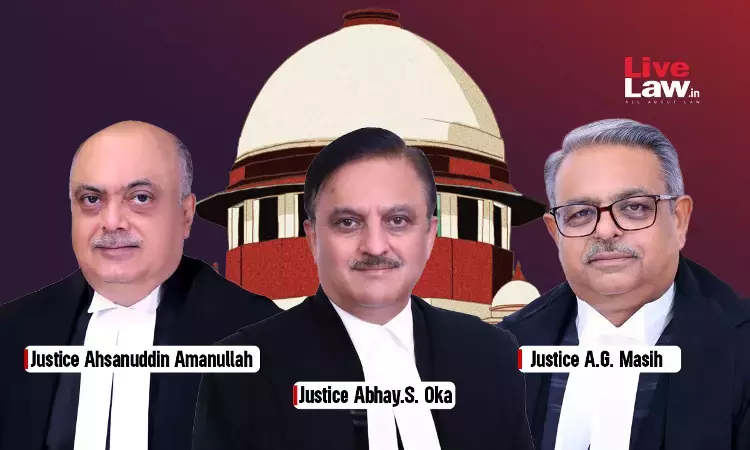
Trial Court Has Duty To Inform Accused Of Right To Free Legal Aid When Accused Has No Means To Engage Advocate: Supreme Court
In a crucial decision, the Supreme Court today set aside the conviction of a man accused of committing a rape and murder of a nine-year-old minor who was not afforded proper legal aid during the trial. The Court was shocked to know that the prosecution witness examination-in-chief was conducted in absence of the legal aid to the accused, depriving the accused of objecting to the...
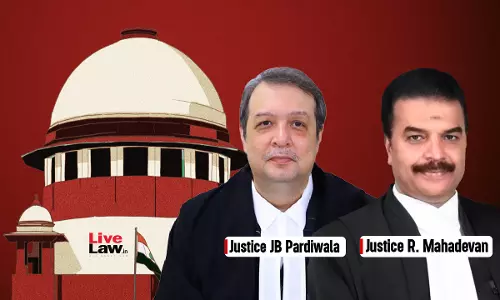
In Specific Performance Suits, Advisable To Seek Interim Injunction Against Sale; Doctrine Of Lis Pendens May Not Be Good Enough : Supreme Court
The Supreme Court recently explained the importance of seeking an interim injunction in a suit for specific performance over simply relying on Section 52 of the Transfer of Property Act, 1882 (“TPA”). The bench, comprising Justice J.B. Pardiwala and Justice R. Mahadevan, observed that although Section 52 TPA takes care of the pendente lite transfers, it may not be effective for taking...