


Supreme court
Knowingly Watching Child Pornography Over Internet Without Downloading Amounts To 'Possession' Under POCSO Act : Supreme Court
The Supreme Court held that watching child pornography over the internet without downloading would also amount to "possession" of such material in terms of Section 15 of the Protection of Children from Sexual Offences Act (POCSO).Section 15 deals with the offence of storage or possession of child pornographic material with an intention to transmit the same. The judgment also held that...

Supreme Court Weekly Round-up: September 16, 2024 To September 22, 2024
IndexCitationsBeena and Ors. v. Charan Das (D) Thr. Lrs. & Ors., Civil Appeal No. 3190 of 2014 2024 LiveLaw (SC) 706Rabina Ghale & Anr v. UOI & Ors, WP (Crl) No. 265 of 2022 & Anjali Gupta v. UOI & Ors, WP (Crl) No. 250 of 2022 2024 LiveLaw (SC) 707Sandeep Kumar v. Vinod & Ors. 2024 LiveLaw (SC) 708Dickey Alternative Investment Trust and Anr. v. Ahmed Buhari and...
Storage Of Child Pornography Without Deletion Or Reporting Indicates Intention To Transmit, Constitutes POCSO Act Offence :Supreme Court
Setting aside a Madras High Court judgment which held that mere storage of child pornographic material without any intention to transmit the same was not an offence under the Protection of Children from Sexual Offences Act (POCSO Act), the Supreme Court on Monday (September 23) held that the storage of such material, without deleting or without reporting the same, would indicate an intention...

Arbitration | Non-Signatory Party's Conduct And Relationship With Signatories May Indicate Intent To Be Bound : Supreme Court
In a recent ruling, the Supreme Court observed that an arbitration agreement is not necessarily non-binding on a non-signatory party. Such party, though not a signatory, may have intended to be bound through its conduct or relationship with the signatory parties. A referral court must determine the issue from a prima facie perspective; although, ultimately, it is the arbitral tribunal which...
75 Landmark Supreme Court Judgments: Part I | Celebrating 75 Years of India's Supreme Court
This year marks 75 years since the establishment of the Supreme Court. Since its inception, the Supreme Court has pronounced many landmark judgments that became the cornerstone for testing the fundamental rights violations under Part III of the Constitution. We look at the 75 significant judgments of the Supreme Court through a three-part series.Interpretation of Fundamental rights,...

Supreme Court Holds JAL Liable For Over Rs. 3.05 Crores Land Acquisition Compensation For Cement Project Transferred To Ultra Tech
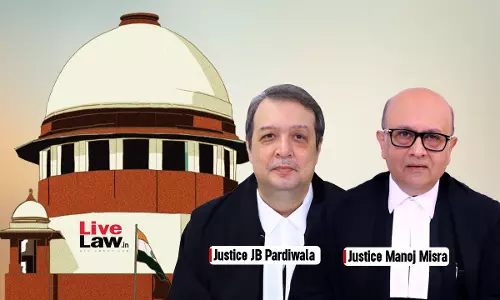
The Supreme Court held Jaiprakash Associates Ltd (JAL) liable for payment compensation of over Rs. 3.05 Crores under a 2022 Supplementary Award to persons whose land was acquired for establishing a safety zone for a cement project run by JAL in Himachal Pradesh.A bench of Justice JB Pardiwala and Justice Manoj Misra said that though the project was transferred to Ultra-Tech Cement Ltd. in...
S. 304-B IPC | Factum Of Dowry Demand Not Proved : Supreme Court Acquits Parents-In-Law
The Supreme Court acquitted the parents-in-law of a deceased wife who were charged with committing dowry death since the factum of a dowry demand was not proved. The Court reiterated that for convicting an accused under Section 304-B of the Indian Penal Code, it must be proved that soon before her death, the deceased was subjected to cruelty or harassment in relation to the alleged demand...
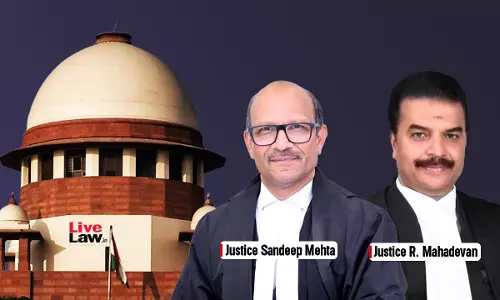
Temporary Workers Engaged In Maharashtra Public Works Dept Entitled To Holidays On 2nd & 4th Saturdays : Supreme Court
Recently, the Supreme Court granted relief to the temporary workers engaged in the Public Works Department of Maharashtra observing that they are entitled to get the benefits of public holidays as well as holidays on the 2nd and 4th Saturdays of each month. The respondents herein were the employees employed by the State's Public Works Department. On 27th February 2004, the respondent...

Notary's Omission To Make Entry In Notarial Register Misconduct : Supreme Court
In a case where a Notary was alleged to have notarized affidavit of the petitioner in his absence, and the petitioner denied filing the special leave petition, the Supreme Court recently observed that an act or omission on part of a Notary in violation of Rule 11 of the Notaries Rules 1956 would amount to misconduct, and such Notary would be unfit to be a Notary."...the Notaries Act...
Strange Approach By HC : Supreme Court Sets Aside Order Dismissing FIR Quashing Petition As 'Infructuous' Due To Petitioner's Arrest
The Supreme Court today (September 20) criticized a decision of the Allahabad High Court, which declared a petition seeking the quashing of an FIR as “infructuous” solely because the petitioner had been arrested.A bench of Justice Abhay Oka and Justice Pankaj Mithal set aside the High Court's order that dismissed the petition without considering its merits.In its order, the Supreme...
State Must Ensure Timely Payment Of Land Acquisition Compensation Even If Private Company Is Ultimately Liable, Delay Violates Art 300A: Supreme Court
The Supreme Court today (September 20) criticised the State of Himachal Pradesh for failing to ensure the timely payment of additional compensation of Rs. 3,05,31,095 awarded to landowners for land acquired in 2008 for a cement project run by JAL(M/s Jaiprakash Associates Limited).A bench of Justice JB Pardiwala and Justice Manoj Misra said that the state government should have...

Insufficiently Stamped Document Not Admissible Merely Because It Was Exhibited Unless Deficiency Is Cured : Supreme Court
Recently, the Supreme Court justified the dismissal of the specific performance suit because it was filed based on the insufficiently stamped agreement to sell. The Court said that a relief cannot be sought based on a document that has not satisfied the legal requirements for admissibility i.e., an insufficiently stamped instrument being inadmissible in evidence could not bring relief to...