


Supreme court
'People Don't Purchase High-End Luxurious Cars To Suffer Discomfort' : Supreme Court Holds Mercedes Benz Liable For Faults In Vehicles
The Supreme Court on Tuesday upheld orders of the National Consumer Disputes Redressal Commission (NCDRC) granting relief to two companies who had purchased cars from luxury car company Mercedes-Benz for the use of their directors.A bench of Justice Bela M Trivedi and Justice Pankaj Mithal was dealing with appeals arising out of a case of a car developing heating issues and another case of...
Power Of Attorney Impliedly Revoked When Principal Acts Independent Of Agency With Knowledge To Agent & Third Parties : Supreme Court
The Supreme Court on Tuesday (July 9) observed that there would be an implied revocation of Power of Attorney (“POA”) granted to the agent if the act of Principal choosing to act for himself is known to an agent and third person."In a case where the principal chooses to act for himself, particularly to the agent's knowledge and a person to be affected, then it can be held that Section 207...
Principle Of Res-Judicata Applicable Between Co-Defendants If There Exists Conflict Of Interest Between Them : Supreme Court
Observing that the principle of res judicata is applicable not only between the plaintiff and the defendants but also between the co-defendants, the Supreme Court held that the condition precedent to make the principle of res judicata applicable between the co-defendants is that there must be a conflict of interest between the co-defendants. The bench comprising Justices Abhay S. Oka and...

Disturbing That ED Hasn't Completed Investigation Even After 5 Years : Supreme Court On Chhattisgarh NAN Scam Case
The Supreme Court on Tuesday said that it is disturbing that the Directorate of Enforcement has not completed the investigation in the 2015 Nagrik Apurti Nigam (NAN) scam case concerning corruption in the Public Distribution System (PDS) in Chhattisgarh.A bench of Justice Abhay S Oka and Justice Augustine George Masih granted two weeks' time to the ED to file an affidavit to show that...
S.313 CrPC | Non-Questioning On Incriminating Circumstances Vitiates Trial If It Resulted In Material Prejudice To Accused :Supreme Court
The Supreme Court on Monday (July 8) held that the non-questioning of an accused on 'incriminating circumstances' and depriving him of an opportunity to explain the incriminating circumstances under Section 313 of the Code of Criminal Procedure ("CrPC") would vitiate the trial if such omission result in a miscarriage of justice. The Court said that non-adherence to the provision of Section 313...
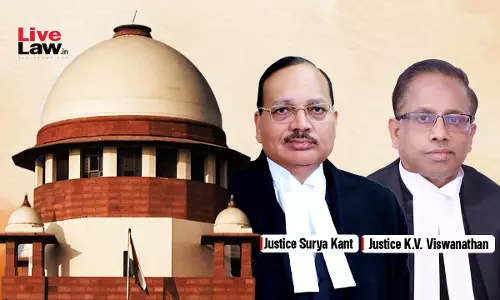
Supreme Court Upholds Provision Of Age Relaxation To Shiksha Karmis In Recruitment To Post Of Prabodhak In Rajasthan
The Supreme Court upheld the age relaxation provided to Shiksha Karmis and other government educational project employed candidates for direct recruitment to the post of Prabodhak (teacher) under the Rajasthan Panchayati Raj Prabodhak Service Rules, 2008.A bench of Justice Surya Kant and Justice KV Viswanathan noted that educational projects were implemented to address the issue of...
'Disabling Humour' Disparaging Persons With Disability Must Be Distinguished From 'Disability Humour' : Supreme Court
The Supreme Court today (July 8) in a significant ruling on the Rights of Persons with Disabilities (PwDs) laid down guidelines for ensuring their sensitive portrayal by Creators on Visual and Electronic Media. The Court also highlighted the difference between 'disability humour' and 'disabling humour' which often gets overlooked by the media creators.The Bench of CJI DY Chandrachud and...
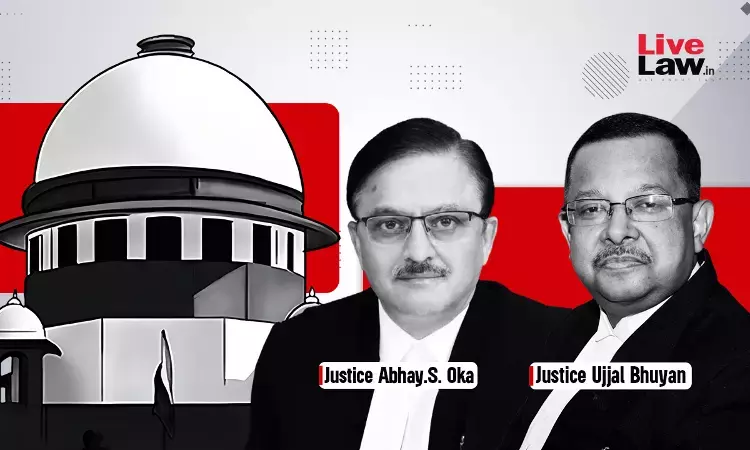
Court Need Not Always Impose Bail Condition Requiring Foreign Accused To Obtain Embassy's Assurance On Not Leaving India: Supreme Court
The Supreme Court clarified today that courts need not impose a bail condition requiring a foreign accused to obtain assurance from his country's Embassy/High Commission that he will not leave India and would appear before the court as required.A bench of Justice Abhay S Oka and Justice Ujjal Bhuyan allowed an appeal by a Nigerian national challenging such a condition imposed on...
Supreme Court Apprehensive About Employers Shunning Women If Menstrual Leave Is Mandated, Asks Centre To Examine
The Supreme Court on Monday (July 8) asked the Union to consult all stakeholders on the question of having a menstrual leave policy for working women. The Court also expressed apprehension that such a policy may not be welcomed by the employers and create troubles for women seeking jobs. The bench led by CJI DY Chandrachud comprising Justice JB Pardiwala and Manoj Misra was hearing a...

'They Must Not Be Lampooned' : Supreme Court Issues Guidelines To Visual Media For Portrayal Of Persons With Disabilities
In a notable judgment delivered today, the Supreme Court has issued a set of guidelines to the visual media to ensure a dignified portrayal of persons with disabilities. The Court stressed that portrayals which carry negative stereotypes about persons with disabilities would impact their dignity and perpetuate social discrimination against them.A bench comprising Chief Justice of India...