


Supreme court
S. 498A IPC | Supreme Court Imposes Rs 5 Lakh Cost On Wife's Father For Filing False Cases At Different Places To Harass Husband
The Supreme Court on Friday (April 19) imposed a cost of Rs.5 Lakhs on a wife's father for lodging a false Section 498A IPC case at different places against the husband to harass him by facing trial at different places."We thus deprecate this practice of state machinery being misused for ulterior motives and for causing harassment to the other side (husband), we are thus inclined to impose...
Process For IBC Offences To Be Issued By Sessions Court Despite Companies Act Amendment Vesting Jurisdiction On Judicial Magistrate: Supreme Court
Observing that the offences committed under the Insolvency and Bankruptcy Code, 2016 (“IBC”) would be tried by the Special Court established under Section 435 of the Companies Act, 2013 and the sessions judge would have the power to issue process against the accused, the Supreme Court on Friday (April 19) upheld the issuance of process by the sessions judge to the accused.The Court...
![The Complete Supreme Court Annual Digest- 2023 [Part-VIII]](https://www.livelaw.in/h-upload/2024/04/17/500x300_534362-complete-supreme-court-annual-digest-2023-part-8.webp "The Complete Supreme Court Annual Digest- 2023 [Part-VIII]")
The Complete Supreme Court Annual Digest- 2023 [Part-VIII]
Criminal Law High Courts while exercising Section 482 Cr.P.C. power legally bound to see if accusations constitute any offence. Abhishek Saxena v. State of Uttar Pradesh, 2023 LiveLaw (SC) 1072 No adverse inference against prosecution merely because witnesses are withheld. Maheshwari Yadav v. State of Bihar, 2023 LiveLaw (SC) 1063 Delay in filing fir not satisfactorily...
![Supreme Court Weekly Digest With Subject /Statute Wise Index [March 18 to 24]](https://www.livelaw.in/h-upload/2024/04/02/500x300_531717-supreme-court-weekly-digest.webp "Supreme Court Weekly Digest With Subject /Statute Wise Index [March 18 to 24]")
Supreme Court Weekly Digest With Subject /Statute Wise Index [March 18 to 24]
Citations 2024 LiveLaw (SC) 240 to 2024 LiveLaw (SC) 255Arbitration and Conciliation Act 1996Arbitration and Conciliation Act 1996; Section 78(5) – Arbitration clause – Two-Contract Case – When the parties enter into a contract, making a general reference to another contract, such general reference would not have the effect of incorporating the arbitration clause from the referred...
To Prove S.27 Evidence Act Statement, Investigating Officer Must Narrate What Accused Stated; Merely Exhibiting Memorandum Not Enough : Supreme Court
In a notable judgment, the Supreme Court has discussed how to prove a disclosure statement made by an accused under Section 27 of the Indian Evidence Act.The Court noted that the statement of an accused recorded by a police officer under Section 27 of the Evidence Act is basically a "memorandum of confession" of the accused recorded by the Investigating Officer during interrogation which has...
Supreme Court Permits Withdrawal Of Plea Seeking Regulation Of Inappropriate Content On OTT Platforms, Asks Litigant To First Approach Govt
The Supreme Court today permitted withdrawal of a plea seeking regulation of inappropriate content on over-the-top (OTT) platforms, while granting liberty to the petitioner to make a representation to the Union of India.The Bench of Justices BR Gavai and Sandeep Mehta passed the order on the petition filed in public interest, challenging the publication of inappropriate content on OTT...
Supreme Court Stays Himachal Pradesh HC Order Refusing Recall Of Transfer Directions Against Kangra SP
The Supreme Court on Friday (April 19) stayed the order of the Himachal Pradesh High Court which directed the transfer of Superintendent of Police (SP), Kangra District. The High Court in the impugned order refused to recall its earlier directions on transferring Kangra SP Shalini Agnihotri and DGP Sanjay Kundu. The Supreme Court bench comprising CJI DY Chandrachud and Justice JB Pardiwala...
'This Is A Scam' : Supreme Court Suprised At Gujarat APMC Allowing 5-Star Hotel On Land Meant For Agriculture Market Yard
The Supreme Court on Friday (April 19) declined to interfere with the order passed by the Gujarat High Court directing the Agricultural Produce Market Committee (APMC), Surat to auction the land allegedly misappropriated for the construction and running of a 5-star hotel. The Supreme Court observed that the High Court was correct in directing such an auction for the land allotted to be...
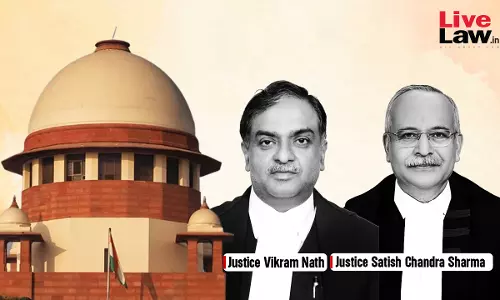
If Magistrate Takes Cognizance Of Additional Materials Along With Protest Petition, Case Has To Proceed As Private Complaint : Supreme Court
The Supreme Court held that if the Magistrate takes cognizance of the offence and issues summons to an accused by recording satisfaction based on the additional evidence produced by way of a protest petition filed by the informant, then such a protest petition ought to be treated as a private complaint case under Section 200 of the Code of Criminal Procedure.Reversing the findings of the...
Jalgaon Mosque Dispute : Supreme Court Directs Municipal Council To Keep Main Entrance Key, Allows Opening Of Back Gate For Namaz
Today (April 19), the Supreme Court ordered that the keys to a mosque in Erandol Taluka, Jalgaon, will remain with the municipal council. While ordering thus, the bench of Bench of Justices Surya Kant and K.V Vishwanathan disposed of an appeal preferred by the Jumma Masjid Trust Committee against the Bombay High Court's order directing it to return the keys of the Jalgaon mosque to the council...
Supreme Court Seeks Centre's Response On Plea Challenging Bar On Surrogacy For Second Child Of Couples Already Having A Healthy Child
The Supreme Court on Friday (April 19) sought the Union government's response on a plea filed to allow an intending couple, having a healthy biological child, to beget a second child through surrogacy if it so wants.The bench of Justices BV Nagarathna and AG Masih passed the order upon hearing a petition under Article 32 of the Constitution, which challenged the constitutional validity of...
Supreme Court Imposes Rs. 5 Lakh Cost On Telangana Govt For Incorrect Affidavits, Allows State To Recover Amount From Erring Officials
The Supreme Court on Thursday (April 18) imposed a cost of Rs. 5 Lakhs on the State of Telangana with liberty to recover the said cost from the erring officials who have facilitated and filed incorrect affidavits in the ongoing proceedings.The case relates to the declaration of the reserved forest land as private land in favor of the private persons by the High Court while exercising its...