


Supreme court
Supreme Court Half Yearly Digest 2023- Arbitration
12 months’ time limit under Section 29A Arbitration Act not applicable to international commercial arbitration. TATA Sons Pvt. Ltd. v. Siva Industries and Holdings Ltd., 2023 LiveLaw (SC) 39 : 2023 INSC 13 : (2023) 5 SCC 4212015 Arbitration Amendment not applicable though S.11 application was filed after it, if arbitration notice was issued pre-amendment. Shree Vishnu Constructions v....

Violation Of Section 19 PMLA Will Vitiate Arrest; Magistrate Should Ensure That ED Followed Arrest Procedure : Supreme Court
The Supreme Court on Monday held that any non-compliance of the mandate of Section 19 (Power To Arrest) of the Prevention Of Money Laundering Act, 2002, would vitiate the very arrest itself. A division bench of Justice A S Bopanna and Justice M M Sundresh while dismissing Tamil Nadu Minister Senthil Balaji's plea challenging custody by Enforcement Directorate in the money laundering...
‘Custody' Under Section 167 CrPC Includes Custody Of Other Investigating Agencies Such As ED, Not Just Police: Supreme Court
The Supreme Court on Monday held that ‘custody' under Section 167 of the Code of Criminal Procedure, 1973 includes custody of other investigating agencies such as the Enforcement Directorate and not just the police alone.The said observation was made by a division bench of Justice A S Bopanna and Justice M M Sundresh while dismissing Tamil Nadu Minister Senthil Balaji's plea challenging...
Section 41A CrPC Not Applicable To Arrest Made Under PMLA: Supreme Court
The Supreme Court on Monday while dismissing Tamil Nadu Minister Senthil Balaji's plea challenging custody by Enforcement Directorate in the money laundering case, held that Section 41A of the Code of Criminal Procedure, 1973 (Notice of appearance before police officer) would not apply to an arrest made under the Prevention Of Money Laundering Act, 2002."Section 41A of the CrPC, 1973 has got...
Habeas Corpus Writ Not Maintainable Against ED Alleging Illegal Arrest;Plea To Be Raised Before Magistrate: Supreme Court
The Supreme Court on Monday while dismissing Tamil Nadu Minister Senthil Balaji's plea challenging custody by Enforcement Directorate in the money laundering case, held that a writ of habeas corpus would not be maintainable on allegation of illegal arrest by the ED. The Apex Court clarified that the plea regarding illegal arrest is to made before concerned the Magistrate, since custody...
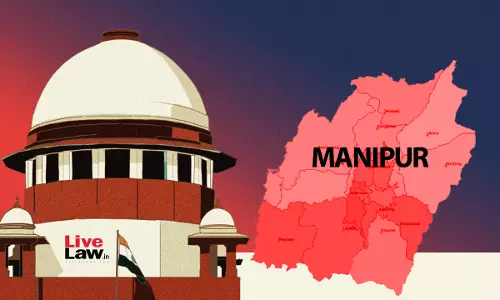
Manipur Violence : Supreme Court Appoints Officer To Monitor CBI Investigation, Includes Officers From Other States In SIT
The Supreme Court on Monday said that it will pass a slew of directions in relation to the Manipur violence cases to "restore a sense of faith in the rule of law and build a sense of confidence".The Court said that it will constitute a committee of three former female High Court judges to "look at diverse aspects on humanitarian nature". It will be a "broad based committee" looking at...
![Supreme Court Weekly Digest With Nominal And Subject/Statute Wise Index [July 17 – 23, 2023]](https://www.livelaw.in/h-upload/2023/05/10/500x300_471741-supreme-court-weekly-digest-with-nominal-and-subject-statute-wise-index.webp "Supreme Court Weekly Digest With Nominal And Subject/Statute Wise Index [July 17 – 23, 2023]")
Supreme Court Weekly Digest With Nominal And Subject/Statute Wise Index [July 17 – 23, 2023]
SUBJECT WISE INDEXBailSupreme Court grants bail to Teesta Setalvad; calls Gujarat HC observations 'perverse', 'contradictory'. Teesta Atul Setalvad v. State of Gujarat, 2023 LiveLaw (SC) 554 : 2023 INSC 637ChequeNI Act | In cheque dishonour case, interim compensation can be ordered to be paid only after the accused pleads not guilty. Pawan Bhasin v. State of U.P., 2023 LiveLaw (SC)...
Central Civil Service Rules | Retired Employee Can Be Appointed As Inquiry Authority In Disciplinary Proceedings : Supreme Court
The Supreme Court recently held that the disciplinary authority under the Central Civil Service Rules is empowered to appoint a retired employee as an inquiry authority. It is not necessary that the inquiry officer should be a public servant. The Supreme Court bench comprising Justices Sanjiv Khanna and Justice Bela M Trivedi was hearing an appeal against Odisha HC judgment which relied on...

'Trivial' : Supreme Court Quashes 2014 Criminal Case Over Petty Office Altercation
The Supreme Court quashed a chargesheet filed against an executive engineer in connection with an office altercation with his peon long back in 2014. The court took into account the trivial nature of the allegations. The court observed that there was no progress in the trial pending before Chief Judicial Magistrate since 2015. The Supreme Court bench comprising Justices Sanjiv Khanna and...
Supreme Court Reduces Sentence Awarded To Woman For Assaulting Govt Official During Labourers Protest 30 Years Ago
The Supreme Court granted the benefit of probation to a social worker who was convicted of assaulting a public servant and reduced her sentence to 1 month. The incident related to 1992 when she had barged into the office of the Directorate(Women and Child Development) and abused and pushed a public official who got injured in her right finger.The Supreme Court bench comprising Justices Abhay...
Registration Of All BS VI Diesel Compliant Vehicles Permissible In NCT Delhi : Supreme Court
In a recent order, the Supreme Court has clarified that the registration of all BS VI Compliant diesel vehicles is allowed to be done in NCT Delhi, irrespective of their requirement for the G-20 summit.The bench of Justice Sanjay Kishan Kaul and Justice Sudhanshu Dhulia said, “From a reading of the order it does appear that the order has been passed in the aforesaid terms but learned...
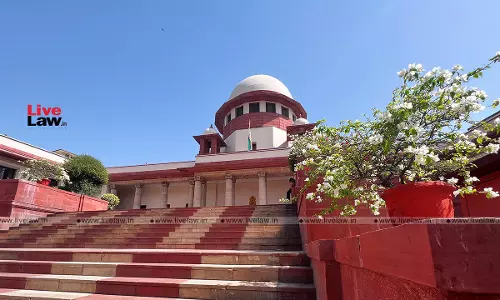
Allegations In Complaint Made In Good Faith To Lawful Authority Cannot Attract Offence Of Defamation : Supreme Court
The Supreme Court quashed a defamation case against a man accused of making defamatory allegations in his complaint before Sub Divisional Magistrate.It is not defamation to prefer in good faith an accusation against any person to any of those who have lawful authority over that person with regard to the subject-matter of accusation, the bench of Justices J B Pardiwala and Manoj Misra...