


Supreme court
Supreme Court Constitutes Expert Committee to Find a Solution for Unregulated Entry of Pilgrims into Core Areas of National Parks and Wildlife Sanctuaries
The Supreme Court of India on Wednesday set up a high-level panel to examine the environmental issues arising as a result of a large number of pilgrims visiting the temples located inside the core area of Rajasthan’s Sariska Tiger Reserve and directed them to furnish a report within six weeks. The bench held: “The perusal of an affidavit by the deputy forest conservator...
Gurugram Prime Plot 'Sold' Through Fake GPA : Supreme Court Forms SIT To Probe Land Scam; Questions Role Of Sub-Registrar's Office
The Supreme Court, recently, directed the Commissioner of Police, Gurugram to constitute a Special Investigation Team (SIT) to investigate a land scam that involves officials at the office of land Registering Authorities and other accused persons allegedly duping an elderly NRI couple. The Apex Court categorically stated that the Commissioner of Police, Gurugram is personally responsible...
Revenue Dept Can't Recover Refunded Cess Amount Because Refund Was Based On A Judgment Which Was Later Overruled : Supreme Court
The Supreme Court has upheld the decision of the Jammu and Kashmir and Ladakh (J&K&L) High Court where the court had held that the assessee was not liable to return the Education Cess and Secondary & Higher Education Cess in view of the law subsequently laid down by the Supreme Court in M/s Unicorn Industries vs. Union of India, (2020) 3 SCC 492.In the present case Commissioner...
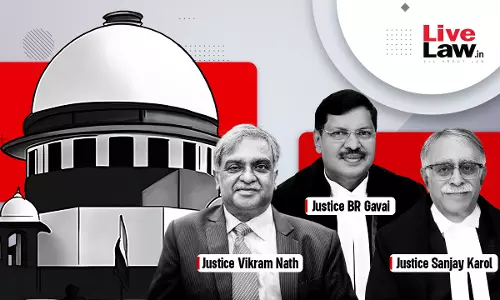
Supreme Court Rejects Argument That 'Piecemeal’ Extensions Will Affect Independence Of Directors Of CBI & ED; Upholds Amendments To CVC Act & DSPE Act
The Supreme Court of India on Tuesday, while upholding the validity of the 2021 amendments to the Central Vigilance Act and the Delhi Special Police Establishment Act, rejected the argument that granting extensions of only one year at a time to the terms of the heads of the Directorate of Enforcement and the Central Bureau of Investigation would threaten the independence of the agencies....

Persons With Disability Act 1995 Mandated Reservation In Promotions Too : Supreme Court Grants Relief To RBI Employee
Recently, the Supreme Court invoked Article 142 of the Constitution of India to direct RBI to extend the benefit of reservation in promotion to an employee with disability, who was denied the same for a long time(Reserve Bank of India v. A.K. Nair And Ors).The challenge in the petition pertained to securing promotion to the post of Assistant Manager in the RBI under Persons with...
Regularizing Service Of Few Employees And Not Others Despite Eligibility Is Violative Of Article 14: Supreme Court
The Supreme Court has held that act of regularizing the services of only some employees and not of other entitled employees, is discriminatory and violative of Article 14 of the Constitution of India. The Chief Commissioner of Income Tax had found 65 employees entitled to regularization of employment but only 35 could be regularized, since only 35 posts were available. The Bench comprising...
Can Documents Relied On By Prosecution Be Supplied To Accused In Digital Format? Supreme Court To Examine Whether Hard Copy Is Mandatory
The Supreme Court will examine whether supplying of hard copies of the documents relied on by the Prosecution, is mandatory, or can it be supplied in digital format?This issue was raised in a special leave petition filed by Central Bureau of Investigation against the Judgment of Madhya Pradesh High Court that had upheld the direction issued by the Special Judge ordering for supply of hard...

Nullification Of Court Direction By Legislation Impermissible Without Altering Basis Of Judgment : Supreme Court In ED Director's Case
While holding the extensions given to the term of ED Director Sanjay Kumar Mishra, the Supreme Court reiterated that a legislative act to nullify a judgment, without taking away its basis, is an impermissible exercise.A bench comprising Justices BR Gavai, Vikram Nath and Sanjay Karol noted that ignoring the direction given by the Supreme Court in the 2021 judgment in the case Common Cause...
Order VII Rule 11 CPC - Appropriateness Of Prayer Sought Is Not An Issue To Be Considered While Deciding Application Seeking Rejection Of Plaint: Supreme Court
The Supreme Court observed that appropriateness of prayer sought is not an issue that should be considered while deciding an application seeking rejection of plaint under Order VII Rule 11 of Code of Civil Procedure.In this case, the defendants filed the application seeking rejection of the plaint on the ground that the plaintiff had not sought for an appropriate prayer to declare the sale...
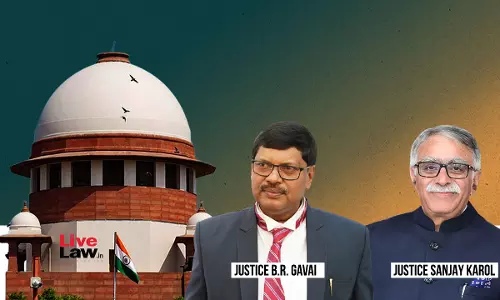
Ballistic Expert's Evidence Important In Cases Of Murder Caused By Firearms: Supreme Court
The Supreme Court observed that, in cases where injuries are caused by firearms, the failure to examine Ballistic Expert would be a glaring defect when the prosecution case is based on circumstantial evidence.In this case, the High Court of Punjab and Haryana, had upheld the conviction of the accused in a murder case. The conviction based on on the last seen theory and the...
Supreme Court Invalidates Extensions Of ED Director SK Mishra's Term; Permits Him To Continue Till July 31
The Supreme Court on Tuesday held as illegal the extension given to the term of Enforcement Directorate chief SK Mishra for violating the mandate of the Supreme Court's 2021 judgment in the Common Cause case that he should not be given further extension. However, the Court allowed him to continue in his post till July 31, 2023, taking into consideration the concerns expressed by the...
Supreme Court 'Shocked' To See Lawyer Filing Article 32 Petition Against State To Recover Legal Fees
On Monday, while disposing of a writ petition filed by a former Additional Advocate General of the State of Uttar Pradesh seeking writ of mandamus against the State Government to clear the bills of his outstanding fees, the Supreme Court expressed doubt whether such a petition can be entertained in exercise of jurisdiction under Article 32 of the Constitution of India, especially when...