


Supreme court
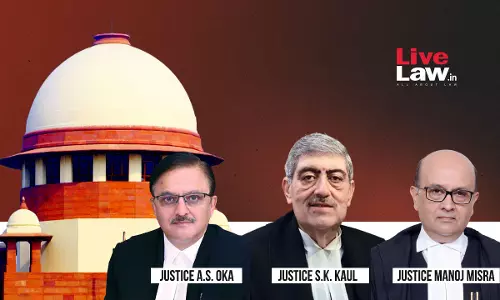
Affinity Test Not Essential To Determine Correctness Of Caste/Tribe Claim : Supreme Court
The Supreme Court, on Friday, answered the reference pertaining to the question - whether the affinity test is integral to the determination of caste status made by the Caste Scrutiny Committee.Affinity test is used to ascertain if the person follows the traditional cultural traits of the community.A Bench comprising Justice S.K. Kaul, Justice A.S. Oka and Justice Manoj Misra held that...
Mere Membership Of Unlawful Organization Is UAPA Offence : Supreme Court Overrules 2011 Precedents
In a significant verdict, the Supreme Court on Friday overruled its 2011 judgments in Arup Bhuyan vs State of Assam, Indra Das vs State of Assam and State of Kerala vs Raneef which held that mere membership of a banned association is not sufficient to constitute an offence under the Unlawful Activities (Prevention) Act 1967 or the Terrorism and Disruptive Activities (Prevention) Act, unless it...
Breaking: 14 Political Parties Move Supreme Court Seeking Guidelines Against Alleged Arbitrary Action Of ED, CBI On Opposition Leaders
14 political parties including the Indian National Congress, Aam Aadmi Party and Shiv Sena have moved the Supreme Court against alleged arbitrary use of central investigating agencies Enforcement Directorate and Central Bureau of Investigation in arresting opposition leaders.The matter was mentioned today before CJI DY Chandrachud by Senior Advocate AM Singhvi. The political parties seek...

'Large Number Of Remand Orders Passed In Violation Of Law Are From Uttar Pradesh' : Supreme Court Seeks Allahabad HC's Intervention
The Supreme Court recently noticed that a very large number of orders remanding accused to custody in violation of the directives issued by the top court are coming from Uttar Pradesh.A bench comprising Justices Sanjay Kishan Kaul, Ahsanuddin Amanullah and Aravind Kumar was ascertaining the compliance of the directions given in the judgement in Satender Kumar Antil vs Central Bureau...
Queer Non-Binary Lawyer Writes To Supreme Court For Infrastructural Inclusivity & LGBTQIA+ Representation On Gender Sensitisation Committee
Amid calls for greater diversity and inclusion in the higher judiciary, the Supreme Court Gender Sensitisation and Internal Complaints Committee has received a representation on the need for infrastructural inclusivity in the top court and queer representation on the committee. Queer, non-binary lawyer Rohin Bhatt, while noting that with every passing day, more and more...
Teesta Setalvad Case : ASG To Inform Supreme Court If Anything Substantial Survives In The Matter
The Supreme Court, on Thursday, adjourned the hearing in a batch of pleas filed by Teesta Setalvad in relation to three FIRs lodged against the couple over alleged embezzlement of funds raised for victims of 2002 Gujarat riots.The Additional Solicitor General, Mr. S.V. Raju apprised a Bench comprising Justice SK Kaul, Justice Ahsanuddin Amanullah and Justice Aravind Kumar that Teesta...
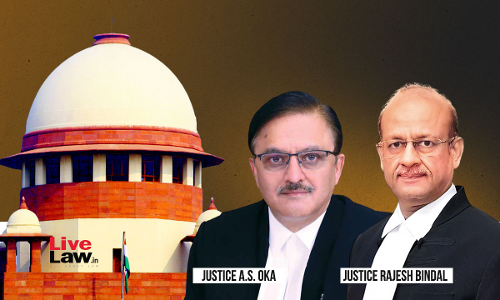
Supreme Court Acquits Man Accused Of Taking Rs 300 Bribe Twenty Years Ago
The Supreme Court on Thursday acquitted a man who was convicted under the Prevention of Corruption Act 1988 for accepting a bribe of Rupees 300 in the year 2003.The convict, who was working as a cleaner, was accused to taking bribe for supplying a copy of the death certificate to the complainant. The Supreme Court allowed his appeal against the concurrent findings of the trial court and...

Carrot-and-Stick Policy Of Extending ED Director's Tenure By One Year At A Time Threatens Independence : Petitioners Tell Supreme Court
The carrot-and-stick policy of granting piecemeal extensions of only one year at a time to chiefs of investigating agencies threatened the independence of the institutions since the heads would either be perceived to have or would actually be compelled to compromise their duties towards the end of their tenure to secure an extension, Senior Advocate Gopal Sankaranarayanan told the...
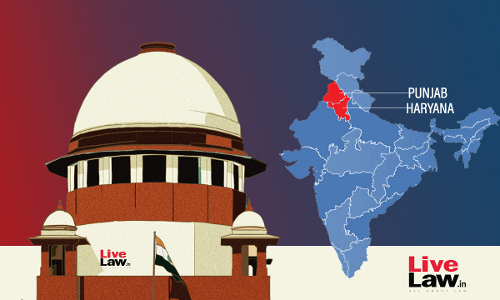
Supreme Court Urges Union To Play A Proactive Role To Resolve Sutlej-Yamuna Canal Dispute Between Punjab & Haryana
The Supreme Court, on Thursday, asked the Union Government to play a proactive role in the endeavour made by the neighbouring States of Punjab and Haryana to find workable solutions in relation to the Sutlej-Yamuna Link (SYL) canal dispute. A three-judge bench comprising Justice Sanjay Kishan Kaul, Justice Ahsanuddin Amanullah, and Justice Aravind Kumar was hearing an original suit filed...
IBC- Once Resolution Plan Is Approved, No Modifications Are Permissible : Supreme Court
The Supreme Court has held that the declaration made by the NCLT to the effect that the trademarks “Deccan Chronicle” and “Andhra Bhoomi”, which originally belonged to Deccan Chronicle Holdings Ltd. (“DCHL/Corporate Debtor”), continues to be under the ownership of DCHL post the approval of resolution plan, would amount to impermissible modification of resolution plan as the same...
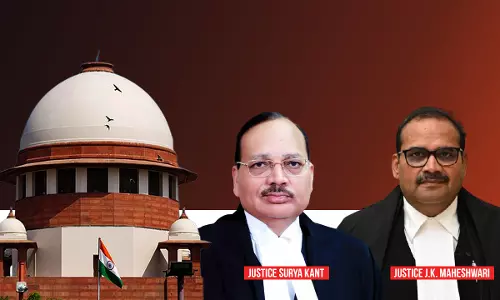
Advocate Making Baseless Allegation That Another Lawyer Took Money In Judge's Name; Supreme Court Affirms Contempt Of Court Proceedings
Taking a lenient view in an appeal filed by an advocate who was punished for contempt of Court, the Supreme Court reduced the penalty amount from Rs. 2 Lakhs to Rs. 1 Lakh.However, the Bench comprising of Justice Surya Kant and Justice J.K. Maheshwari upheld sentence for contempt of court against the advocate who raised frivolous allegations against another advocate that the latter was asking...

Supreme Court Asks Centre To File Response In Plea To Protect Western Ghats
Recently the Supreme Court bench comprising CJI D.Y Chandrachud, Justice P.S Narasimha, and Justice J.B Pardiwala passed an order directing the Central government to file a counter affidavit within four weeks in the matter concerning the protection of the Western Ghats.The matter will be next posted on July 25, 2023.About the case In 2019, a writ petition was filed by several individuals...