Supreme court
SARFAESI Act | Supreme Court Flags Inconsistency Between S.13(8) Act & Rules On Borrower's Redemption Right, Urges Govt To Amend
The Supreme Court on Monday (Sep. 22) flagged a significant inconsistency between the SARFAESI Act, 2002 ("Act") and the Rules concerning the borrower's right of redemption after the 2016 amendment. A bench of Justice JB Pardiwala and Justice R Mahadevan heard the case arising out of the Madras High Court's decision which had quashed a sale certificate issued in favour of auction...
High Court's Inherent Power Can Be Invoked To Cancel Bail After Sessions Court's Dismissal Of S.439(2) CrPC Plea : Supreme Court
The Supreme Court has held that a plea for cancellation of bail can be moved before the High Court by invoking its powers under Section 439(2) read with Section 482 of the Code of Criminal Procedure, even if the Sessions Court has already declined a cancellation application under Section 439(2).The Court rejected the contention that once a Sessions Court declines an application under...
SARFAESI Act | 2016 Amendment To S. 13(8) Applies To Pre-Amendment Loans If Default Occurred After That: Supreme Court
The Supreme Court held that the 2016 amendment to Section 13(8) of the SARFAESI Act, which extinguishes a borrower's right of redemption once the secured creditor publishes an auction notice, will apply even to loans taken before the amendment came into force, provided the default occurred after September 1, 2016(the date when the amendment came into force).A Bench of Justices J.B. Pardiwala...
S. 27 Evidence Act | Simultaneous Disclosure Statements Made By Multiple Accused Need Greater Scrutiny: Supreme Court
The Supreme Court on Monday (Sep. 22) observed that for joint disclosure statements, made by multiple accused simultaneously, to become admissible under Section 27 of the Evidence Act, high scrutiny is needed to rule out the possibilities of tutoring of the accused. The Court added that while simultaneous disclosure statements can be legally admissible, courts must exercise heightened...
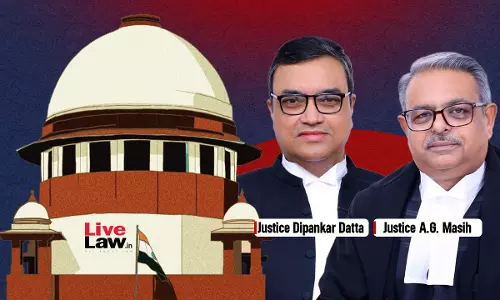
'Antecedents Alone Not Ground To Cancel Bail': Supreme Court Restores Bail To Accused In SDPI Leader Shan Murder Case
The Supreme Court on Monday (September 22) set aside the judgment of the Kerala High Court, which cancelled the bail granted to five persons who are accused of murdering the then Social Democratic Party of India (SDPI) State Secretary KS Shan in December 2021.A bench comprising Justice Dipankar Datta and Justice AG Masih granted bail to five accused, who are alleged to be members of the RSS....

Supreme Court Weekly Roundup: September 15, 2025 To September 21, 2025
Reports/JudgmentsWaqf Amendment Act 2025 : Supreme Court Stays Certain ProvisionsCase Details: In Re The Waqf (Amendment) Act, 2025 | W.P.(C) No. 276/2025Citation: 2025 LiveLaw (SC) 909The Supreme Court stayed certain provisions of the Waqf (Amendment) Act 2025, while observing that several other provisions did not require any interference at the interim stage.The key points from the...
![Supreme Court Weekly Digest September 2025 [Sep 1 - 10, 2025]](https://www.livelaw.in/h-upload/2025/09/13/500x300_620311-supreme-court-weekly-digest.webp "Supreme Court Weekly Digest September 2025 [Sep 1 - 10, 2025]")
Supreme Court Weekly Digest September 2025 [Sep 1 - 10, 2025]
Citation 2025 LiveLaw (SC) 859 - 2025 LiveLaw (SC) 882Arbitration and Conciliation Act, 1996 (1996 Act) - Section 31(7)(b) - Award of interest - Pendente Lite interest - Whether a clause in the agreement barring interest on 'delayed payment/disputed claim' also bars the arbitral Tribunal from awarding pendente lite interest – Held, clause restricting interest on delayed payments by itself...
Touching Private Parts Of Minor Not Offence Of Rape, But Sexual Assault Under POCSO Act : Supreme Court
The Supreme Court held that merely touching the private parts of a minor girl will not constitute the offence of rape under Section 375/376AB of the Indian Penal Code (IPC) or penetrative sexual assault under Section 6 of the Protection of Children from Sexual Offences (POCSO) Act.The Court clarified that such conduct would instead amount to the offence of “aggravated sexual assault”...

Supreme Court Half Yearly Digest 2025: IPC & BNS
SUPREME COURT HALF YEARLY DIGEST 2025BHARTATIYA NYAYA SANHITA, 2023 (BNS) / INDIAN PENAL CODE, 1860 (IPC)Section 3(5). General explanations- Acts done by several persons in furtherance of common intentionSections 34, 149 IPC - Difference between 'Common Intention' (S.34 IPC) & 'Common Object' (S.149 IPC) - Section 34 IPC (Common Intention): Requires active participation and proof of an...