


Supreme court

S. 223 CrPC/S. 243 BNSS | Supreme Court Lays Down Principles For Joint Trial In Criminal Cases
Interpreting Section 223 Cr.P.C (now Section 243 BNSS), the Supreme Court held that a joint trial is permissible where multiple accused are involved in offences arising out of the same transaction and a separate trial would be warranted only if the acts attributed to each accused are distinct and severable. The Court laid down the following propositions regarding the joint trial:- (i)...


Supreme Court Weekly Round-Up: September 8, 2025 to September 14, 2025
Reports/Judgments'Judicial Impropriety' : Supreme Court Criticises High Court For Modifying Bail Condition When Bail Order Was Under Challenge In SCCause Title: Sreeja D G & Ors. v. Anitha R. Nair & Anr.Citation: 2025 LiveLaw (SC) 874The Supreme Court criticized the Kerala High Court for 'judicial impropriety' in modifying bail conditions while its anticipatory bail order was...



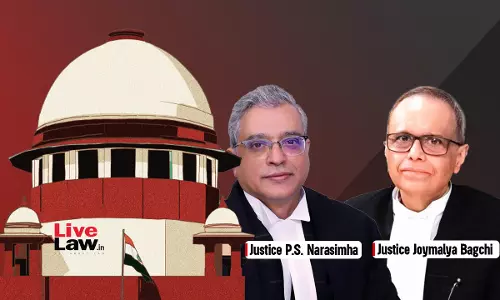
Order VIII Rule 6-A CPC | Defendant Can't File Counter-Claim Against Co-Defendant: Supreme Court
Holding that a counter-claim under Order VIII Rule 6-A CPC can be filed only against the plaintiff, the Supreme Court set aside the Gujarat High Court's decision that allowed one defendant to file a counter-claim against a co-defendant. A bench of Justice PS Narasimha and Justice Joymalya Bagchi ruled in favor of the plaintiff, who appealed against the High Court's decision to allow filing...

Financial Bids In Public Tenders Can't Be Altered After Opening; Sanctity Of Process Can't Be Compromised For More Revenue : Supreme Court
The Supreme Court in a recent case ruled that once financial bids of the tender are opened, it would not be permissible to rectify the bids. Otherwise, the sanctity of the tendering process would be compromised. The Court reiterated that the mere possibility of accrual of more money would not be a ground to rectify the bid once opened.A bench of Justice Manoj Misra and Justice Ujjal Bhuyan...
For Search Without Warrant Under Special Enactments, Recording Of Reasons Is Mandatory : Supreme Court
The Supreme Court recently held that in every search conducted under a special enactment without warrant, the requirement of recording reasons to believe is mandatory.The Court noted that Section 165 of the Code of Criminal Procedure (S.185 BNSS) mandates the recording of reasons for the belief regarding the existence of incriminating materials and the necessity of imminent search, when a...


Vantara's Acquisition Of Animals As Per Regulations : Supreme Court Accepts SIT Report
The Supreme Court today(September 15) observed that the acquisition of animals in Vantara (Greens Zoological Rescue and Rehabilitation Centre) run by the Reliance Foundation at Jamnagar, Gujarat, is prima facie within the regulatory mechanism. There was no foul play found by the Special Investigation Team(SIT) constituted by the Court to inquire into various allegations, including whether...
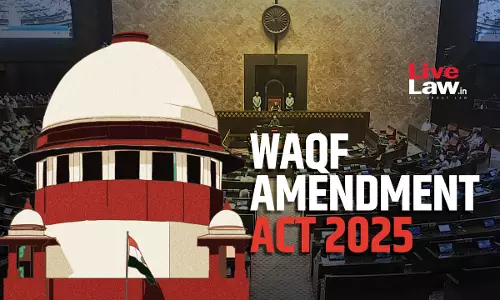
Abolition Of 'Waqf By User' Is Not Arbitrary Prima Facie : Supreme Court
The Supreme Court on Monday (September 15) refused to stay the provision in the Waqf Amendmnt Act 2025 which abolished the concept of 'Waqf by user'."Waqf by user" is a concept that recognized a property as waqf not through a formal dedication deed but through long, consistent public use of the property for a religious or pious purpose.The 2025 amendment deleted Section 3(r)(i) of the...