



- Home
- /
- Supreme court
- /
- Accused Entitled To Parity With...
Accused Entitled To Parity With Discharged Co-Accused If Evidence Against Him Is Not Qualitatively Stronger: Supreme Court
Yash Mittal
20 May 2026 10:43 AM IST
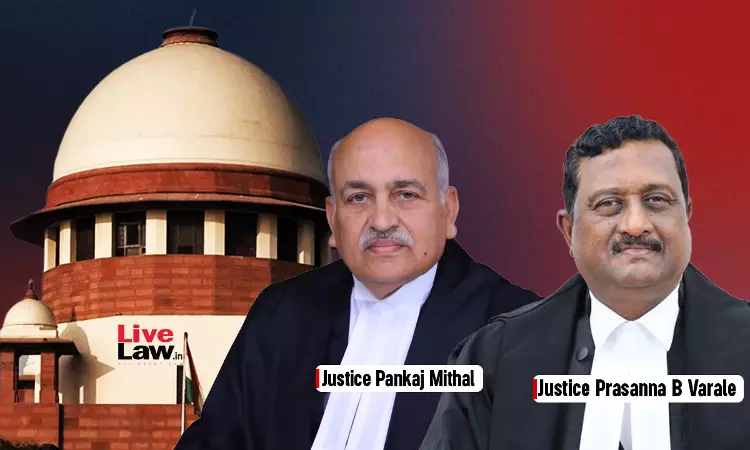
The Court observed that the principle of parity was a fundamental tenet of criminal jurisprudence.
The Supreme Court has held that an accused cannot be singled out for prosecution when similarly placed co-accused have already been discharged, particularly where the material against the remaining accused is not qualitatively stronger.A bench of Justices Pankaj Mithal and Prasanna B Varale discharged a Forest Range Officer facing corruption and conspiracy charges in an alleged illegal...
This is a premium content
Available exclusively to
Our subscribers
Subscribe Premium 
INR 1099+GST
Your support helps us to bring you more content at
an affordable subscription scheme !!!
All payment options available
The Supreme Court has held that an accused cannot be singled out for prosecution when similarly placed co-accused have already been discharged, particularly where the material against the remaining accused is not qualitatively stronger.
A bench of Justices Pankaj Mithal and Prasanna B Varale discharged a Forest Range Officer facing corruption and conspiracy charges in an alleged illegal timber felling case in Odisha, holding that the prosecution materials contained only vague, omnibus allegations without specifying his individual role.
The Court strongly underscored the principle of parity in criminal jurisprudence, noting that two co-accused Indian Forest Service officers, who were more senior and more prominently placed in the administrative decision-making chain, had already been discharged.
“A comparative examination of the roles ascribed to the discharged co-accused and the present Appellant shows no distinguishable basis that would justify differential treatment,” the Court observed.
Calling parity a “fundamental tenet of criminal jurisprudence,” the bench said similarly situated accused persons must be treated alike.
"The principle of parity, which is a fundamental tenet of criminal jurisprudence, requires that similarly situated accused persons be treated alike.
“When the allegations and evidence against the Appellant are not even qualitatively stronger than those against the discharged co-accused, the continuation of proceedings against the Appellant alone would be arbitrary and violative of Article 14 of the Constitution of India,” the Court held.
Criminal trial cannot be an instrument of oppression
The Supreme Court also cautioned against allowing criminal prosecution to become a tool of harassment, observing that courts must intervene at the threshold where the materials fail to disclose any offence.
"This Court is further persuaded by the broader consideration that the criminal process must not be permitted to degenerate into an instrument of oppression. The law must act as a shield for the innocent, not as a sword in the hands of the vindictive. Where the material does not disclose the commission of an offence, the Court is duty-bound to interdict the proceedings at the threshold. The criminal trial is not a mere formality, nor a ritualistic procedure to be endured regardless of merit. It entails stigma, hardship, and irreparable harm to the reputation and liberty of the individual. Where the materials do not establish even a grave suspicion, the accused must not be compelled to undergo the ordeal of trial."
The Court thus quashed a corruption case against the Forest Range Officer, who was accused of abusing his position and colluding with other officers to permit illegal felling of a large number of trees in Kalimela and Chitrakonda Ranges of Odisha, reiterating that the allegations labelled against him were vague and generalised without showing his direct involvement in the commission of the crime.
“In any criminal case, there must be clear and specific material that shows the accused might have committed the crime. A case cannot be allowed to continue based only on guesses or vague statements. In this case, the material does not show any direct involvement of the Appellant in the crime. The accusations are made against a group of people together and do not explain what exactly the Appellant is supposed to have done. Such broad and general claims, without mentioning the Appellant's individual role, are not enough to continue with the trial.”, observed the bench.
The Appellant approached the Supreme Court, against the Odisha High Court's order refusing to allow his plea for discharge, claiming a parity with co-accused. The appellant claimed discharge, arguing that since the FIR didn't contain any specific allegations attributing the individual involvement of the Appellant, rather it contained a generalized allegation against a group of persons, therefore in absence of any specific role played by the Appellant towards commission of the alleged offences, the continuation of the proceedings against him would be abuse of a process of a law.
Allowing the plea, the judgment authored by Justice Varale observed:
“We are of the opinion that the presence of general allegations, without any overt act or specific imputations against the accused, cannot be sufficient to proceed to trial. The law is well settled that at the stage of consideration of discharge, though a detailed appreciation of evidence is not warranted, the Court must be satisfied that there exists sufficient ground for proceeding against the accused. In this case, even if the entirety of the material produced by the prosecution is accepted as true, it does not disclose the commission of any offence by the Appellant. The allegations appear to be cast in a net wide enough to implicate all, without regard to individual acts or culpability. This is impermissible under law.”
“In the absence of allegations indicating specific role played by the Appellant towards commission of the alleged offences, continuance of criminal proceeding against the Appellant shall not serve any useful purpose and rather would amount to abuse of process of court. Therefore, in order to secure ends of justice, criminal proceeding, against the Appellant is liable to be dropped.”, the court added.
In terms of the aforesaid, the appeal was allowed, the pending case against the Appellant was quashed.
Cause Title: SUSANTA KUMAR DALEI @SUSANTA KUMAR DALAI VERSUS STATE OF ODISHA (VIGILANCE)
Citation : 2026 LiveLaw (SC) 518
Click here to download judgment
Appearance:
For Petitioner(s) Mr. P. Vamshi Rao, Adv.(argued by) Mr./Ms. Prakshi Narang, Adv. Mr. Abhishek Choudhary, Adv. Mr. Rohit Kumar Mohanta, Adv. Mr. Aashish Saini, Adv. Mr. Srijan Sinha, AOR
For Respondent(s) Mr. Suvendu Suvasis Dash, AOR (argued by) Ms. Swati Vaibhav, Adv. Ms. Shailja Singh, Adv.

Yash Mittal
Yash Mittal is a Correspondent with LiveLaw, covering the Supreme Court of India

