



- Home
- /
- Supreme court
- /
- Admiralty Law | Valid Bareboat...
Admiralty Law | Valid Bareboat Charter Termination Ends Demise Charter Without Physical Repossession : Supreme Court Vacates Vessel Arrest
Yash Mittal
25 Sept 2026 6:41 PM IST
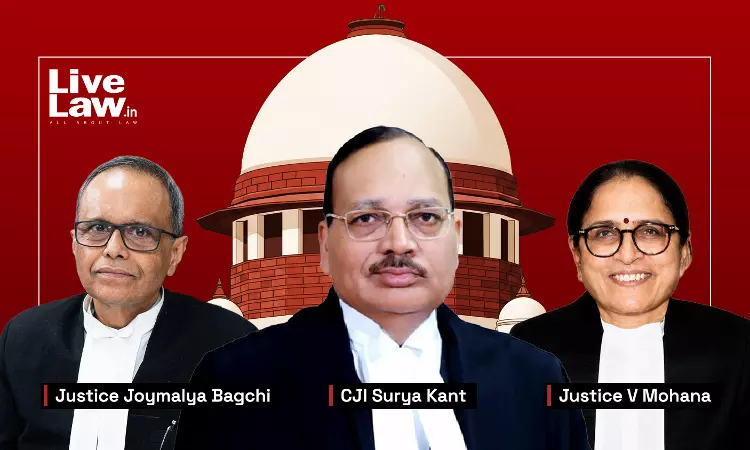
In a significant ruling in the context of maritime and admiralty laws, the Supreme Court on Friday (September 25) has held that when a shipowner validly terminates a demise or bareboat charter, the charter comes to an end even if the owner has not yet physically taken back the vessel. A bench of Chief Justice of India Surya Kant, Justice Joymalya Bagchi and Justice V. Mohana heard the...
This is a premium content
Available exclusively to
Our subscribers
Subscribe Premium 
INR 1099+GST
Your support helps us to bring you more content at
an affordable subscription scheme !!!
All payment options available
In a significant ruling in the context of maritime and admiralty laws, the Supreme Court on Friday (September 25) has held that when a shipowner validly terminates a demise or bareboat charter, the charter comes to an end even if the owner has not yet physically taken back the vessel.
A bench of Chief Justice of India Surya Kant, Justice Joymalya Bagchi and Justice V. Mohana heard the dispute concerning the arrest of vessel M.V. Nereus Progress under Section 5(1)(b) read with Section 5(2) of the Admiralty (Jurisdiction and Settlement of Maritime Claims) Act, 2017.
Nereides Marine Services was the demise charterer of the vessel under a BIMCO BARECON 2017 charterparty. After Nereides defaulted on payment of hire, the owner issued an Anti-Technicality Notice on November 6, 2025 and subsequently terminated the charter on November 13 under Clause 31.
The owner issued a Repossession Notice on November 19. Before physical possession could be taken at Tuticorin, Om Freight Forwarders Ltd., which had separately chartered another vessel to Nereides and was claiming unpaid dues from it, obtained an order on December 4 for arrest of M.V. Nereus Progress.
The Madras High Court refused to vacate the arrest, holding that a demise charter ordinarily continues until physical repossession or redelivery.
Disagreeing the High Court's decision, the judgment authored by CJI Kant relied particularly on Clause 32 of the BARECON 2017 charterparty. The clause said that after termination, and until physical repossession, the charterer would hold the vessel “as gratuitous Bailee only” for the owner. This means a person holding a vessel as a gratuitous bailee cannot at the same time continue to be its demise charterer.
“Given this fundamental distinction, Nereides could not have simultaneously held the Vessel both as a 'demise charterer' and a 'gratuitous bailee'.”, the Court held.
The Court explained that termination and repossession are two different things. Termination ends the contractual relationship, while repossession is the later physical process of taking control of the vessel.
“The deeming provision that the Vessel shall be deemed repossessed upon the boarding of the Owners' representative merely fixes the point from which the Owners resume operational responsibility for the Vessel. It does not determine when the demise charter itself comes to an end.”, the Court observed.
The Court also noted that the owner had acted promptly after Nereides' payment default and had repeatedly tried to take back the vessel. The delay in physical repossession was not caused by the owner.
Further, the Court examined Section 5(1)(b) read with Section 5(2) of the Admiralty Act. The Court held that for a vessel to be arrested on the basis of the liability of a demise charterer, it must be shown that the person was still the demise charterer when the arrest was made.
In the present case, Nereides' charter had already been validly terminated on November 13, nearly three weeks before the arrest on December 4.
Therefore, Nereides was no longer the demise charterer when the vessel was arrested. It was holding the vessel only as a gratuitous bailee pending physical repossession, the Court held.
Accordingly, the Court set aside the Impugned Judgment and allowed the appeal in the following terms:
"(i) The termination of the BBC by the Appellant, vide the Termination Notice dated 13.11.2025, was preceded by due compliance with the contractual pre-conditions prescribed under Clause 31(a) read with the Anti-Technicality mechanism incorporated in the BBC. The termination was founded upon an admitted and continuing default in payment of hire on the part of Nereides and is accordingly held to be valid;
(ii) A validly issued notice of termination under Clause 31(a) of the BBC was sufficient to bring the demise charter to an end, and physical repossession thereafter operated only to complete the practical transfer of control of the Vessel;
(iii) The validity of the Termination Notice, coupled with the demonstrably bona fide conduct of the Appellant in pursuing repossession, and the absence of any assertion by Nereides itself to the contrary, is sufficient to establish that Nereides had ceased to be the demise charterer of the Vessel well before the date of arrest, i.e., 04.12.2025, and at that point in time held the Vessel only as a gratuitous bailee under Clause 32 of the BBC;
(iv) The order of arrest, resting on a contrary and unsustainable premise, cannot be sustained and is accordingly vacated;"
Headnote
Admiralty (Jurisdiction and Settlement of Maritime Claims) Act, 2017 — Section 5(1)(b) read with Section 5(2) — Sister-Ship Arrest — Twin Jurisdictional Requirements - For a valid sister-ship arrest in rem under Section 5(2) read with Section 5(1)(b), the claimant must establish that - (i) the demise charterer of the vessel at the time the maritime claim arose is liable for the claim; and (ii) such person continues to be the demise charterer (or owner) of the arrested vessel at the time the arrest is effected - If the bareboat charterparty stood validly terminated prior to the date of arrest, the entity ceases to be the demise charterer, displacing the statutory foundation for an arrest in rem under Section 5(1)(b). [Paras 30 - 44]
Bareboat Charterparty (BIMCO BARECON 2017) — Clauses 31 & 32 — Termination vs. Repossession — Status as Gratuitous Bailee - A validly issued notice of contractual termination (under Clause 31 for non-payment of hire following anti-technicality grace periods) operates of its own force to bring the demise charter to an end - Physical repossession is not a condition precedent to termination; it is merely the consequential practical mechanism by which the owner recovers physical control - Under Clause 32 of BIMCO BARECON 2017, pending physical repossession, the charterer holds the vessel strictly as a "gratuitous bailee only to the Owners" - An entity cannot simultaneously be a 'demise charterer' (exercising full commercial dominion and control) and a 'gratuitous bailee' (holding property without user rights) - Because the demise charter had terminated and the charterer was holding the vessel merely as a gratuitous bailee prior to the date of the arrest order, the vessel was not liable to arrest under Section 5(1)(b). [Paras 20 - 45]
Commercial Contracts — Interpretation and Business Efficacy - Commercial documents must be interpreted to give full effect to the intention of the parties and commercial efficacy to contractual terms as understood and intended - If a demise charter were deemed to survive despite contractual termination until physical repossession is completed, an owner's termination right would be held hostage to the defaulting charterer's evasive conduct or technical delays outside the owner's control. [Relied on M/s Tomorrowland Limited v. Housing and Urban Development Corporation Limited & Anr., 2025 INSC 207; Paras 19, 32-39]
Cause Title: Owners and Parties Interested in M.V. Nereus Progress Versus Om Freight Forwarders Ltd.
Citation : 2026 LiveLaw (SC) 991
Appearance:
For Petitioner(s) :Mr. Atmaram S Nadkarni, Sr. Adv. Mr. Shikhil Suri, Sr. Adv. Mr. Prashant Asher, Adv. Ms. S. Lakshmi Iyer, AOR Mr. Naishad Bhatia, Adv. Mr. Dhruva Gandhi, Adv. Ms. Deepti Arya, Adv. Ms. Himanshi Nagpal, Adv. Ms. Wamika, Adv.
For Respondent(s) :Mr. Ashwin Shanker, Adv. Mr. Sunand Subramaniam, Adv. Ms. Keyna Bhavsar, Adv. Ms. Anjali Singariya, Adv. Ms. Sonali Jain, AOR Mr. Kabir Dixit, AOR
Tags

Yash Mittal
Yash Mittal is a Correspondent with LiveLaw, covering the Supreme Court of India

