



- Home
- /
- Supreme court
- /
- 'Advocate Cannot Compromise Without...
'Advocate Cannot Compromise Without Client's Authorisation', Supreme Court Explains Law On Compromise Decree
Yash Mittal
2 July 2026 10:28 AM IST
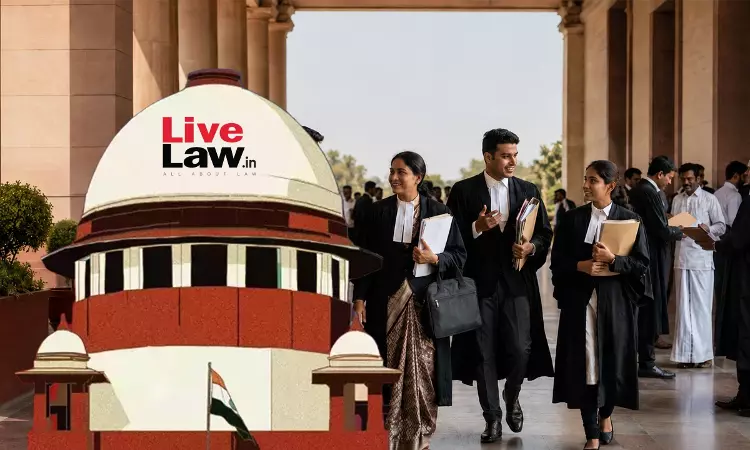
The Court upheld the setting aside of the 28-year-old compromise decree, as it was signed by the advocate without the client's express authorisation.
The Supreme Court on Wednesday (July 1) observed that unless there is an express authorisation by the client, an advocate is not empowered to enter into a compromise on behalf of his client. The Court added that the essential prerequisite of a compromise decree under Order XXIII Rule 3 CPC is that, a compromise must be signed by each party.Referring to precedents, the bench of Justice...
This is a premium content
Available exclusively to
Our subscribers
Subscribe Premium 
INR 1099+GST
Your support helps us to bring you more content at
an affordable subscription scheme !!!
All payment options available
The Supreme Court on Wednesday (July 1) observed that unless there is an express authorisation by the client, an advocate is not empowered to enter into a compromise on behalf of his client. The Court added that the essential prerequisite of a compromise decree under Order XXIII Rule 3 CPC is that, a compromise must be signed by each party.
Referring to precedents, the bench of Justice Sanjay Karol and Justice Nongmeikapam Kotiswar Singh laid down the law regarding the aspects of a compromise decree:
(a) Prior to the 1976 Amendment to the CPC, a compromise could be either oral or written, and the Court could decide the same on the basis of general evidence by the parties, Gurpreet Singh v. Chatur Bhuj Goel
(b) After the amendment, it has been clarified that a compromise must be in writing and must be signed by the parties, Som Dev v. Rati Ram
(c) The objective of the amendment is to prevent false and frivolous pleas of compromise having been entered into between the parties; (Gurpreet Singh supra)
(d) A compromise decree being signed by all parties is a mandate of the law; (Gurpreet Singh supra)
(e) It has to be voluntarily accepted by parties and once such acceptance is recorded by the Court, it acquires the sanctity of the judicial order, Banwari Lal v. Chando Devi
(f) A counsel/duly authorised representative/GPA holders is permitted to sign a compromise decree on behalf of those he represents, granted there is express authorisation or exigency of circumstance (Byram Pestonji Gariwala v. Union Bank of India ; Pushpa Devi Bhagat v. Rajinder Singh,
(g) In accepting a compromise decree, while it is true that the court merely put a seal of approval, but its role cannot be reduced to being only a recorder. It has to apply its judicial mind to the terms to ensure that they are lawful; (Banwari Lal supra)
(h) A consent decree which is the conclusion of a compromise, does not operate as a res judicata for it does not meet Section 11 (CPC) requirements; (Baldevdas Shivlal v. Filmistan Distributors (India) (P) Ltd.
(i) The only remedy available against a compromise decree is a recall application. A fresh suit or an appeal is not maintainable against this kind of decree; (Navratan Lal Sharma v. Radha Mohan Sharma).
Background
The dispute arose out of a partition suit instituted in 1989 relating to ancestral property. In February 1994, the trial court passed a compromise decree based on a compromise petition purportedly filed jointly by the parties. A final decree followed in 1997.
Nearly 28 years later, the legal heirs of one of the defendants challenged the compromise decree, alleging that their predecessor had never signed the compromise petition, had not authorised any advocate to enter into a compromise on his behalf, and that the vakalatnama and written statement relied upon were forged.
The trial court accepted these allegations at the preliminary stage and set aside the compromise decree. The Patna High Court affirmed the order, leading the appellants to approach the Supreme Court.
Decision
Dismissing the appeal, the judgment authored by Justice Karol observed that the lawyers are expected to act strictly in accordance with their clients' instructions and cannot substitute their own judgment when entering into compromises affecting valuable civil rights.
Since there was no material showing that the concerned defendant had expressly authorised his counsel to enter into the compromise, the Court found that the compromise decree suffered from a fundamental legal defect.
“…there is no express authorisation by defendant no.5 allowing Mr. Mehta to sign the compromise on his behalf, nor is there anything on record to demonstrate the exigent circumstances which prompted the counsel to act without seeking a clear approval from defendant no.5. In absence of the aforesaid, the 'voluntary' aspect mandated by Order XXIII Rule 3 of the Code of Civil Procedure, 1908, which is essential for a compromise decree cannot be established on the record. As such, the requirements of Rule 3 have not been complied with. The resulting compromise is contrary to law.” observed the Court.
The Court refused to interfere with the concurrent findings of the Patna High Court and the trial court, which had declared the compromise entered by an advocate on behalf of his client i.e., defendant no.5 to be contrary to law, as there was no express authorisation on behalf of the defendant no.5 to an advocate to assent to the compromise in a case related to partition of an ancestral property.
The appeal was accordingly dismissed, however, with the setting aside of a compromise between the parties, the Court said that “the issues of the partition suit require to be adjudicated in a full trial.”
“While we acknowledge the difficulty that may arise in 1989 suit being taken to trial 37 years later, but it is not possible to decide the rights of the parties without the due process of collection and weighing of evidence, whatever may be available.”, the Court held.
Headnote
Code of Civil Procedure, 1908 — Order XXIII Rule 3 — Compromise of Suit — Absence of Express Authorisation to Counsel — Validity of Consent Decree — Mandate of Law post 1976 Amendment — A compromise decree must strictly adhere to the mandatory requirements of Order XXIII Rule 3 of the CPC - Post the 1976 Amendment, a compromise must be in writing and signed by the parties to prevent false and frivolous pleas - While a counsel or duly authorized representative is permitted to sign a compromise decree on behalf of the client, such an act requires an express authorization or the existence of exigent circumstances - An advocate should not act on implied authority to conclude or surrender the substantial legal rights of a client without clear instructions - In the absence of express authorization in the Vakalatnama or evidence of exigent circumstances, the "voluntary" aspect mandated by Order XXIII Rule 3 cannot be established, rendering the resulting compromise contrary to law. [Paras 4, 5]
Code of Civil Procedure, 1908 — Section 151 — Inherent Powers — Recall of Fraudulent Compromise Decree — Delay and Limitation — The law of limitation cannot be utilized as a shield to defeat substantive rights or to perpetuate an illegality that is contrary to law - Where a compromise decree is obtained by fraud and without the signature or authorization of an affected party, the Court can exercise its inherent powers under Section 151 of the CPC to set aside the decree for the ends of justice. While a delay of 28 years (1994 to 2022) is egregiously large, the strict rule of limitation may be given a go-by based on the specific facts of a case, especially where basic facts are heavily contested and the affected party's rights are directly compromised without due process. Issues in such a partition suit require adjudication through a full trial. [Relied on Gurpreet Singh v. Chatur Bhuj Goel, (1988) 1 SCC 270; Som Dev v. Rati Ram, (2006) 10 SCC 788; Himalayan Coop. Group Housing Society v. Balwan Singh, (2015) 7 SCC 373; Para 6]
Cause Title: KRISHNA KUMAR OJHA &ORS. Versus JITENDRA CHAUDHARY & ORS.
Citation : 2026 LiveLaw (SC) 652
Click here to download judgment
Appearance:
For Petitioner(s) : Mr. S.B.Upadhyay, Sr. Adv. Mr. Abhinav Kathuria, Adv. Ms. Nisha Thakur, Adv. Ms. Anisha Upadhyay, AOR
For Respondent(s) :Mr. R K Sanghi, Sr. Adv. Mr. Arun Maittri, Adv. Mr. Rabin Majumder, AOR Ms. Radhika Chandrasekhar, Adv. Ms. Mousumi Roy, Adv. Mr. Shivam Majhi, Adv.
Tags

Yash Mittal
Yash Mittal is a Correspondent with LiveLaw, covering the Supreme Court of India

