



- Home
- /
- Supreme court
- /
- Air Force Act | Disciplinary...
Air Force Act | Disciplinary Proceedings Can't Be Initiated Against Officer Discharged In Criminal Trial On Same Charge : Supreme Court
Yash Mittal
16 April 2026 12:33 PM IST
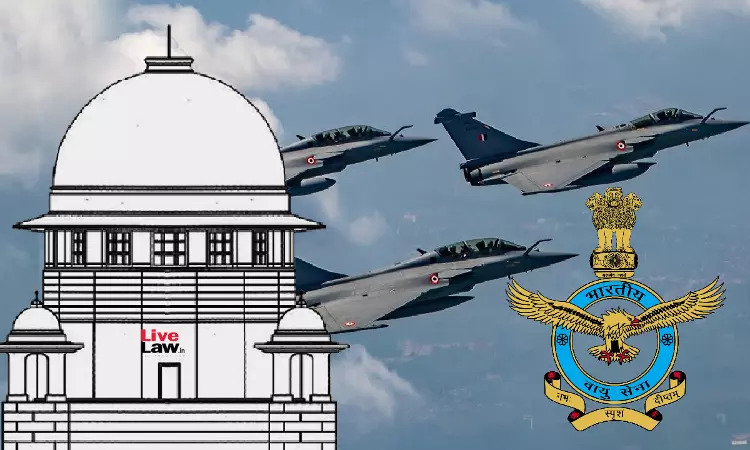
Setting aside the dismissal of the officer, the Court ordered that a formal farewell be organised for him, to restore his honour.
The Supreme Court on Wednesday (April 15) observed that once the defence forces have elected a continuation of criminal proceedings over the disciplinary proceedings, then acquittal in a criminal proceeding would bar the subsequent initiation of the disciplinary proceedings against a defence personnel. Setting aside the Delhi High Court's Division bench judgment, a bench of Justice...
This is a premium content
Available exclusively to
Our subscribers
Subscribe Premium 
INR 1099+GST
Your support helps us to bring you more content at
an affordable subscription scheme !!!
All payment options available
The Supreme Court on Wednesday (April 15) observed that once the defence forces have elected a continuation of criminal proceedings over the disciplinary proceedings, then acquittal in a criminal proceeding would bar the subsequent initiation of the disciplinary proceedings against a defence personnel.
Setting aside the Delhi High Court's Division bench judgment, a bench of Justice Dipankar Datta and Justice KV Viswanathan restored the honour of an ex-Air Force personnel, with granting consequential service benefits nearly after three decades, who was subjected to a disciplinary inquiry post-acquittal in a criminal proceeding.
“…the Air Force upon electing to have the alleged offence tried by the criminal court, it is clear (in view of the discussion above) that they then cannot fall back on either a court martial or any disciplinary action. Once the road is chosen, the traveller must walk it to the end.”, observed the court, emphasizing that “once the appellant has been discharged by the criminal court, that should mark the end of the matter.”
“Initiation of administrative proceedings for disciplinary action against the appellant, we unhesitatingly hold, was bad in law and non-est.”, the court said, adding that “once an accused has been discharged, he is entitled to avail of all benefits that are otherwise available to an acquitted person and cannot be placed in a less advantageous position.”
The Court also noted that in the case Union of India v. Harjeet Singh Sandhu (2001) 5 SCC 593, while examining Sections 19 and 125 of the Army Act and Rule 14 of the Army Rules, which are pari materia Sections 19 and 124 of the AF Act and Rule 6 of the 1969 Rules, respectively, the Supreme Court had observed that where the commanding officer, exercising discretion vested in him to choose between a trial by a criminal court and a court-martial, opts for trial before a criminal court, an acquittal of the accused by such court brings finality to the matter. In such circumstances, the initiation or continuation of disciplinary action would not be sustainable.
"Though the law laid down in Harjeet Singh Sandhu (supra) is on consideration of the provisions of the Army Act and the Army Rules, there is no reason why it would not squarely apply to a case covered by pari materia provisions of the AF Act and the AF Rules," the Court observed.
"True though, as per Harjeet Singh Sandhu (supra), initiation of administrative proceedings is barred when an accused is 'acquitted'; however, we find no reason for the ratio of the decision to not apply in a case where the accused is 'discharged' (which stands on a better footing than acquittal, as discussed supra). Once the appellant has been discharged by the criminal court, that should mark the end of the matter."
Background
The case arose from an incident dated March 29, 1987, when the appellant, then serving as a Senior Operations Officer in a remote Air Force unit in the Thar desert, acted on the instructions of his superior, a Wing Commander.
A driver employed with the General Reserve Engineer Force (GREF), allegedly intoxicated and having caused damage to critical equipment, was taken away from the camp by the appellant and others and left at a remote location. The driver later went missing and was found dead a few days later.
An FIR was registered, and the Air Force chos to have the matter tried by a criminal court instead of a court-martial, invoking the powers under Section 124 of the Air Force Act.
In January 1990, the Sessions Court discharged all accused persons, finding no prima facie case and noting the absence of a sanction under Section 197 CrPC. The discharge order attained finality. I
Despite this, the Air Force initiated administrative action and ultimately dismissed the appellant from service in 1993. Notably, the superior officer who issued the instructions was awarded only a minor penalty of “severe displeasure.”
The Single Judge of the High Court held the disciplinary proceedings to be bad in law; however, the Division Bench upheld the same, prompting the officer to move to the Supreme Court.
Discharged accused stands on a better footing
The Air Force authority initiated the disciplinary proceedings on the reasoning that the discharge of the petitioner will not bar administrative action since the effect of a discharge is that he was neither “acquitted nor convicted”.
The Supreme Court termed this understanding as "fallacious", and explained :
"Discharge is a pre-trial termination of proceedings for lack of evidence. As and when ordered, discharge signifies and reinforces the position that there is no material against the accused for him to stand trial. Whereas, acquittal is a post- trial outcome declaring the accused either innocent due to lack of credible material or on account of grant of the benefit of doubt. Insufficient evidence to even frame charges for standing trial would lead to a discharge while evidence presented not proving guilt leads to acquittal. In that sense, an accused discharged of a criminal offence stands on a better footing than an accused who is finally acquitted after a full-fledged trial. It is not the law that an accused, unless he is acquitted, must still carry the label on his forehead that he is accused of a criminal offence. Once an accused has been discharged, he is entitled to avail of all benefits that are otherwise available to an acquitted person and cannot be placed in a less advantageous position."
Reference was made to the recent judgment in Yuvraj Laxmilal Kanther v. State of Maharashtra 2025 LiveLaw (SC) 304.
Punishment arbitrary
The Court also noted that by the time the disciplinary action was initaited in 1990, Court-martial options had also become time-barred as per Section121 of the Air Force Act, since 3 Years had elapsed since the date of the alleged offence.
The Court also found the punishment to be disproportionate.
The Court observed that the appellant had been placed in an impossible situation, effectively caught between obeying and disobeying his superior's instructions. Had he refused to remove the driver from the camp, he would have risked disciplinary action for insubordination and indiscipline; yet he was punished for relocating the driver to an isolated location in compliance with those very instructions. While it was assumed that the body later found may have been that of the driver who could not survive the harsh climate of the Thar desert, there was no material to indicate that the appellant acted with any intention to cause harm. The record suggested that the real objective of the relocation was to prevent the driver from creating a disturbance during the anticipated visit of the AOC-in-C, and that the Wing Commander had issued specific directions in this regard, which were later viewed as encouraging suppression of the truth.
In these circumstances, the Court held that the appellant may have had little option but to obey his superior's orders, and that the failure to consider these factors, coupled with the absence of reasons in the punishment order, rendered the decision arbitrary and unsustainable in law, thereby vitiating the entire proceedings against him.
Since the appellant has already crossed the age of superannuation, he cannot be reinstated. Therefore, the Court ordered that he be given the service benefits.
The Court also ordered the grant of a farewell for him.
"Irrespective of service benefits, restoration of honour remains the foremost concern of a defence personnel. We restore it with the direction that on a date to be fixed by the Chief of Air Staff, the appellant shall be signed off in the normal manner he would have otherwise been entitled to, but for the order of dismissal."
Headnote
Air Force Act, 1950 — Section 19 — Air Force Rules, 1969 — Rule 16 — Administrative Action following Criminal Discharge — Maintainability — The Supreme Court held that once a person subject to the Air Force Act is discharged by a criminal court, administrative action or disciplinary proceedings on the same facts are not sustainable - Supreme Court clarified that "Discharge" stands on a better footing than "Acquittal" because it signifies a lack of sufficient material even to initiate a trial - Where the authorities exercise discretion under Section 124 to have an accused tried by a criminal court rather than a Court Martial, they cannot later fall back on administrative action once that criminal process concludes in a discharge or acquittal. [Paras 18 - 27]
Service Law — Disciplinary Proceedings — Natural Justice — Reasoned Order — Supreme Court emphasized that in cases where no regular inquiry is conducted and the delinquent is deprived of cross-examination, the show cause notice and the final order are critical safeguards - A "cryptic or mechanical" rejection of a detailed, non-frivolous defense violates principles of natural justice - Vague expressions like "morally convincing evidence" fall short of the required standard for recording findings in disciplinary proceedings. [Paras 31 - 33]
Service Law — Quantum of Punishment — Doctrine of Proportionality and Equality — Imposing the harshest punishment (dismissal) on a subordinate for complying with a wrongful order, while the superior officer who issued the order receives a lenient penalty (severe displeasure), is arbitrary and violates the principle of equality - Following the principle that 100% back wages require an affidavit stating the employee was not re-employed, and in the absence of such material on record, the Court awarded 50% back wages from the date of illegal dismissal until superannuation. [Relied on Union of India v. Harjeet Singh Sandhu (2001) 5 SCC 593; Yuvraj Laxmilal Kanther v. State of Maharashtra 2025 SCC OnLine SC 520; Sengara Singh v. State of Punjab (1983) 4 SCC 225; Paras 37 – 41]
Cause Title: EX. SQN. LDR. R. SOOD VS. UNION OF INDIA & ORS.
Citation : 2026 LiveLaw (SC) 376
Click here to download judgment
Appearance:
For Appellant(s) : Mr. R. C. Mishra, Sr. Adv. Mr. Alok Kumar Dwivedi, Adv. Mr. Mahendra Kumar, Adv. Mr. Rohit Singh, Adv. Ms. Abha R. Sharma, AOR
For Respondent(s) :Ms. Archana Pathak Dave, A.S.G. Mr. Mukesh Kumar Maroria, AOR Mr. Kamal Digpaul, Adv. Ms. Harshita Chaubey, Adv. Ms. Seema Bengani, Adv. Mr. Mohan Prasad Gupta, Adv.
Tags

Yash Mittal
Yash Mittal is a Correspondent with LiveLaw, covering the Supreme Court of India

