



- Home
- /
- Supreme court
- /
- Anticipatory Bail Cannot Be...
Anticipatory Bail Cannot Be Restricted Till Filing Of Chargesheet Ordinarily: Supreme Court
LIVELAW NEWS NETWORK
12 Feb 2026 4:37 PM IST
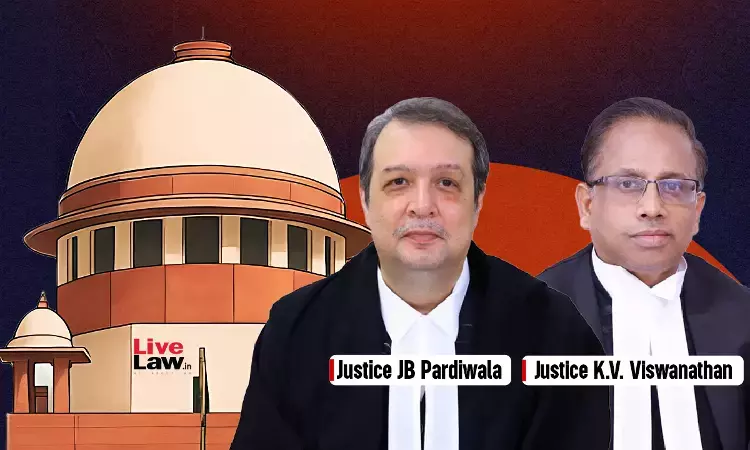
Expiry clauses inserted for anticipatory bail at inception are unsustainable, the Court said.
The Supreme Court has held that anticipatory bail cannot be mechanically restricted till the filing of the chargesheet and ordinarily continues without a fixed time limit unless special reasons are recorded.A Bench of Justice JB Pardiwala and Justice KV Viswanathan set aside an order of the Allahabad High Court which had rejected a second anticipatory bail plea after earlier limiting...
This is a premium content
Available exclusively to
Our subscribers
Subscribe Premium 
INR 1099+GST
Your support helps us to bring you more content at
an affordable subscription scheme !!!
All payment options available
The Supreme Court has held that anticipatory bail cannot be mechanically restricted till the filing of the chargesheet and ordinarily continues without a fixed time limit unless special reasons are recorded.
A Bench of Justice JB Pardiwala and Justice KV Viswanathan set aside an order of the Allahabad High Court which had rejected a second anticipatory bail plea after earlier limiting protection only till the filing of the police report.
"The position of law is well settled: once anticipatory bail is granted, it ordinarily continues without fixed expiry. The filing of a charge-sheet, taking of cognizance, or issuance of summons does not terminate protection unless special reasons are recorded," the Court observed.
Reliance was placed on the Constitution Bench judgment in Sushila Aggarwal v. State (NCT of Delhi) which held that anticipatory bail should not invariably be limited to a fixed period.
Background
The FIR was registered by the Uttar Pradesh Police for offences under Sections 80(2)/85 of the Bharatiya Nyaya Sanhita and Sections 3 and 4 of the Dowry Prohibition Act, 1961 against the appellant, the brother-in-law of the deceased woman.
The appellant had initially obtained anticipatory bail from the High Court. However, the High Court restricted the protection “till the filing of the police chargesheet”. Once the chargesheet was filed, the protection lapsed and the appellant's fresh anticipatory bail application was rejected.
Challenging that rejection, the appellant approached the Supreme Court.
HC order "Unusual"
The Supreme Court described the High Court's earlier order as “very unusual”. It observed that once the court had exercised its discretion in favour of the accused after considering the nature of allegations and the role attributed to him, there was no justification to confine the relief only till filing of the chargesheet.
The Bench noted that while rejecting the second anticipatory bail plea, the High Court did not indicate any change in circumstances that warranted denial of protection.
“Either the Court may grant anticipatory bail or may decline. However, once having exercised its discretion in favour of the accused upon consideration of the overall matter, there was no good reason for the High Court to restrict it upto the stage of filing of the chargesheet,” the Court observed.
The Court also referred to Gurbaksh Singh Sibbia v. State of Punjab(1980), Bharat Chaudhary v. State of Bihar(2003) and Siddharth v. State of Uttar Pradesh(2021) to reiterate that filing of a chargesheet or taking cognizance does not bar grant or continuation of anticipatory bail. Reference was also made to Md. Asfak Alam vs. State of Jharkhand and Another
"Risk management can be taken care of by way of imposing conditions of cooperation, attendance, and non-tampering, not by imposing time limits. Where circumstances change, modification or cancellation may be sought under the BNSS, 2023, but expiry clauses inserted at inception are unsustainable," the Court said.
When Graver Offences Added
The Court also clarified the position where new cognizable and non-bailable offences are added after grant of bail. Referring to Pradeep Ram v. State of Jharkhand and Prahlad Singh Bhati v. NCT of Delhi, it held that courts must apply their mind afresh in such situations.
The principles were summarised :
(i) The accused can surrender and apply for bail for newly added cognizable and non-bailable offences. In the event of refusal of bail, the accused can certainly be arrested.
(ii) The investigating agency can seek order from the court under Sections 437(5) or 439(2) of Cr.P.C. respectively for arrest of the accused and his custody.
(iii) The Court, in exercise of its power under Sections 437(5) or 439(2) of Cr.P.C. respectively, can direct for taking into custody the accused who has already been granted bail after cancellation of his bail. The Court in exercise of its power under Section 437(5) as well as Section 439(2) respectively can direct the person who has already been granted bail to be arrested and commit him to custody on addition of graver and non-cognizable offences which may not be necessary always with order of cancelling of earlier bail.
(iv) In a case where an accused has already been granted bail, the investigating authority on addition of an offence or offences may not proceed to arrest the accused, but for arresting the accused on such addition of offence or offences it needs to obtain an order to arrest the accused from the Court which had granted the bail.
The Court also directed that a copy of its order be forwarded to the Registrar General of the Allahabad High Court to be placed before the Chief Justice.
Headnote
Criminal Procedure — Anticipatory Bail — Duration of Protection — The Supreme Court reiterated that once anticipatory bail is granted, it should not invariably be limited to a fixed period or restricted to the stage of filing a charge-sheet - The protection should ordinarily enure in favor of the accused without restriction on time and can continue until the end of the trial, unless specific facts or features necessitate a limited tenure.
Criminal Procedure — Section 438 Cr.P.C. (Section 482 BNSS, 2023) — Impact of Charge-sheet — The mere filing of a charge-sheet, taking of cognizance, or issuance of summons does not automatically terminate the protection granted under Section 438 Cr.P.C. - There is no restriction on granting or continuing anticipatory bail even after a charge-sheet is filed, as the primary objective is to prevent undue harassment through pre-trial arrest.
Criminal Procedure — Addition of Graver Offences — Procedure for Arrest — Where an accused is already on bail and new, more serious, cognizable, and non-bailable offences are added, the accused does not automatically lose their liberty but the court must apply its mind afresh. In such cases – i. The accused may surrender and apply for bail for the newly added offences; ii. The investigating agency must obtain an order from the Court that granted bail to arrest the accused; a routine arrest without such an order is not permissible. [Relied on Sushila Aggarwal & Ors. vs. State (NCT of Delhi) & Anr. (2020) 5 SCC 1; Bharat Chaudhary and Anr. vs. State of Bihar and Anr. 2003) 8 SCC 77; Siddharth vs. State of Uttar Pradesh & Anr. (2022) 1 SCC 676; Shri Gurbaksh Singh Sibbia vs. State of Punjab (1980) 2 SCC 565; Paras 12-25, 31-34]
Case : Sumit v. State of UP and another
Citation : 2026 LiveLaw (SC) 147
Click here to read the judgment
For Petitioner(s) : Mr. Shiv Sagar Tiwari, AOR Mr. Varinder Kumar Sharma, Adv. Mr. Mata Prasad Singh, Adv. Mr. R.D. Rathore, Adv. Mr. Vinay Rajput, Adv. Ms. Ashiya Bano, Adv. Ms. Aakansha Tiwari, Adv. Ms. Shweta Bhadauria, Adv. Mr. Yugal Kishor Prasad, Adv. Mr. Bikash Chandra, Adv. Mr. Bishan Dass, Adv. Ms. Gitesh Kumari, Adv. Mr. Rajesh Ranjan Kumar, Adv. Mr. Rajesh Kumar, Adv.
For Respondent(s) : Mr. Ankit Goel, AOR Mr. Mayank Tiwari, Adv.


