Can't Penalise Flat Buyers Who Relied On Official Documents : Supreme Court Directs Alternative Site Before Demolition
Yash Mittal
25 Oct 2026 6:07 PM IST
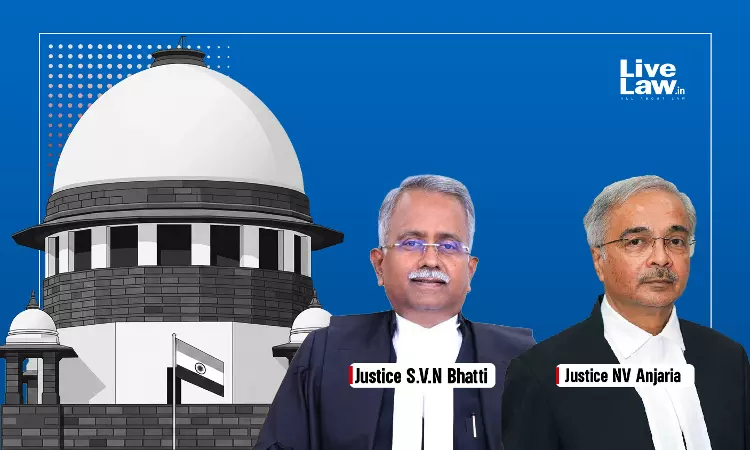
The Supreme Court has held that flat purchasers who relied on government permissions and official revenue records while purchasing properties cannot be made to suffer for the lapses of government authorities, directing the Tamil Nadu government to provide an alternative site to the owners of 20 flats before demolishing their apartments built on land classified as a water body.
A bench of Justice SVN Bhatti and Justice NV Anjaria directed the Chief Secretary of Tamil Nadu and the District Collector of Tiruvallur to allot a vacant site of commensurate value to the flat owners represented by their society, preferably within six months, before proceeding with the demolition of the apartments constructed on 0.22 acres of the disputed land.
The Court observed that the authorities had issued building permissions and altered revenue records in a manner that led bona fide purchasers to believe that the property was legally available for purchase.
"These permissions/Orders lead a bona fide purchaser to believe that the subject matter is available and free from any objectionable use," the Court observed.
The bench further remarked that a bona fide purchaser ordinarily relies on the presumptive value of revenue entries and town survey records while purchasing property.


"At the government's convenience, the nature of the land is changed," the Court said.
The Court was hearing appeals filed by a flat owner and Tamil Nadu Mercantile Bank Limited challenging a Madras High Court judgment that upheld the cancellation of a ryotwari patta granted over the disputed land and directed the demolition of unauthorised structures.
Background
The dispute concerns 0.72 acres of land in Survey No. 572 at Thirumullaivoyal village in Tiruvallur district. The land was classified as "Government Poramboke - Kanakkan Kuttai" in the 1911 Resurvey and Resettlement Register.
In 2011, the District Revenue Officer, Tiruvallur, granted a ryotwari patta over 0.72 acres to P. Ramadoss, treating the land as ryoti land rather than a water body.
Ramadoss subsequently mortgaged the land to Tamil Nadu Mercantile Bank to secure credit facilities of ₹3.40 crore. A portion measuring 0.22 acres was settled in favour of his wife, who executed a power of attorney in favour of a builder.
The builder constructed 20 residential flats on the property and sold them to individual purchasers along with undivided shares in the land.
In 2014, a third-party objector challenged the grant of patta before the Commissioner of Land Administration. In December 2019, the Commissioner cancelled the patta, finding that it had been granted illegally over land classified as a government water body.
The Madras High Court subsequently upheld the cancellation and directed the removal of unauthorised structures across the larger extent of 1.68 acres and restoration of the water body.
The flat owner and the bank approached the Supreme Court challenging the High Court's decision.
Government Authorities Had Approved Construction
The Supreme Court noted that the municipal authorities had approved the building plans for the apartments, while the revenue department had altered the Town Survey Land Register and approved the subdivision of the disputed property.
The Court observed that these official actions had created a situation in which purchasers could reasonably believe that the land was free from legal impediments.
The bench emphasised that the government's obligation to protect water bodies did not justify ignoring the hardship caused to innocent purchasers by the actions of its own officials.
It noted that directing demolition without examining the flat owners' hardship and their independent legal remedies against the landowner and developer would cause irreparable financial injury and leave families without homes.
Accordingly, while refusing to interfere with the cancellation of the patta, the Court directed the State to provide an alternative site before proceeding with demolition.
“the flat owners have been led to believe that the Government has no interest under Section 14-A of the Act, 1948. Therefore, directing the demolition of flats without examining the hardship of the flat owners and the independent remedies available to them in law against the owner of the land and the developer of the apartments would cause irreparable financial injury and throw the families on the streets. In the circumstances of the case, to ameliorate the possible hardship and, without committing a breach of Section 14-A of the Act, 1948, we direct the Chief Secretary, State of Tamil Nadu, and the District Collector, Tiruvallur, to allot a vacant, commensurate site to the owners of the flats represented by the Society, preferably within 6 months from today, and thereafter to undertake the demolition of the constructed area to an extent of 0.22 acres.”, the Court said.
No Patta Can Be Granted Over Water Bodies
The Supreme Court, however, rejected the appellants' challenge to the cancellation of the patta.
It held that the earliest revenue and settlement records showed that the disputed land had been classified as a government water body and that the appellants had not established that it was ryoti land eligible for a ryotwari patta.
The bench relied on Section 14-A of the Tamil Nadu Estates (Abolition and Conversion into Ryotwari) Act, 1948, which prohibits the grant of ryotwari pattas over private tanks or ooranis and provides for the cancellation of pattas granted over such lands.
The Court also rejected the argument that the land's designation as a mixed residential zone under the urban development plan altered its legal character.
It clarified that zoning regulations permitting residential development do not extinguish the government's rights over poramboke lands or water bodies.
The Court dismissed the appeals, directing the Tamil Nadu government to allot an alternative site to the flat owners, preferably within six months, before demolishing the apartments. It also clarified that the flat owners and the bank could pursue appropriate legal remedies against the developer, landowner or mortgagor.
Further, the Court granted a liberty to the State Government to initiate or conclude disciplinary action against the erring Officers for failing to maintain the records and water bodies.
The Court accordingly dismissed the appeals while upholding the cancellation of the patta.
Appearance:
Mr. T. Raja. Sr. Adv., Mr K.S. Mahadevan Adv. for the Appellants
Ms. Jayasree Narasimhan, Adv. for the Respondents.